
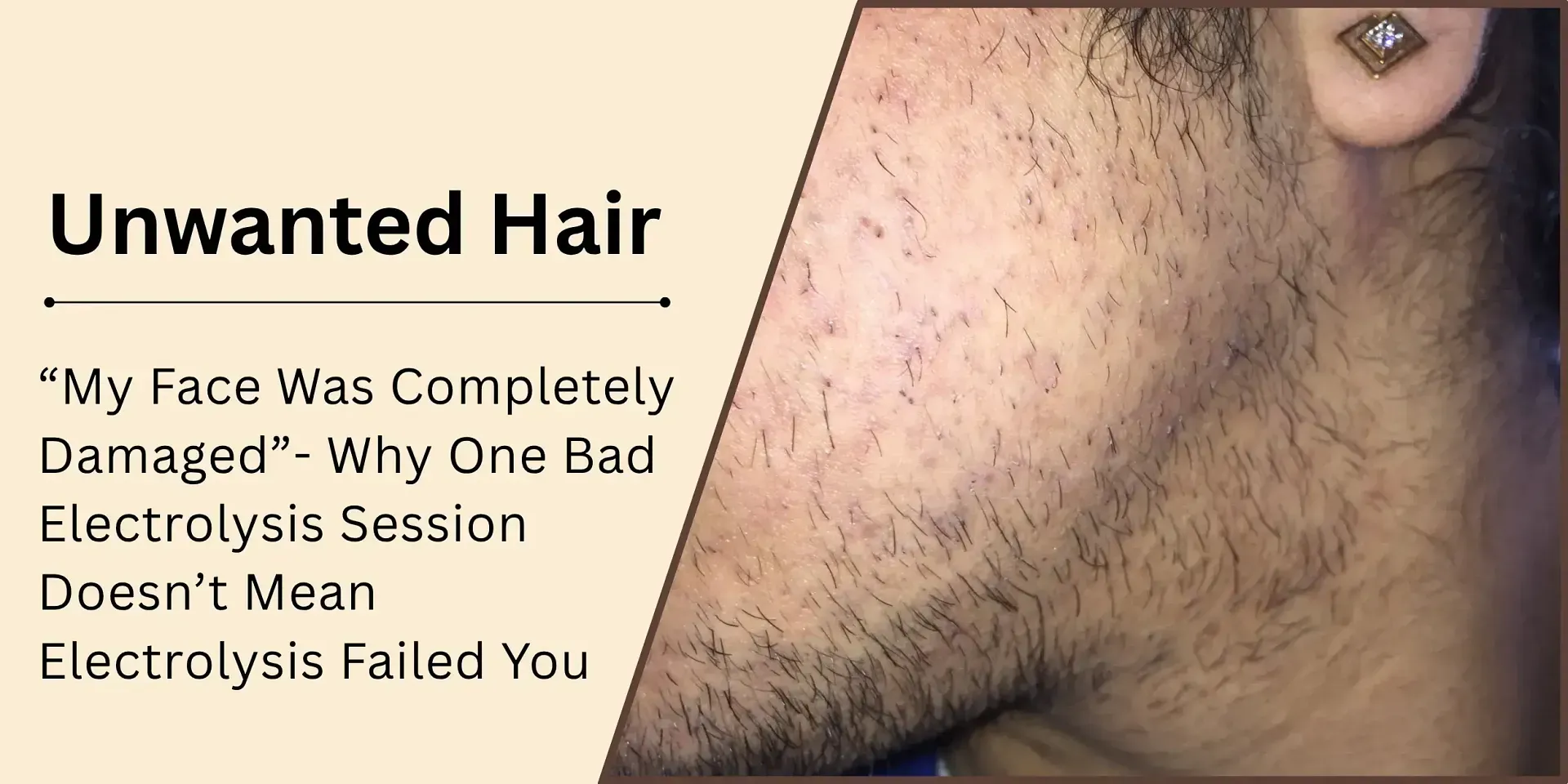
My Face Was Completely Damaged — Why One Bad Electrolysis Session Doesn't Mean Electrolysis Failed You
2026-07-10
"My Face Was Completely Damaged" — Why One Bad Electrolysis Session Doesn't Mean Electrolysis Failed You
By Dr. Seema Bali, MD BHMS
Holistic Dermatologist | Founder, Valeda Skin & Hair Clinic, New Delhi
41+ Years of Clinical Experience in Permanent Hair Removal | AEA Member Since 1990 | IGPE Member Since 1992
A patient sat across from me recently — a married man in his late thirties, working in digital marketing, here in Delhi. He had done his homework. He had read our literature. He had gone through our website. He came in informed, but he also came in guarded — and once he told me his full story, I understood exactly why.
He had spent five to six years on laser, treating his beard and side-face area, and he was genuinely pleased with those results — his dark hair was gone. What remained was a scattering of white and grey hair that laser, by its very nature, was never going to touch.
So, roughly ten months before he came to see me, he had tried electrolysis at another facility. One session. About an hour long. He was told, he said, that all his available hair had been completely covered in that single sitting.
He never went back.
"I didn't see the result," he told me. And then, more pointedly: "I got a lot of scars here, and swelling also. My face was completely damaged."
This is one of the most important conversations I have with patients, and I want to share it — not to criticise another clinic, but because this exact fear, this exact disappointment, sits behind why so many people who genuinely need electrolysis never pursue it properly. I want to explain what likely happened, why it happened, and why one difficult experience should not become a permanent verdict on an entire treatment method.
"I Was Told I Was Covered In One Hour. Why Didn't It Work?"
This is the question underneath everything he asked me, even when he didn't phrase it directly.
Here is the honest clinical reality: one hour of electrolysis on a face carrying years of laser-treated and residual white hair growth is, in almost every realistic scenario, not enough to "complete" anything. A human face contains approximately 25,000 to 30,000 hair follicles in total. Even when treatment is focused only on residual or white hair — a smaller subset of that total — the realistic time required for meaningful, lasting clearance, particularly across a full treatment programme, runs into many hours, not one.
When a patient is told that "everything is covered" after a single one-hour session, and is not given a clear framework for what "covered" actually means — versus what remains biologically present but not yet visible — disappointment is almost inevitable. Not because electrolysis as a method failed. But because the expectation was never built on an accurate technical foundation.
This is exactly why, in our practice, we explain the concept of a clearance before a single probe touches the skin: a clearance treats all hair currently visible and available within a defined 40-day biological cycle — not the total lifetime crop of that area in a single sitting. A typical comprehensive programme requires 7 to 8 clearances over approximately one year. One hour, one time, was never going to be "the whole problem solved."
What Likely Caused the Scarring and Swelling
This is the part patients in his position need explained clearly and honestly, because the fear of scarring stops more people from seeking permanent treatment than almost any other factor.
Electrolysis works by inserting a fine probe into the natural pathway of the hair follicle, down toward the structures responsible for hair production — without puncturing the skin itself. The challenge is that hair follicles are not always straight. They can run straight, curved, helical, or embedded at an angle. Treating a follicle correctly requires precisely matching the probe's depth and angle to the follicle's actual path — typically taking between 4 and 40 seconds per follicle, depending on this complexity.
When this is done with precision, the surrounding skin tissue is essentially undisturbed — the follicle's growth structures are targeted, not the skin around them. Established clinical literature on electrolysis technique confirms that when a properly insulated, correctly positioned probe is used, peribulbar tissue damage is enhanced precisely where intended, while damage to the surrounding dermis is minimised — which is the entire basis for electrolysis being capable of permanent, low-scarring results when performed correctly.
When technique is imprecise — particularly under time pressure, in a single rushed session attempting to "cover everything" at once — the risk of skin trauma, inflammation, and resulting swelling rises considerably. What this patient experienced was very likely a consequence of technique and pacing, not a flaw in electrolysis as a method.
The Method We Use — And Why the Combination Matters
At Valeda Skin & Hair Clinic, our approach — EBVHCM, Electrolysis Blend Valeda Holistic Combination Mode — is built specifically around combining two long-established electrolysis techniques rather than relying on speed alone.
Galvanic electrolysis, first documented in medical literature in 1875, works by passing a small direct current — approximately 0.5 milliampere — through the probe. This breaks down water and salt molecules at the base of the follicle, forming a tiny quantity of sodium or potassium hydroxide directly at the site, which then acts on and removes the cells responsible for hair regeneration. This method is recognised for its thoroughness.
Thermolysis, using radiofrequency energy and in clinical use since the 1920s, works through controlled heat rather than chemical action, and is recognised for its speed.
The Blend method, combining both, is specifically recognised in clinical and academic electrology literature as the treatment of choice for fine white and grey hairs that do not respond to laser — precisely the category of hair this patient needed treated. Combining both techniques allows the thoroughness of galvanic with more manageable treatment timing, rather than forcing a single technique to do work it was not optimally suited for under time pressure.
This is not a faster way to "finish everything in one sitting." It is a more careful way to ensure each follicle that is treated is treated completely — which is what actually prevents both regrowth and unnecessary skin trauma.
New Growth vs Regrowth — The Distinction That Changes Everything
I explained this to him directly, because it is the single most important concept for any patient transitioning between treatment providers or treatment methods to understand.
When a follicle is properly and completely treated, it does not regrow. The cells responsible for producing that hair are destroyed, and since hair follicles do not regenerate once eliminated in this way, the result is permanent.
However, two genuinely different things can appear to look the same to a worried patient checking their skin in the following weeks:
Regrowth occurs when a follicle was not completely treated — often because of its curved, helical or embedded path making full treatment more difficult in a single pass. When this happens, hair may reappear, typically between 3 weeks and 3 months later — but this regrowth hair is noticeably thinner than the original.
New growth, by contrast, comes from a different follicle entirely — one that was resting, dormant, and simply not available for treatment during the earlier session. This new growth is as thick as the original hair, because it was never touched by treatment in the first place; it is simply completing its own natural cycle.
I tell every patient this explicitly so they are not alarmed if they see hair reappear during the course of treatment. It does not mean treatment failed. In the overwhelming majority of cases, it means a different, previously dormant follicle has simply entered its turn in the biological cycle — and it, too, will ultimately be treated and permanently eliminated across the planned clearances.
Why Transparency About Cost Structure Matters As Much As the Science
Part of what had unsettled this patient was uncertainty about cost — a common concern, and one I address directly with every new patient.
Unlike laser, which is typically billed as a flat procedure regardless of how many hairs are present, electrolysis is inherently time-based — because each follicle is individually treated. This means cost is calculated according to actual treatment time required, not a flat package sold without a clear basis.
At Valeda, this is structured transparently: a standard card rate, an itemised breakdown of consultation, constitutional medicine, disposables, and procedure charges, and — for patients who prefer a structured commitment — introductory package options offering substantial savings over the card rate, with built-in provisions to ensure no patient ever loses paid treatment hours, even as one package transitions into the next.
We explain this not to oversell a package, but because patients who understand exactly what they are paying for, and why, are patients who trust the process enough to complete it — which is, ultimately, the only way permanent hair removal actually works.
The Real Lesson Here
If you have had a difficult experience with electrolysis elsewhere — visible scarring, swelling, disappointment with results that didn't match what you were promised — please understand: this does not mean electrolysis cannot work for you. It very likely means the technique, the pacing, or the framework of expectations set for you was not what it should have been.
Electrolysis, performed correctly — with proper technique matched to each follicle's individual path, realistic clearance-based timelines, and transparent explanation of new growth versus regrowth — remains the only method capable of permanently removing white, grey and pigment-free hair that laser simply cannot treat.
One difficult session at one clinic is not a verdict on the method. It is, often, simply a sign that the approach needs to be different the next time.
About Dr. Seema Bali
Dr. Seema Bali (MD, BHMS) is the founder and director of Valeda Skin & Hair Clinic, established in 1985 at Rajendra Place, New Delhi. She is the pioneer developer of EBVHCM — Electrolysis Blend Valeda Holistic Combination Mode — and has been a member of the American Electrology Association (AEA) since 1990 and the International Guild of Professional Electrologists (IGPE) since 1992. Over four decades, she has worked with patients who arrive after difficult prior experiences elsewhere, helping them understand what went wrong and rebuilding their confidence in a treatment method that, performed correctly, delivers genuinely permanent results.
Contact Us!
| 🏥 Address: | Valeda Skin and Hair Clinic |
| 📞 Phone: | 9313233341, 9971854669 |
| ☎️ Landline: | 011 40244119 |
| 📩 Email Id: | doctor@valedalife.com |