
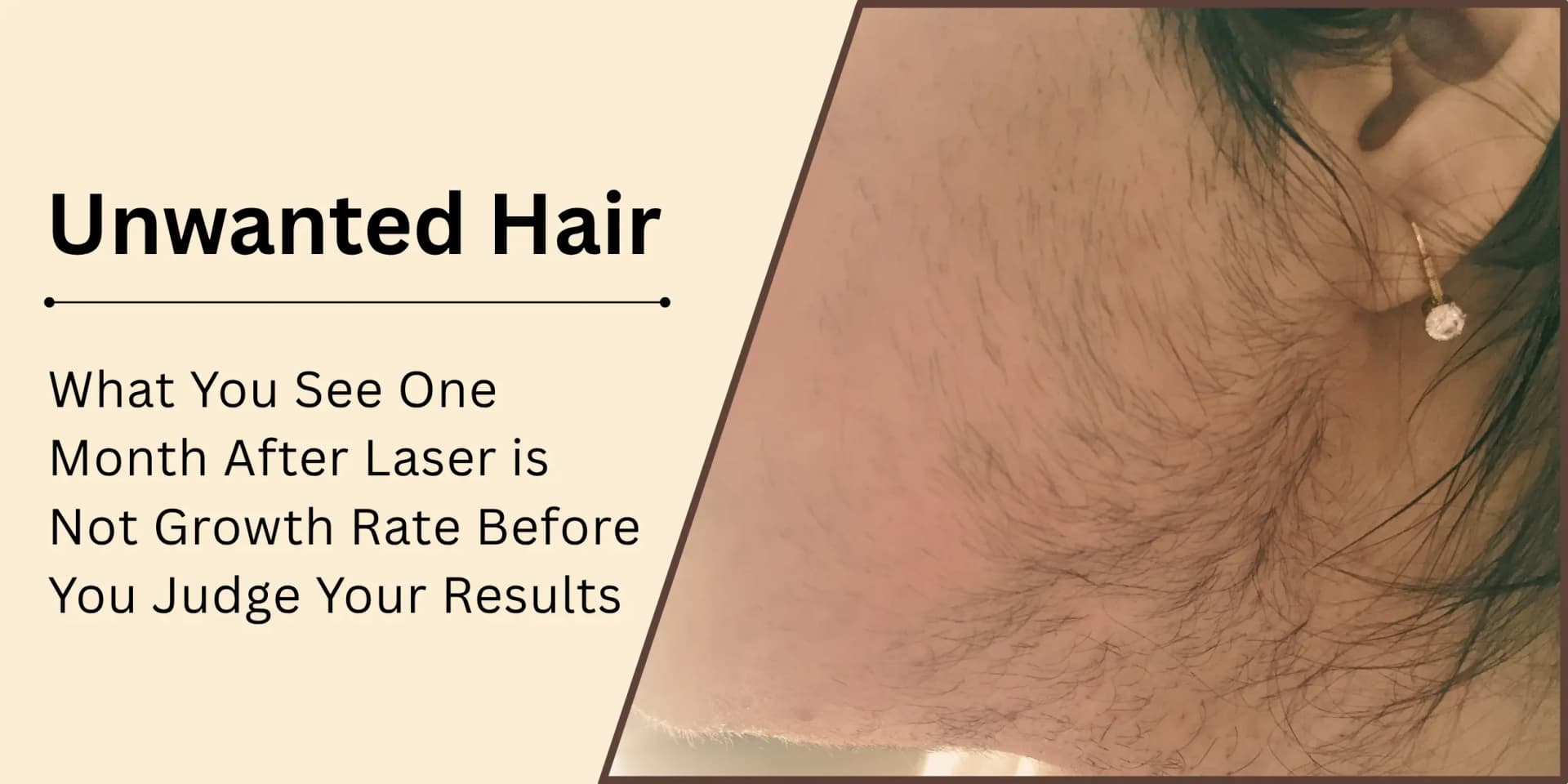
What You See One Month After Laser Is Not What's Really There: Understanding Hair Growth Rate Before You Judge Your Results
2026-07-09
What You See One Month After Laser Is Not What's Really There: Understanding Hair Growth Rate Before You Judge Your Results
By Dr. Seema Bali, MD BHMS
Holistic Dermatologist | Founder, Valeda Skin & Hair Clinic, New Delhi
41+ Years of Clinical Experience in Permanent Hair Removal | AEA Member Since 1990 | IGPE Member Since 1992
A patient came to see me recently — a married man in his late thirties from Delhi. He had a long history with laser hair removal, spanning five to six years, treating the beard and side-face area. The dark hair, he told me proudly, was gone. Laser had done its job well there. What remained was a scattering of white and grey hairs across his chin, side face and upper lip — hairs laser was never built to treat.
He had a question that, on the surface, sounded simple: "Doctor, if this is what's left after my last laser session, is this the complete picture? Is this everything that's there?"
It is a question I am asked constantly, by patients moving from laser to electrolysis, by patients assessing regrowth after any hair removal method, and by patients simply trying to understand their own skin. The answer requires understanding one foundational fact of hair biology that very few people are ever taught.
The Number Every Patient Should Know: 0.35 Millimetres Per Day
Human hair grows at an average rate of approximately 0.35 millimetres per day — a figure well established in clinical literature and confirmed through research published via the U.S. National Institutes of Health. This translates to roughly 1 centimetre of growth per month, or about 6 inches per year, for hair in its active growth phase.
This single number explains an enormous amount about why hair removal results are so often misunderstood.
If a patient looks at their skin one month after a laser session and sees a certain amount of visible hair, that hair represents, at most, about 1 centimetre of growth — for the hairs that happen to be in their active growth phase during that month. It is not the complete crop of hair present in the skin. It is a partial, time-limited snapshot.
Why Hair Doesn't All Grow at Once — The Three-Phase Cycle
To understand why what you see today is incomplete, you need to understand that hair follicles do not operate on a single, synchronised schedule. Each follicle independently cycles through three distinct phases, as established in clinical research indexed by the NIH:
Anagen — the active growth phase. This is when the follicle is actively producing hair, elongating at the rate of approximately 0.3 to 0.4 millimetres per day. Depending on the body area, anagen can last anywhere from several months to several years.
Catagen — the transitional phase. A brief period, typically lasting a few weeks, during which the follicle regresses and growth halts.
Telogen — the resting phase. The follicle is biologically dormant. No growth occurs. This phase can last approximately three months before the follicle re-enters anagen and begins producing hair again.
At any single point in time, only a portion of your total follicles in a given area are in the active anagen phase — visibly growing, measurable, treatable. The remainder are resting in telogen, invisible and inactive, waiting for their turn in the cycle.
This is the central insight that changes how every patient should interpret what they see in the mirror.
"What I See Today" Is Not "My Total Crop"
When my patient looked at his white and grey facial hair and assumed it represented the complete remaining problem, he was making a very natural — but biologically incomplete — assumption.
What he was actually observing was the crop of follicles that happened to be in their active growth phase at that particular moment, displaying whatever length of growth had accumulated since his last temporary removal (in his case, cutting, done every 3 to 4 days).
The follicles currently resting in telogen — potentially a significant proportion of his total white hair-producing follicles — were simply not visible. They had not yet begun their growth cycle. They were biologically present but invisible.
This is precisely why, in clinical assessment, we apply a fundamental principle: if hair is allowed to grow undisturbed for a period of approximately 4 to 6 months — without cutting, shaving, waxing or any other temporary removal method — the crop that becomes visible during that window represents your true, complete growth picture. Not a fragment. Not a snapshot interrupted by your last haircut or last laser session. The genuine, full crop.
A snapshot taken one month after a laser session, or five days after the last cutting, will always understate the true picture — because it captures only the follicles whose individual growth cycles happened to align with that narrow window.
Why This Matters Enormously for Treatment Planning
This biological reality has direct, practical consequences for anyone planning hair removal treatment, particularly when transitioning between methods — as my patient was, moving from laser (for dark hair) to electrolysis (for the remaining white hair).
If a treatment plan, a cost estimate, or a duration estimate is built around what is visible during a brief, interrupted observation period, that estimate will almost certainly underestimate the true scope of the work required. This is one of the most common sources of patient frustration in our field — not because treatment failed, but because the initial assessment was based on an incomplete picture through no fault of the clinic or the patient.
At Valeda Skin & Hair Clinic, when we assess a case like this, we explain clearly to the patient that early sessions may reveal more hair than initially estimated — not because new hair is being created, but because previously dormant follicles are completing their natural cycle and becoming visible and treatable for the first time.
New Growth vs Regrowth — A Critical Distinction Every Patient Must Understand
This same biological principle explains one of the most common questions I receive: "Will the hair you treat today come back?"
The honest, complete answer requires distinguishing between two genuinely different phenomena:
New growth refers to hair emerging from a follicle that was never treated in the first place — because it was resting in telogen, invisible, during the previous treatment session. When this follicle later enters its anagen phase and produces a visible hair, this is not treatment failure. It is simply a follicle completing its natural biological schedule, now ready to be treated for the first time.
Regrowth refers to a genuinely different situation — a follicle that was treated, but where the treatment did not fully destroy the follicle's growth-generating cells. This can occur due to unusual follicle depth, curvature, or anatomical variation that makes complete destruction more difficult in a single application. Regrowth hair is typically noticeably finer and weaker than the original hair, and generally responds well to a follow-up treatment.
A correctly performed electrolysis treatment, applied to a properly identified active follicle, permanently destroys that specific follicle. It does not regenerate. Any hair appearing later in the same general area, in the overwhelming majority of cases, originates from a different, previously dormant follicle completing its own independent cycle — not the treated follicle returning to life.
The Clearance System — Designed Around This Exact Biology
This is also precisely why permanent hair removal at Valeda Skin & Hair Clinic is structured around what we call a clearance — treating all hair visible and available within a defined area across a complete 40-day biological cycle, rather than a single visit.
The 40-day window is not an arbitrary administrative interval. It corresponds directly to the time needed for a meaningful proportion of resting follicles to complete their telogen phase and enter active growth, becoming available for treatment. A typical comprehensive treatment programme, depending on the area, history and density involved, requires 7 to 8 clearances over approximately 10 to 14 months to ensure the complete follicular population — including those that were invisible during early sessions — has been addressed.
Why Laser Succeeds on Dark Hair but Cannot Touch White Hair
For patients like the one I described — successfully treated for dark hair by laser, now needing a different solution for white and grey hair — it helps to understand why the two hair types respond so differently.
Laser hair removal works through selective photothermolysis: light energy is absorbed by melanin, the dark pigment within the hair shaft, and converted to heat that destroys the follicle. Dark, pigmented hair responds well because there is abundant melanin to absorb the laser energy.
White and grey hair contains essentially no melanin. There is nothing for the laser beam to target. This is not a flaw in any particular laser device or clinic's technique — it is a fundamental physical limitation that applies universally. No amount of additional laser sessions will treat hair that has no pigment to absorb the light.
This is precisely the gap that electrolysis — and specifically our EBVHCM (Electrolysis Blend Valeda Holistic Combination Mode) method — is designed to fill. Electrolysis does not rely on pigment. A fine, sterile probe is introduced directly into the individual follicle, and an electrical current destroys the follicle's growth centre mechanically, completely independent of hair colour.
A Word on Skin Sensitivity and Scarring History
For patients with a personal history of scarring — a consideration that comes up often in our consultations — it is worth distinguishing between true scarring and a far more common, temporary phenomenon called post-inflammatory hyperpigmentation (PIH).
Clinical research published through the NIH confirms that PIH is a temporary darkening of the skin that can occur as a natural response to any form of skin trauma, including electrolysis. It is more pronounced and more common in individuals with darker skin tones, and while it may take several months to fully resolve, it is not permanent scarring and generally improves with appropriate aftercare.
For patients with a documented scarring tendency, our approach at Valeda involves conservative current settings during initial sessions, close monitoring of treatment response, and a structured aftercare protocol — allowing treatment to proceed safely and effectively even in more sensitive cases.
The Takeaway
If you are looking at your skin today — one month, two months, or even eight months after your last hair removal session of any kind — and trying to judge whether your treatment "worked" based on what you currently see, please remember this: what you see today is not the complete picture. It is a snapshot of whichever follicles happened to be in their active growth phase at that moment.
The true picture only emerges with patience — ideally over a 4 to 6 month undisturbed growth window for accurate assessment, and over the full course of 7 to 8 properly spaced clearances for complete, permanent treatment.
Hair removal, done correctly, is not a single event. It is a process that respects the biological rhythm of your own skin — one follicle, one cycle, one clearance at a time.
About Dr. Seema Bali
Dr. Seema Bali (MD, BHMS) is the founder and director of Valeda Skin & Hair Clinic, established in 1985 at Rajendra Place, New Delhi. She is the pioneer developer of EBVHCM — Electrolysis Blend Valeda Holistic Combination Mode — and has been a member of the American Electrology Association (AEA) since 1990 and the International Guild of Professional Electrologists (IGPE) since 1992. Over four decades, she has guided patients through the complete journey from laser to permanent electrolysis treatment, including complex cases involving prior treatment history and sensitive skin.
Contact Us!
| 🏥 Address: | Valeda Skin and Hair Clinic |
| 📞 Phone: | 9313233341, 9971854669 |
| ☎️ Landline: | 011 40244119 |
| 📩 Email Id: | doctor@valedalife.com |