
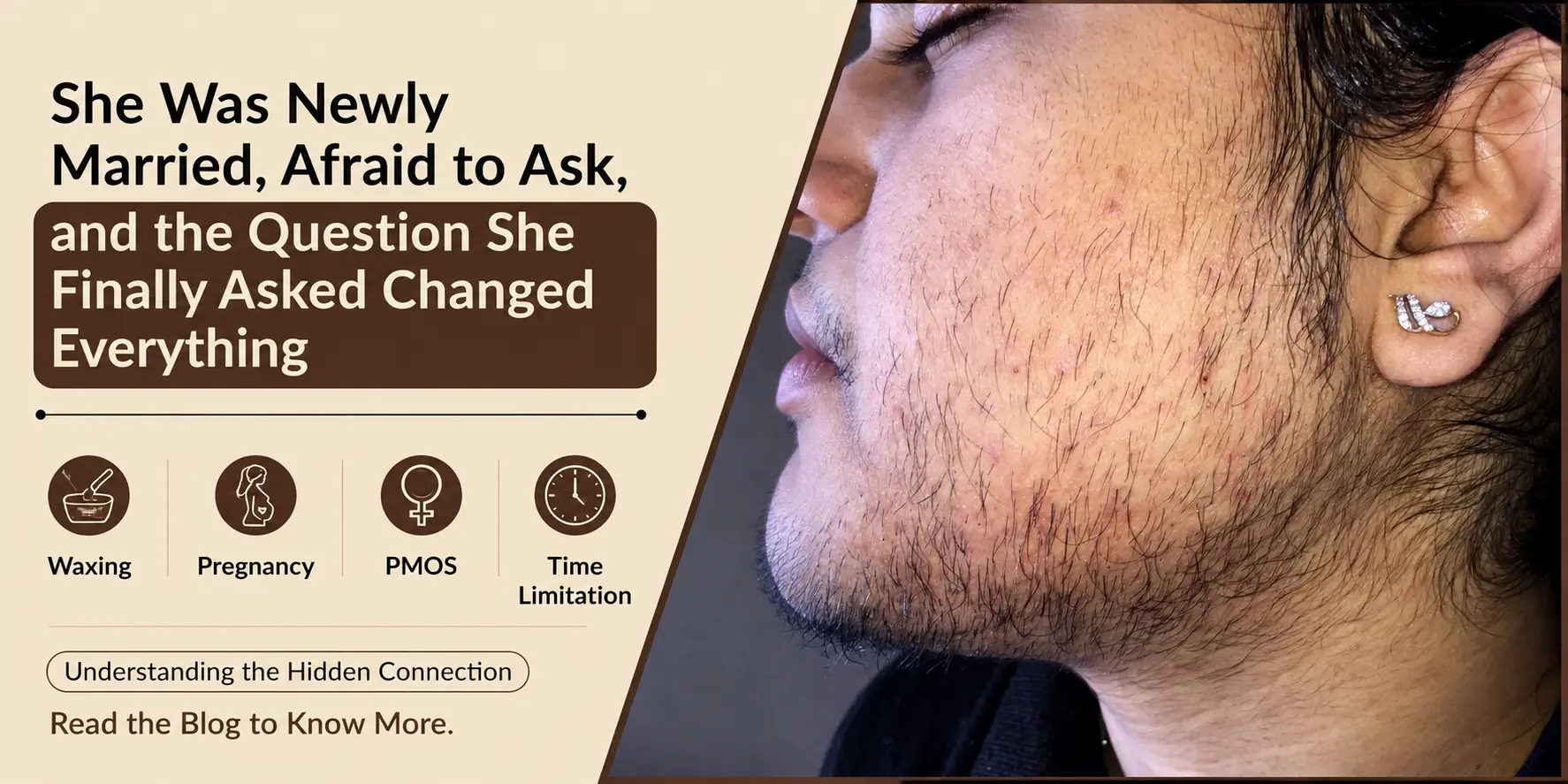
She Was Newly Married, Afraid to Ask, and the Question She Finally Asked Changed Everything
2026-07-17
She Was Newly Married, Afraid to Ask, and the Question She Finally Asked Changed Everything
By Dr. Seema Bali, MD BHMS
Holistic Dermatologist | Founder, Valeda Skin & Hair Clinic, New Delhi
41+ Years of Clinical Experience | AEA Member Since 1990 | IGPE Member Since 1992
She came to us from Noida. Twenty-nine years old, married four months ago, working as a planning executive at a private company. She had found us on Instagram, confirmed us on YouTube, and sat in front of us carrying something that most women in her position carry and rarely say out loud.
Her husband knew about the hair. He was the one who told her to look into a permanent solution. Together, they had already researched a clinic in their area — found the reviews, found the comments — "only takes money," "zero results after months" — and decided against going there. They had found Valeda instead.
She had questions about duration, cost, process, side effects. She asked all of them clearly and well. And then, toward the end of the conversation, she asked the one she had saved for last.
"Will this affect my plans for a baby?"
That question — asked quietly, after all the practical questions were out of the way — is the one I want to begin with. Because it is the question that most women sitting in her position are actually asking, even when they phrase it as something else. And because the answer to it contains everything important about why what we do at Valeda is fundamentally different from anything she had encountered before.
What Five Years of Plucking Actually Does
Her story began, as it does for so many women, with one or two hairs.
In 2020, she noticed them — on the chin, mostly, and the upper lip. She plucked them. The interval between plucking sessions was two months at first. Then one and a half months. Then one month. Then every week.
She assumed the hair was growing back faster. What was actually happening was something different, and understanding it changes how you see the problem entirely.
Hair follicles form in the human body before birth. You are born with your complete, lifetime endowment of follicles — no new ones are created after birth, at no point in your life, regardless of what you do to your skin. What changes over time, particularly from the ages of 12 to 20 and beyond, is which follicles become activated. In women, androgen-sensitive follicles on the face, chin and upper lip respond to testosterone and its more potent derivative, dihydrotestosterone — even at the relatively low androgen levels normal for women, which are approximately 15 to 30 times lower than in men. The sensitivity of the individual follicle to androgen, not just the level of androgen in the blood, determines whether that follicle converts from a fine, barely-visible vellus hair to a coarser, darker terminal hair. Research published through the NIH confirms that the severity of hirsutism frequently does not correlate with circulating androgen levels — local follicular sensitivity is often the more significant factor.
When she began plucking in 2020, she was not removing her hair problem. She was initiating a biological cascade.
Plucking forcibly extracts the hair from the follicle. The follicle registers this as trauma. Local blood circulation increases as the body responds to repair the area. Increased blood supply means increased nutritional delivery to the follicle — and to the follicles nearby. Follicles that were previously dormant, that might have remained quiet for years or permanently, receive stimulation. They activate. They begin producing hair. Published research from the NIH on management of hirsutism states this directly: plucking and waxing in androgenised skin areas should be discouraged, as these techniques not only fail to destroy follicles but can also induce folliculitis, trauma to the hair shaft, ingrown hairs, and further skin damage. The problem gets worse.
This is why the interval shrank — not because her hormones were surging, but because she had been systematically waking dormant follicles, one pluck at a time, for five years.
What she sees growing back after a week is not the hair she removed a week ago. Hair grows at approximately 0.4 millimetres per day — the hair visible after seven days represents less than 3 millimetres of growth. The hairs she sees returning are hairs that began their growth cycle 3 to 6 months ago, now reaching the surface for the first time. She is not winning the race. She is running in it.
The Question She Had Not Asked Anyone Else
When she asked whether treatment would affect her fertility, it was not a casual question. She and her husband had discussed it. She was newly married. They had plans. She was also experiencing irregular periods — something she had noted as a concern for years, something she had taken allopathic medicines for, something she knew was connected to this problem but did not quite know how.
Here is what I told her.
The constitutional homeopathic medicines that form a central part of the EBVHCM programme at Valeda Skin and Hair Clinic are not cosmetic adjuncts. They are individually prescribed based on a complete constitutional assessment — her hormonal picture, her menstrual history, her physical constitution, her stress patterns, her overall health. They work internally to address the underlying endocrine imbalance that is expressing itself on the surface as unwanted hair, and that is expressing itself internally as irregular periods.
This endocrine imbalance — now formally recognised by the world's leading medical institutions as Polyendocrine Metabolic Ovarian Syndrome, renamed from PCOS in The Lancet in May 2026 — is characterised by complex interactions between the androgen system, the insulin system, the thyroid axis, and the pituitary. It is not just an ovarian condition. It is a multi-system hormonal condition. And it is precisely this kind of condition that holistic constitutional medicine is designed to address, not from the outside in, but from the inside out.
The result, for a significant number of our patients, goes well beyond the reduction of unwanted hair. We have documented cases of women who came to Valeda for unwanted hair treatment, received constitutional homeopathic medicines as part of their EBVHCM programme, and found that the same internal hormonal rebalancing that resolved their unwanted hair also resolved conditions they had not even presented with as primary complaints. Irregular cycles that returned to regularity. Hormonal profiles that normalised. And in multiple cases — cases of primary and secondary sterility — women who had struggled to conceive, were blessed with children after their hormonal environment found its natural balance through the programme.
This is not an incidental finding. It is the predictable result of treating the system, not the symptom.
So when she asked whether treatment would affect her baby plans, the honest, evidence-based answer was: not negatively, and potentially positively. Not because we make fertility claims. But because when the internal hormonal environment that is causing the unwanted hair is addressed constitutionally, the same environment that governs menstrual regularity and reproductive health tends to benefit from that rebalancing as well.
What She Also Had — And Why It Matters
Her case record showed more than just facial hair. She had concurrent hair fall — a diffuse pattern that had been quietly developing alongside the unwanted hair. In clinical terms, diffuse alopecia in a young woman with irregular periods and facial hirsutism is not a coincidence. It is another signal from the same underlying system.
Research published in the NIH confirms what we have observed clinically for four decades: androgens have a paradoxical effect on hair. They stimulate terminal hair growth on the face, chin, and body — while simultaneously shortening the anagen (growth) phase of scalp hair, leading to progressive thinning. The same androgen excess, or androgen sensitivity, that produces unwanted facial hair is often simultaneously responsible for unwanted hair loss on the scalp. Two problems that look unrelated, in the mirror, are frequently the same problem wearing different faces.
Her EBVHCM programme addresses both — through constitutional medicines that modulate the androgenic environment internally, supported by specific medicines and topical applications for the hair fall component — with a treatment horizon of 6 months to a year for meaningful improvement.
The Home Remedies That Were Making Things Worse
Gram flour packs. Besan. Multani mitti. Sandalwood paste. Honey packs. These are widely recommended in Indian households and on social media as "natural" solutions for unwanted facial hair.
What actually happens is that any form of physical irritation to the skin in an androgenised, hormonally sensitive area — including the friction of removing a dried face pack — stimulates the follicles in exactly the same way that threading or waxing does. Increased local blood flow, follicular stimulation, activation of dormant follicles. The "natural" remedy and the parlour wax are doing the same biological damage, just more slowly and with a better reputation.
She was advised clearly: stop all of these. Nothing on the chin and upper lip except the prescribed external applications. The follicles need to rest, not be further provoked, while the treatment progressively eliminates them permanently.
The Time Pressure — And What Three Months Can Achieve
She had approximately three months in the Delhi-NCR area before relocating to Punjab. This kind of time pressure is something we plan around with precision.
In three months of regular attendance — weekly visits, maximising every week she is available — it is possible to complete the first two clearances and address the heaviest portion of the visible crop. The standard for hirsutism treatment confirms that 3-4 clearances typically produce 65% improvement. Completing the bulk of this in her Delhi window means she will leave with the heaviest load already permanently removed.
Her medicine programme continues via courier during her time in Punjab. Her diet plan is accessible through her Valeda Patient Portal from anywhere. The permanent results of the treatment already completed continue to hold, wherever she is — because permanently destroyed follicles do not regenerate, regardless of geography.
For the Woman Reading This Who Recognises This Story
If you are in your twenties or early thirties — newly married, or about to be, or simply at a stage where the question of the future feels very present — and you have been managing unwanted facial hair for years with methods that seem to make it worse, not better: you are not imagining it. The biology explains exactly what is happening. The plucking is not removing the problem. It is deepening it.
And if you are carrying, as she was, a quiet question about what treatment might mean for your future — your fertility, your cycles, your body's readiness for the next chapter of your life — you deserve a direct, honest, clinically grounded answer. Not a deflection. Not a pamphlet. Not a dismissal.
The answer, for the programme we offer, is that it does not harm. And for many of our patients, the internal rebalancing it produces has been among the most important health investments of their lives — for reasons they did not originally come to us for.
Come in. Bring your questions. All of them. The practical ones and the ones you've been saving for last.
About Dr. Seema Bali
Dr. Seema Bali (MD, BHMS) is the founder and director of Valeda Skin & Hair Clinic, established in 1985 at Rajendra Place, New Delhi. She is the pioneer developer of EBVHCM — Electrolysis Blend Valeda Holistic Combination Mode — and has been a member of the American Electrology Association (AEA) since 1990 and the International Guild of Professional Electrologists (IGPE) since 1992. For decades before the internet existed, she conducted public welfare programmes on Doordarshan on this subject. She specialises in complex hormonal cases — including women with concurrent hirsutism, hair fall, irregular periods, and skin conditions — treating the complete system, not only the surface symptom.
Valeda Skin & Hair Clinic
7H, 7th Floor, Gopala Tower, Rajendra Place, New Delhi 110008
For consultations, online assessment or courier medicines: valedadoctor.com
This blog is for educational purposes. Individual treatment requirements vary and are assessed during personal consultation.
Contact Us!
| 🏥 Address: | Valeda Skin and Hair Clinic |
| 📞 Phone: | 9313233341, 9971854669 |
| ☎️ Landline: | 011 40244119 |
| 📩 Email Id: | doctor@valedalife.com |