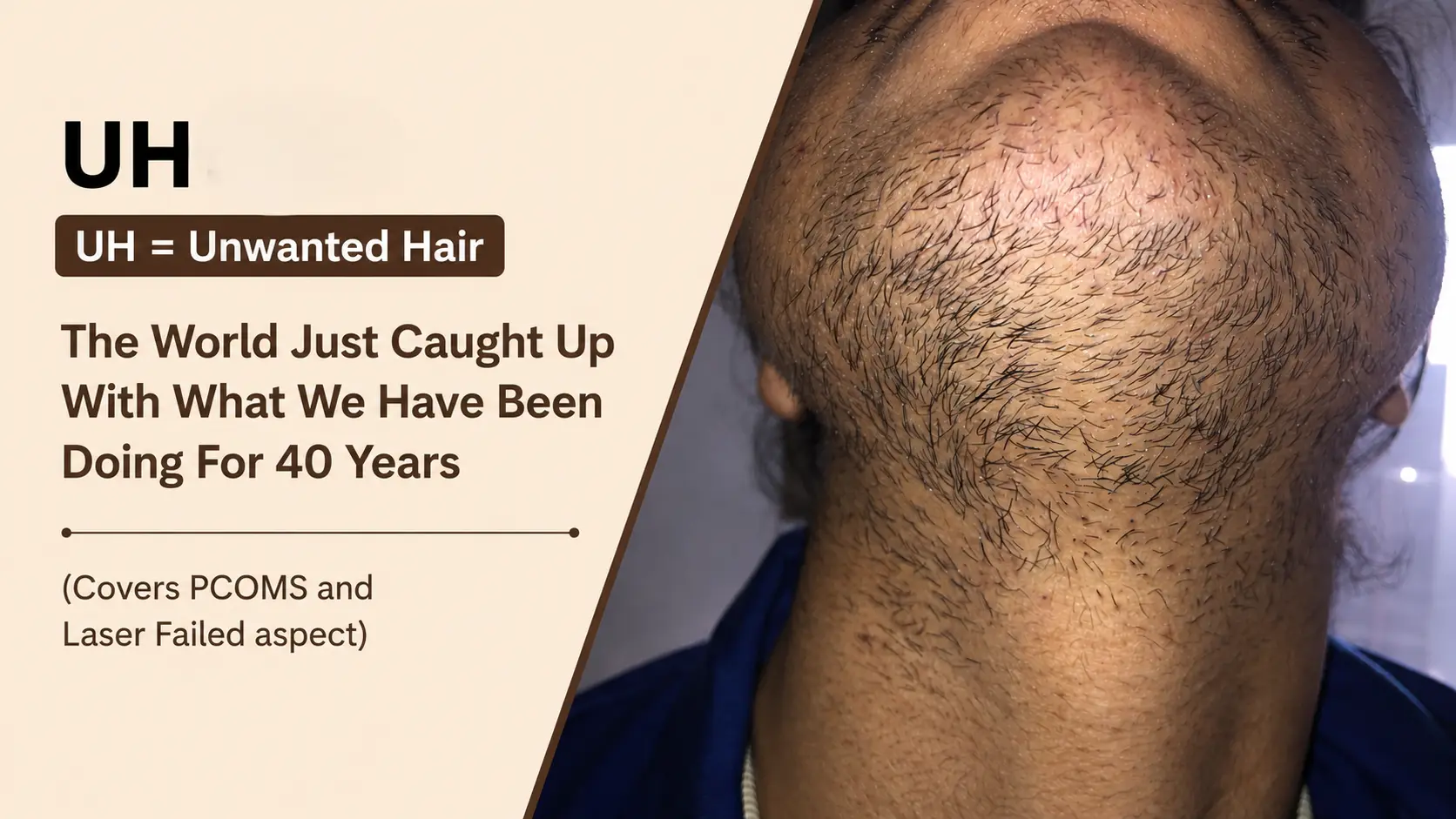
The World Just Caught Up With What We Have Been Doing For 41 Years
2026-07-15
The World Just Caught Up With What We Have Been Doing For 41 Years
By Dr. Seema Bali, MD BHMS
Holistic Dermatologist | Founder, Valeda Skin & Hair Clinic, New Delhi
41+ Years of Clinical Experience | AEA Member Since 1990 | IGPE Member Since 1992
A young woman sat in my clinic recently. Thirty-two years old, a housewife from Paschim Vihar, Delhi. Educated, thoughtful, and carrying the particular kind of exhaustion that I recognise immediately — the exhaustion of someone who has been managing a problem for years, who has tried what they were told to try, who has spent money on what was advertised as a solution, and who is still sitting in front of me with the same problem they started with.
She had been waxing regularly. She had tried laser. She had heard that electrolysis was "the other option." She had a list of questions. She also had, underneath those questions, something more important — a well-founded suspicion that she had been given incomplete information by the people she had trusted with her skin.
She was right. She had been.
I want to use her visit as the starting point for a conversation I believe every woman in India dealing with unwanted facial hair deserves to have. Not about a machine, not about a technique — about a way of thinking about the body that most clinics in this country, and most clinics in the world, have been very slow to adopt.
What the World Now Calls PMOS — And What We Have Called It For 40 Years
In May 2026, The Lancet — one of the most authoritative medical journals in the world — published a landmark paper announcing that PCOS, polycystic ovary syndrome, had been officially renamed. After more than a decade of debate, 22,000 survey responses from patients and professionals across the world, and a formal global consensus process, the condition is now called PMOS: Polyendocrine Metabolic Ovarian Syndrome.
The reason for the change, stated plainly in The Lancet, was that the old name was inaccurate. It implied the problem was about ovarian cysts. It obscured what the condition actually is — a multi-system endocrine and metabolic condition involving interacting hormonal disturbances across the insulin system, the androgen system, the thyroid axis, the pituitary, the pancreas, and the ovary simultaneously. The old name, the authors stated, had contributed to "delayed diagnosis, fragmented care, and stigma" for more than 170 million women worldwide.
I read this announcement with a particular feeling that I imagine is familiar to anyone who has spent decades explaining something that the mainstream had not yet caught up with.
At Valeda Skin and Hair Clinic, we have been treating this condition as a polyendocrine metabolic syndrome for more than forty years. We did not call it that. The world did not have that name yet. But our clinical approach was built entirely on the understanding that unwanted facial hair in women — the symptom that brings most of our patients through the door — is almost never a skin problem. It is a systemic signal. A communication from the endocrine system, the metabolic system, and the constitution of the individual woman, presented visibly on the surface of her skin.
This is why we have never offered electrolysis alone. This is why we have never offered any single treatment alone.
Why Laser Is a Substitute for Waxing — Nothing More, Nothing Less
I told this patient something that I have been telling patients since 1992, when I published an article on exactly this subject: laser hair removal is not permanent hair removal. It is a more expensive, less frequent version of waxing.
This is not an opinion. It is a regulatory fact. In 1995, the United States FDA granted market clearance to the first laser hair removal device. The clearance was for permanent hair reduction — not permanent hair removal. The FDA's own language. The distinction is not semantic. A device that produces permanent reduction cannot claim permanent removal, because it does not produce it.
I know this history not only from published literature but from a direct and rather remarkable correspondence. Thermolase Corporation, at the time the largest manufacturer of medical laser devices in the world, approached our clinic and offered us a free machine — fifty thousand patients' worth of treatments — in exchange for data. Their Vice President, Sylvia, was herself trying to understand what laser could and could not achieve. After several years of this exchange, she sent a clear, unambiguous statement: there is no laser in the world that achieves permanent hair removal. Not even theirs. It is a substitute for waxing — more expensive per session, longer lasting per session, but not permanent.
The world has been troubled by this confusion for thirty years. Women in India have spent fortunes on laser treatment that they were told would solve their problem permanently. The problem came back — because the follicles were not destroyed, because the laser does not destroy follicles, and because in a significant proportion of cases, repeated laser treatment on genetically programmed facial and chin hair leads to paradoxical hypertrichosis — a contradictory thickening and densification of the very hair the laser was supposed to remove.
When this happens — and I see it regularly — the patient is in a worse position than when she started. More hair, thicker hair, with a history of skin exposure to repeated laser energy on top of it.
What Permanent Actually Means — The Biology
Here is the simple, anatomical truth that underpins everything we do.
Hair follicles form in the human body before birth. You come into this world with your complete, lifetime endowment of follicles. No new follicles are formed after birth. No new follicles are formed at any point in your life, regardless of what you do to your skin.
This means that if a follicle is permanently destroyed, it cannot regenerate. That hair is gone. Forever. Not for six weeks, not for three months, not until the next cycle — permanently and irreversibly gone.
The only treatment method in the world that works on this principle — physically destroying the follicle's growth centre through a direct electrical current, independent of hair colour, skin colour, or follicular depth — is electrolysis.
The US FDA recognises electrolysis as the sole method of permanent hair removal. This has been its position for decades and has not changed.
Laser is categorised as permanent hair reduction. Electrolysis is categorised as permanent hair removal. These are not marketing terms. They are the FDA's own regulatory classifications.
But Electrolysis Alone Was Never Enough — Not For Us
Here is the point I most want to make — and the point that separates what we do at Valeda Skin and Hair Clinic from what is available almost anywhere else.
When a woman has unwanted facial hair driven by PMOS — now formally recognised by the world as a condition involving multiple interacting hormonal and metabolic systems — the follicle producing that hair is not the problem. It is the symptom. If you destroy the visible follicles without addressing the internal hormonal environment, the next generation of androgen-sensitive follicles, the ones that were dormant when you started, will continue to activate. You will always be one step behind.
This is why our treatment framework, EBVHCM — Electrolysis Blend Valeda Holistic Combination Mode — was built from the beginning around four pillars working simultaneously, not sequentially.
The first pillar is Blend Electrolysis. This is the permanent removal component — the direct, physical destruction of each individual follicle through a combination of galvanic current (in clinical use since 1875) and radiofrequency thermolysis (in clinical use since 1923), with approximately 242 possible combinations applied depending on each follicle's depth, angle, and structural characteristics.
The second pillar is Traditional Acupuncture. Clinical evidence from published research confirms that acupuncture influences hypothalamic-pituitary signalling, which directly governs the hormonal cascade that drives androgen excess in women with PMOS. In our clinical experience across four decades, acupuncture plays a meaningful role in modulating the hormonal environment during treatment — not as a complementary nicety, but as an active, evidence-based component of the programme. We have documented cases where patients receiving acupuncture as part of their EBVHCM programme showed measurable improvement in thyroid function — including two sisters who recently completed a hundred-hour programme with us whose thyroid indicator came down from thirteen to five point five over the course of treatment.
The third pillar is Constitutional Homeopathic Medicines. These are not generic supplements. They are individually prescribed after a thorough constitutional assessment of the patient's complete health picture — her hormonal profile, her menstrual history, her general constitution, her stress patterns. The constitutional medicines work internally to support the body's return to hormonal balance. I have been prescribing constitutional medicines to women with unwanted hair driven by endocrine imbalance for forty years, and I have seen, repeatedly, outcomes that go far beyond the presenting complaint. Women who came for unwanted hair and were prescribed constitutional medicines as part of their programme have conceived — some after years of failed attempts at primary or secondary fertility. Their hormonal environment, once supported internally as part of a holistic treatment approach, found its natural equilibrium. The unwanted hair removed. The cycles regularised. The pregnancies came. This is not a coincidence. It is the predictable result of treating the system, not only the symptom.
The fourth pillar is Constitutional Diet Planning. Every patient at Valeda receives an individually planned dietary programme, uploaded to their personal patient portal, addressing the nutritional factors known to influence androgen activity, insulin sensitivity, and overall endocrine balance. Diet is not an afterthought in our programme. It is a clinical tool.
"The World Is Troubled Since Thirty-Five Years"
That phrase, which I use when I explain laser's limitations to new patients, captures something that I think is important to say plainly.
When Doordarshan was the primary medium for public information in India — before YouTube, before Instagram, before the internet changed everything — I was giving public welfare interviews on this subject. Explaining the difference between temporary and permanent hair removal. Explaining what laser could and could not do. The Times of India published a front-page story in my name on this issue. I published in newspapers, in Hindi and English, year after year, for a simple reason: women were being misled, and I believed they deserved accurate information.
The confusion has not decreased. If anything, the internet has amplified it. More clinics, more machines, more promises, more disappointed patients arriving at our door after spending years and significant amounts of money on treatments that were never going to solve their problem permanently.
I am not against laser. We use laser at Valeda. Laser is a useful tool in appropriate contexts. What I am against is calling it permanent when the FDA — the very body that approved it — has never permitted that claim. What I am against is a patient spending years on a treatment she was told was permanent, then discovering it was not, and arriving in front of me more complicated than when she started.
For the Woman Reading This Who Recognises Herself in This Story
If you are a woman in your twenties or thirties — or older — who has been managing unwanted facial hair for years, who has tried waxing, threading, laser, perhaps even a session or two of electrolysis that did not produce what you expected — I want to say something directly to you.
Your problem is not your skin. Your skin is where your problem is visible. Your problem is a systemic hormonal signal that has been producing follicular activity for years and will continue to do so until it is addressed at both levels: the follicles themselves, and the internal environment that has been activating them.
This is what Valeda Skin and Hair Clinic has been built to address. Not because we invented a clever marketing concept. Because forty-one years of treating thousands of cases taught us that anything less than the complete, holistic approach produces incomplete results — and incomplete results are not acceptable when patients have come to us seeking a permanent solution.
The world has just renamed PCOS to PMOS because the leading medical institutions on earth finally agreed that this is a polyendocrine metabolic condition, not an ovarian one. We have been treating it as exactly that for four decades.
Come in for a consultation. Let us assess your case completely — not just your follicles, but your constitution, your hormonal profile, your history, your health. Let us show you what a genuinely holistic approach produces.
About Dr. Seema Bali
Dr. Seema Bali (MD, BHMS) is the founder and director of Valeda Skin & Hair Clinic, established in 1985 at Rajendra Place, New Delhi. She is the pioneer developer of EBVHCM — Electrolysis Blend Valeda Holistic Combination Mode — and has been a member of the American Electrology Association (AEA) since 1990 and the International Guild of Professional Electrologists (IGPE) since 1992. For decades before the internet existed, she conducted public welfare programmes on Doordarshan explaining permanent versus temporary hair removal to Indian women. Her clinical work has been covered on the front page of the Times of India. She specialises in complex cases — cases that have been complicated by years of laser, paradoxical hypertrichosis, or inappropriate prior treatment — and in delivering complete, permanent outcomes where others have been unable to.
Contact Us!
| 🏥 Address: | Valeda Skin and Hair Clinic |
| 📞 Phone: | 9313233341, 9971854669 |
| ☎️ Landline: | 011 40244119 |
| 📩 Email Id: | doctor@valedalife.com |