
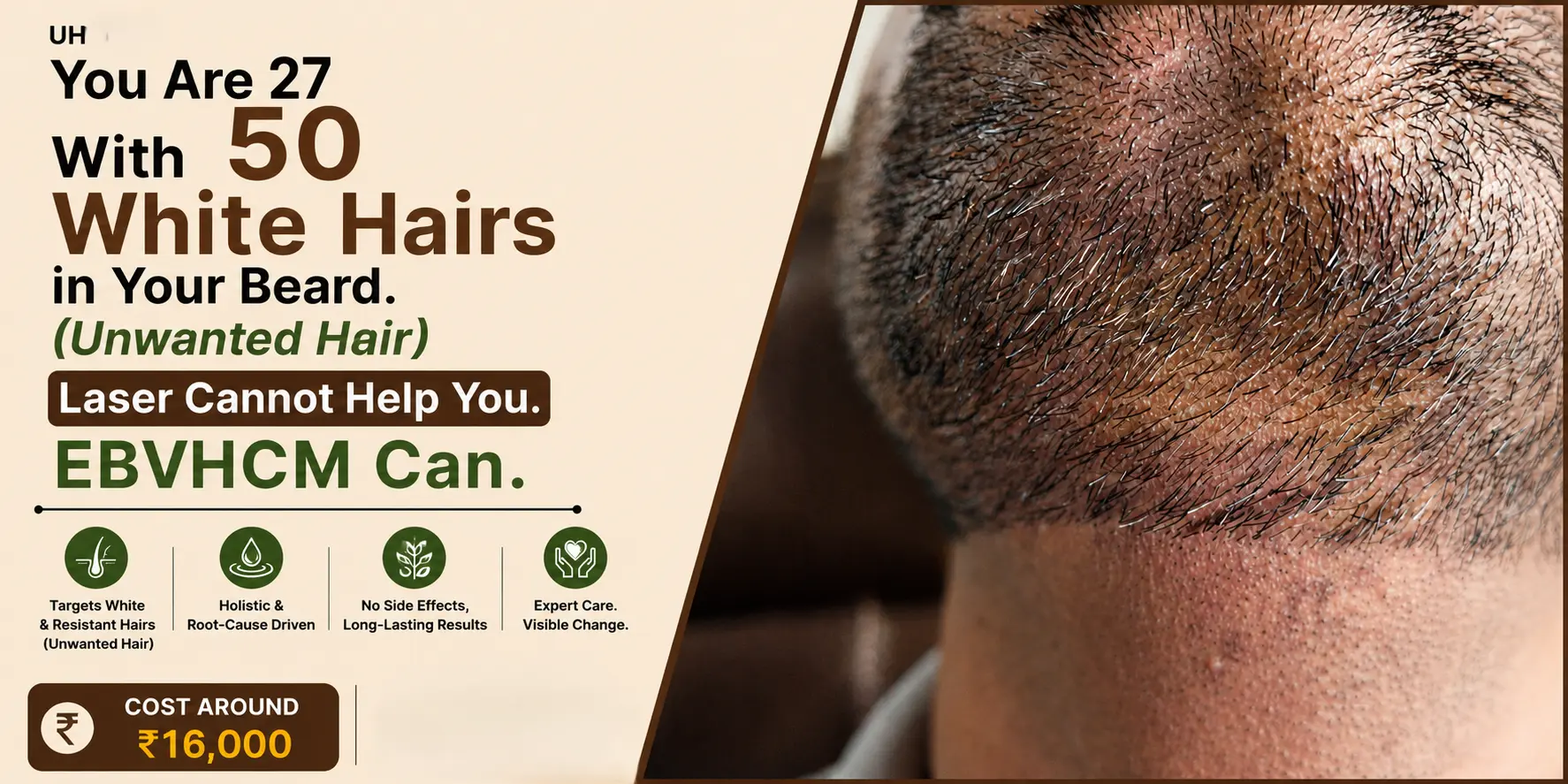
You Are 27 With 50 White Hairs in Your Beard. Laser Cannot Help You. EBVHCM Can.
2026-07-16
You Are 27 With 50 White Hairs in Your Beard. Laser Cannot Help You. EBVHCM Can.
By Dr. Seema Bali, MD BHMS
Holistic Dermatologist | Founder, Valeda Skin & Hair Clinic, New Delhi
41+ Years of Clinical Experience in Permanent Hair Removal | AEA Member Since 1990 | IGPE Member Since 1992
A young man's beard with scattered white and grey hairs — the precise concern that brings patients like Mohit to Valeda Skin & Hair Clinic.
A young man called me recently from Delhi. He was twenty-seven years old. He told me he had approximately fifty to sixty white hairs in his beard — scattered across the chin and under-chin area — and they were bothering him. Not his whole beard. Not even close. Just a small cluster of white strands that appeared too early, that did not belong, and that no amount of grooming could permanently resolve.
He had already been to a laser clinic. They had turned him away. "Laser does not work on white hair," they told him, which was honest of them. Most clinics in that situation are not quite so candid.
I want to explain, clearly and completely, why that laser clinic was right — and what the correct path forward looks like for a twenty-seven-year-old man with white hair in his beard.
Why White Hair Appears Before Its Time — The Biology of Premature Greying
To understand why Mohit's white hairs need a specific approach, it helps to understand why they turned white in the first place.
Hair gets its colour from melanocytes — specialised pigment-producing cells located within the hair follicle. During each hair growth cycle, melanocytes transfer melanin granules to the developing hair shaft. It is this melanin that gives hair its brown, black or dark colour. When melanocyte activity becomes compromised, the hair shaft emerges without pigment — and it appears white or grey.
Research published on the NIH platform has established that premature greying of hair is driven by several converging mechanisms. The depletion of melanocyte stem cells in the hair follicle's bulge region is a primary factor — as these stem cells diminish, the follicle loses its capacity to replenish active melanocytes. A 2014 study in PLOS ONE (PMC3973559) found clear evidence that compromised antioxidant activity in grey hair follicles simultaneously affects both mature melanocytes in the hair bulb and their immature precursor cells in the bulge region — meaning the problem operates at more than one biological level.
Hair is considered to grey prematurely when it appears before the age of 20 in Caucasians and before 25 in Asians. For a twenty-seven-year-old Indian male with 50 white hairs in the beard, the timeline falls into the early-greying category.
The causes of premature greying that clinical research at NIH has documented include:
- Oxidative stress — an imbalance between free radical production and the body's antioxidant defences, which specifically damages melanocyte function in the hair bulb
- Genetic predisposition — family history remains the most reliable predictor of when greying begins
- Nutritional deficiencies — particularly Vitamin B12, ferritin, and certain micronutrients associated with melanin synthesis
- Thyroid dysfunction — particularly autoimmune hypothyroidism, which disrupts the conversion of hormones that normally stimulate intrafollicular melanin synthesis
- Chronic stress — research from Nature (2020) identified a mechanism by which stress-triggered sympathetic nervous system activity depletes melanocyte stem cells, accelerating greying in ways previously attributed purely to ageing
For Mohit at twenty-seven, the most likely contributors are genetics, oxidative stress and possibly nutritional factors — all of which can be assessed and partially addressed through the constitutional homeopathic approach we use at Valeda Skin & Hair Clinic.
The Core Problem With What Mohit Wanted To Do
Here is the immediate question every young man in Mohit's position asks: "Can I simply laser these white hairs off?"
No. And the reason is fundamental, not technical.
Laser hair removal works on the principle of selective photothermolysis — a concentrated beam of light energy is directed at the hair follicle, where it is absorbed by melanin (the dark pigment in the hair shaft) and converted into heat that destroys the growth centre.
The key word is absorbed. Light energy must be absorbed to generate heat. Melanin is what absorbs it.
White hair contains essentially no melanin. There is no pigment for the laser beam to target. The light passes through the follicle without generating enough heat to cause any meaningful damage to the growth centre. Laser is, in this situation, not just ineffective — it is physically incapable of achieving its purpose.
A systematic review of light-based and heat-based therapies for white hair removal, published in PMC (PMC5064690, an NIH-indexed publication), evaluated multiple attempts to make laser work on white hair — including radiofrequency, laser after artificial colouring, and melanin-encapsulated liposomes delivered into the follicle before laser treatment. Results varied between 17 and 54 percent effectiveness across these experimental approaches. None has established itself as a reliable clinical standard.
The same review concluded that electrolysis is the treatment of choice for white hair removal — a position also supported by FDA classification. Electrolysis is the only method approved by the FDA as a method of permanent hair removal, and it works entirely independently of hair colour.
Why Electrolysis Works on White Hair When Nothing Else Does
Electrolysis does not chase pigment. It does not need to.
In EBVHCM — the treatment method developed and practised at Valeda Skin & Hair Clinic — a fine, sterile probe is introduced directly into the individual hair follicle. An electrical current is then delivered precisely to the follicle's growth centre. This current — delivered through a combination of galvanic and high-frequency thermolysis (Blend Electrolysis) — permanently destroys the cell structures responsible for hair production.
The follicle does not need to be dark. It does not need to contain melanin. The probe finds the follicle by navigating its natural anatomy — not by reading its colour. Once the growth centre is destroyed, that follicle does not produce another hair, regardless of what colour that hair was or would have been.
This is why individuals with white beard hairs specifically travel to Valeda Skin & Hair Clinic. Electrolysis is the only permanent solution they can access.
"But I Only Have 50 White Hairs. How Long Can This Really Take?"
This is exactly what Mohit asked.
Let me give you an honest answer — because what I tell patients differs from what they often expect.
When a patient says "I have approximately 50 white hairs," what they are observing is the visible crop at that moment. Hair follicles do not all produce visible hair simultaneously. They operate in cycles — active growth (anagen), regression (catagen), and rest (telogen). At any given time, only a portion of the total white-hair-producing follicles are externally visible.
In our clinical experience across forty-one years, when we examine these cases under magnification, the actual count is frequently higher than the patient estimates. Additionally, follicles that are currently resting and not yet producing white hairs will activate over the coming months and produce their first white hairs — particularly in a twenty-seven-year-old whose greying process has not yet reached its natural plateau.
This is why we recommend 2 to 3 clearances over approximately 4 to 6 months for a case like Mohit's — not to extend treatment unnecessarily, but to ensure that every follicle capable of producing a white hair has had the opportunity to emerge and be permanently treated.
A clearance means treating all visible and available hairs in the area across one 40-day biological cycle. It is not one sitting. It may involve 2 to 4 visits within that cycle depending on the volume of hairs emerging. The 40-day interval corresponds to hair growth biology — it is the window within which resting follicles activate and new hairs become visible.
The Constitutional Medicine Component — Why It Matters at 27
For Mohit at twenty-seven, treatment does not stop with the electrolysis probe.
Because his greying is premature — appearing at an age when the melanocyte stem cell depletion that causes greying should still be years away — there are likely internal factors contributing. Constitutional homeopathic medicines prescribed at Valeda Skin & Hair Clinic serve a dual purpose in cases like his:
1. Retarding the spread of greying to adjacent follicles. If Mohit currently has 50 white hairs, and the underlying oxidative and constitutional causes are left unaddressed, the number of white follicles will grow. Constitutional medicines aim to slow this progression — not by reversing what has already turned white, but by supporting the biological environment that protects remaining melanocytes in follicles that have not yet greyed.
2. Supporting general systemic health during the treatment period. Constitutional medicines address the individual's overall health picture — nutrition, immunity, stress response, organ system balance — which directly influences follicular health, treatment tolerance and long-term outcome.
For premature greying cases, constitutional medicine support is typically recommended for a minimum of 6 months alongside the electrolysis programme.
What the Complete Treatment Plan Looks Like — And What It Costs
Based on Example 7 from our Duration & Cost chapter, here is a clear picture of what a case like Mohit's involves:
Estimated Programme: 2 Hours | 2–3 Clearances | Approximately 4 Visits over 4–6 Months
Because the total programme is only 2 hours, no package is required. The most practical and flexible option is simply to pay at card rate per visit — there is no large advance commitment, no package lock-in, no financial complexity.
First Visit (if starting treatment):
| Component | Amount |
|---|---|
| Consultation Package | ₹2,000 |
| First Month Constitutional Medicines | ₹1,500 |
| External Applications (1 Set) | ₹985 |
| EBVHCM Procedure — First Visit | ₹6,000 |
| First Visit Total | ₹10,485 |
Estimated Complete Programme Cost:
| Component | Amount |
|---|---|
| Consultation (one time) | ₹2,000 |
| EBVHCM Procedure — 2 Hours at Card Rate | ₹12,000 |
| Constitutional Medicines — 6 Months | ₹9,000 |
| External Applications — 1 Set | ₹985 |
| Disposables & Consumables — 4 Visits | ₹2,000 |
| Estimated Total (with Constitutional Medicines) | ₹25,985 |
| Estimated Total (procedure + essentials only) | ₹16,985 |
If you prefer to attend only for consultation and demonstration first: carry ₹2,000.
There is nothing hidden in these numbers. The card rate safety rule applies at every stage: treatment hours given will never exceed the amount paid, calculated at card rate. You are fully protected.
The One Caution I Always Give for This Type of Case
I want to be honest about one thing that young patients in Mohit's situation often do not expect.
If you are twenty-seven years old and your beard is currently showing 50 white hairs — and your father or grandfather greyed early — there is a biological probability that additional follicles will turn white in the coming years as your natural greying process continues. Electrolysis permanently eliminates the follicles that are white today. It cannot treat follicles that have not yet turned white and are not yet visible.
This means that some patients return after a year or two for a small additional programme as new white hairs emerge. This is not a failure of the original treatment. The hairs treated in the original programme are permanently gone. The newly appearing white hairs are new events — new follicles that were dark when you started and have since lost their melanocytes.
Constitutional homeopathic support is one of the meaningful tools available to slow this process. Scientific research confirms a biological basis for the effect of systemic interventions on melanocyte stem cell preservation — and homeopathic constitutional medicines work at exactly this systemic level.
For patients who understand this upfront, the treatment journey is straightforward and the outcome is deeply satisfying. The white hairs that were there are gone. The rate at which new ones appear is slowed. The face in the mirror looks like the face they want to see.
A Final Word to Every Young Man Reading This
If you are in your mid-to-late twenties and you have found white hairs in your beard, you are not unusual. Premature greying affects a significant proportion of men of South Asian descent — earlier than the global average, driven by a combination of genetic tendency, nutritional factors, oxidative stress and the realities of modern urban life.
The white hairs you can see today can be permanently removed. The treatment is not complicated, not prolonged and not expensive when the programme is small. The question is simply whether you act while the number is manageable — or wait until it has spread.
At Valeda Skin & Hair Clinic, we have been managing exactly this kind of case for forty-one years. White beard hairs are not a mystery to us. They are a specific biological situation with a specific, effective, permanent solution.
Come in for a consultation. Let us show you exactly what can be done — and how simply.
About Dr. Seema Bali
Dr. Seema Bali (MD, BHMS) is the founder and director of Valeda Skin & Hair Clinic, established in 1985 at Rajendra Place, New Delhi. She is the pioneer developer of EBVHCM — Electrolysis Blend Valeda Holistic Combination Mode — and has been a member of the American Electrology Association (AEA) since 1990 and the International Guild of Professional Electrologists (IGPE) since 1992. Over four decades, she has treated patients with white, grey, dark, fine and coarse hair from across India and internationally.
Valeda Skin & Hair Clinic
7H, 7th Floor, Gopala Tower, Rajendra Place, New Delhi 110008
For consultations, online assessment or courier medicines: Visit valedadoctor.com
This blog is for educational purposes. Individual treatment requirements vary and are assessed during personal consultation.
Contact Us!
| 🏥 Address: | Valeda Skin and Hair Clinic |
| 📞 Phone: | 9313233341, 9971854669 |
| ☎️ Landline: | 011 40244119 |
| 📩 Email Id: | doctor@valedalife.com |