
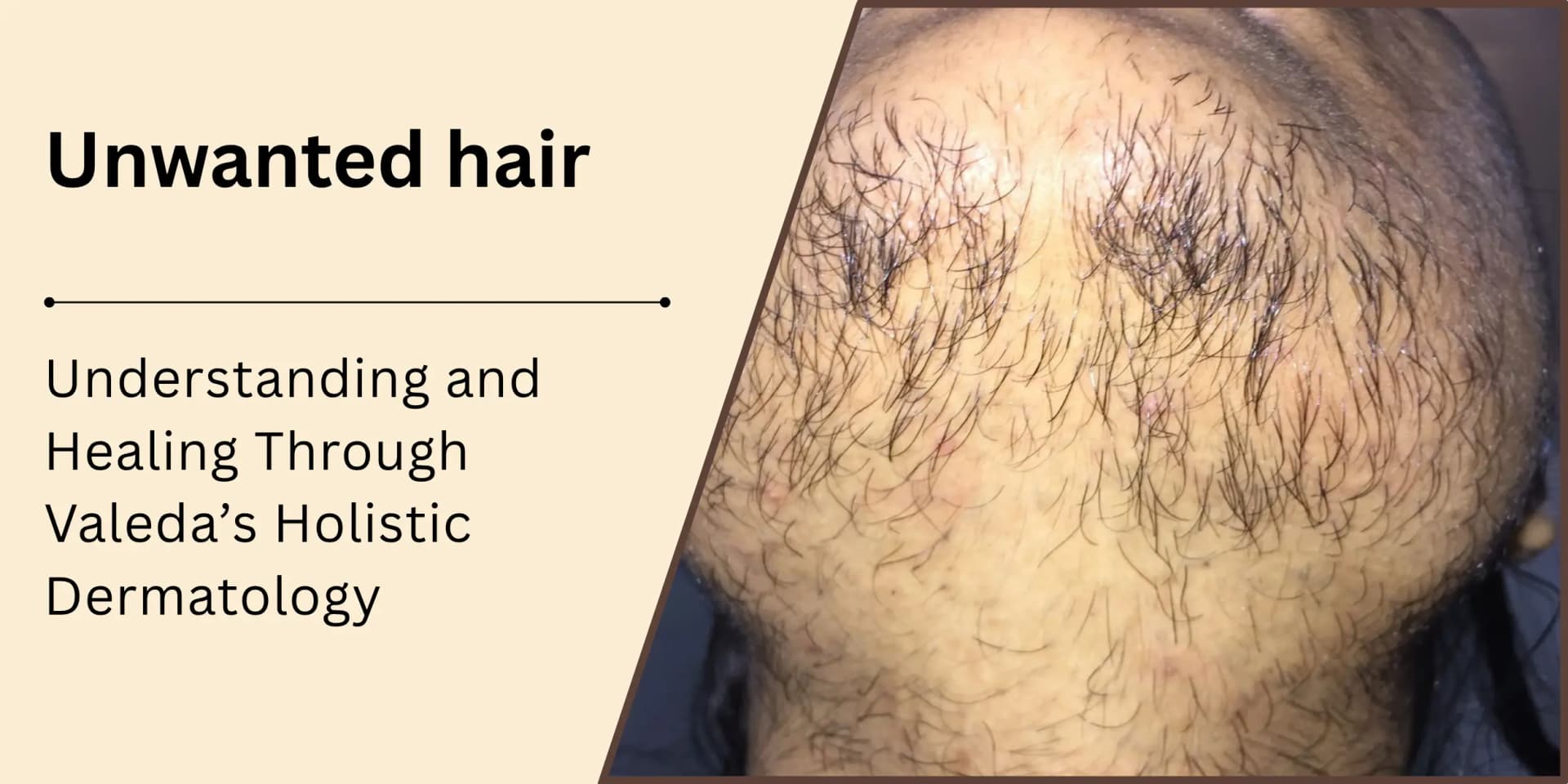
Why the More You Pull, the Worse It Gets — And What Science Says About the Right Way to Stop
2026-06-27
By Dr. Seema Bali, MD BHMS — Holistic Dermatologist | Founder, Valeda Skin & Hair Clinic, New Delhi | 41+ Years of Clinical Experience in Permanent Hair Removal | AEA Member Since 1990 | IGPE Member Since 1992
A few days ago I was speaking on the telephone with a young woman from Paschim Vihar. She was thirty-five years old. She had been managing unwanted facial hair for a long time — threading, waxing, the usual cycle — and she had reached the point where most of my patients reach before they call me. Not panic. Not desperation. Something quieter and more exhausting than either of those: the feeling that she had been doing everything right, and the problem was still getting worse.
She asked me a question that I have been asked thousands of times across four decades of practice. “Doctor, I have been removing this hair regularly for years. Why does it keep coming back? And why does it seem like there is more of it than before?”
That question deserves a real answer. Not a sales pitch. Not a vague reassurance. A biological explanation that she — and the thousands of women across India who are in exactly the same position — can actually use to make a better decision.
This blog is that answer.
First, Understand What Hair Actually Is
Before we talk about removal, we need to talk about structure.
Hair is a keratinised structure. From the moment it is formed inside the follicle, it is biologically dead. The shaft you see above the skin is dead. The root sitting inside the skin is also dead. What is alive is the follicle itself — the tiny organ embedded in your skin that produces hair continuously throughout your life.
The follicle was formed in your body well before you were born. You came into this world with your complete follicular endowment. No new follicles are formed after birth. This is one of the most important facts in dermatology, and most people have never been told it.
What this means practically: when you cut or shave hair, you are removing the dead portion. The follicle sits undisturbed beneath the surface and immediately begins producing the next hair. The hair reappears. This is not a failure of the method. It is biology.
The Pulling Trap — Why Waxing and Threading Make the Problem Worse
Cutting is one thing. Pulling is another — and the consequences are significantly different.
When you thread, wax, tweeze or pluck, you are forcibly extracting the hair from the follicle. The follicle registers this as trauma. Its biological response is repair and replacement — and that response involves something that matters enormously: increased local blood circulation.
When circulation increases at the follicular level, nutritional supply improves. Follicles that were previously lying dormant — quietly inactive, unlikely to produce visible hair in your lifetime — receive an enhanced supply of nutrients and become biologically stimulated. Over time and with repeated pulling, many of these previously dormant follicles activate.
This is the pulling trap that so many women describe without knowing its name: what began as threading once a month became once a fortnight, then once a week, then every four or five days. The waxing is not solving the problem. In a significant proportion of cases, it is slowly deepening it.
Research published on the NIH platform confirms that the hair follicle responds to mechanical stimulation through complex biochemical pathways — including the release of growth-signalling molecules from follicular cells. Scientific work has demonstrated that hair follicle outer root sheath cells release biochemical signals including ATP and neurotransmitters in response to mechanical stimulation, contributing to a cascade of follicular activity that a person pulling hair at home has no way of controlling or predicting.
What You Actually See in the Mirror — The 15% Reality
Here is something that surprises almost every patient I speak to for the first time.
At any given moment, the hair you can see on your skin represents only approximately 15 to 20 percent of your total active follicular crop.
The remaining 80 to 85 percent consists of follicles in resting, dormant or early growth phases — hairs that are developing inside the skin and have not yet emerged. When you wax today, you are removing today's 15 to 20 percent. Over the next three to six months, the hidden follicles gradually emerge. The problem does not shrink. It appears to grow.
This is not a failure of your waxing. It is not a sign that something is wrong with your skin. It is a predictable biological cycle that is the same for every human being on this planet.
When you stop pulling — which is what you must do when you begin permanent treatment — these previously suppressed follicles begin emerging naturally for the first time. For the first few months, it can feel as though the problem is worsening dramatically. I tell every patient I see: this is not new hair. This is hair that was always there, finally revealing itself. The sky is not falling. The full crop is showing itself so it can be permanently treated.
The Follicular Landscape of the Human Face — Numbers That Matter
The human face contains approximately 25,000 to 30,000 hair follicles in the complete beard area alone. These follicles are distributed across the cheek bone, side face, upper lip, chin, under-chin and neck — with the neck alone carrying approximately 55 percent of the total follicular burden. Most people seeking facial hair removal have never considered the neck, and then they are surprised.
Among women, the follicles that produce unwanted facial hair are testosterone-sensitive. Androgens — particularly testosterone and its metabolite DHT — act on sex-specific areas of the body including the face, converting fine vellus hairs into coarser, darker terminal hairs by binding to androgen receptors in the dermal papilla cells of the hair follicle.
In women, circulating testosterone is typically around 1.5 to 6 nanograms per decilitre — approximately 15 to 30 times lower than in males. Yet even at these lower levels, testosterone-sensitive follicles on the face respond. And when you add repeated mechanical stimulation through years of pulling, the picture becomes complex.
In the general population, hirsutism — the excess growth of terminal hair in women in a male-distribution pattern — affects approximately 4 to 11 percent of women, but among women with PCOS, its prevalence rises to an estimated 65 to 75 percent. In my clinical practice of more than four decades, I observe that a substantial proportion of women who present with unwanted facial hair fall within the normal hormonal range. Their follicles are simply genetically programmed to respond to normal female testosterone levels — and this genetic tendency has been worsened, in many cases significantly, by years of repeated pulling.
Why Laser Is Not Permanent Hair Removal
I am asked about laser almost every day, so let me address it directly.
Laser hair reduction works on the principle of selective photothermolysis — a chromatic ray that targets melanin (dark pigment) in the hair shaft. It is effective for dark hair on lighter skin. It is classified, correctly and officially, as permanent hair reduction — not permanent hair removal.
Laser energy acts only on anagen (actively growing) hair follicles. Therefore, multiple treatments are required to achieve significant reduction — typically around 80 percent. For Indian skin types, which are predominantly Types IV and V on the Fitzpatrick scale, long-wavelength lasers such as the Nd:YAG have been found to be most effective.
The word “reduction” is not modesty. It is accuracy. Laser cannot treat white hair, grey hair or light-coloured hair — because there is no melanin for the laser to target. For many women, particularly after the age of thirty, a growing proportion of their facial hair is white or grey. Laser cannot address this population of follicles at all.
Electrolysis, by contrast, works on a fundamentally different principle. A fine probe is introduced directly into the follicle, and an electrical current destroys the follicle at its root — irrespective of hair colour, skin colour or follicle depth. Unlike laser hair removal, which is classified as a permanent hair reduction technique, electrolysis is approved as a permanent hair removal method by the FDA — and has been for over a century.
What EBVHCM Is — And Why It Is Different From Conventional Electrolysis
Over forty-one years of clinical practice, I developed what we at Valeda now call EBVHCM — Electrolysis Blend Valeda Holistic Combination Mode.
It is not a rebrand of conventional electrolysis. Conventional electrolysis treats hair at the surface. EBVHCM integrates what conventional electrolysis leaves out.
The human body is not just a collection of follicles. In many women, unwanted hair is connected to internal factors — hormonal imbalances, constitutional tendencies, medication side effects, nutritional deficiencies. If you destroy follicles at the surface while new follicles continue activating from within, you are fighting a battle on only one front.
EBVHCM addresses both simultaneously. It combines:
- Blend Electrolysis — Galvanic + Thermolysis, with approximately 242 Galvanic-Radiofrequency combinations applicable to different follicular profiles
- Constitutional Homeopathic Medicines — individually prescribed based on your complete hormonal, constitutional and health assessment
- Acupuncture — where clinically indicated
- Constitutional Diet Planning — uploaded on the Valeda Patient Portal
- Deep Follicular Hydration through Mucopolysaccharides — improving conductance, treatment speed and comfort
- Cataphoresis Neutralisation — post-treatment skin stabilisation
- Long-Term Biological Monitoring — ongoing assessment across the entire treatment programme
No two patients receive exactly the same combination. This is a system built on individual case assessment — not a standardised procedure applied uniformly because it is easier.
The Clearance Concept — Understanding Why This Takes Months, Not Days
One of the most important things I explain to every new patient is the concept of clearance.
A clearance means treating all hairs that are externally visible and available for treatment within a particular skin area during a 40-day biological cycle — irrespective of how many visits you make during that period.
Why 40 days? Because hair follicles do not all grow simultaneously. They operate in phases — active growth (anagen), regression (catagen), rest (telogen), and return to growth. At any given moment, only a portion of your follicles are in the anagen phase and externally visible. You must wait for the remaining follicles to emerge over subsequent cycles.
This is why permanent treatment requires 7 to 8 clearances over approximately 8 to 12 months. This is not a commercial arrangement designed to extend your treatment. It is the biology of hair growth cycles.
What the data from our clinic consistently shows:
- 3 to 4 clearances generally produce approximately 60 to 65 percent permanent improvement
- 7 to 8 clearances allow complete biological cycling of most active follicles
- Improvement is progressive and cumulative — each clearance permanently eliminates another portion of the crop
The hair appearing after a successful clearance is not a sign that treatment has failed. It belongs to one of two categories — thick new growth from previously dormant follicles now activating, or thin regrowth from previously treated follicles where small germinal cell populations survived the first treatment. Both are expected. Both are manageable.
A Word About Cost — Before the Numbers Frighten You
I know that when people look at treatment hours multiplied by hourly rates, the number feels large. I understand this. The individuals who come to me have almost always already spent years and significant amounts of money on temporary solutions.
Let me reframe how to think about cost.
Threading every week for ten years is not free. Waxing every fortnight for a decade is not free. Repeated laser sessions are not free. And none of these methods permanently solve the problem.
EBVHCM treatment, planned correctly with the right package structures and payment arrangements, is a one-time investment in a permanent solution. The cost should be evaluated not against this month's budget, but against the cumulative lifetime cost of a problem that otherwise never ends.
For those with programmes requiring 30 hours or more, special introductory programmes and inoculation privilege structures are available — bringing the effective per-hour cost substantially below the card rate of ₹6,000 per hour. All payment structures follow a cardinal safety rule: hours given never exceed the amount paid at card rate. You are protected at every stage.
For the Woman in Paschim Vihar — And the Many Like Her Across India
The woman I spoke to from Paschim Vihar is thirty-five years old. She has been pulling hair since she was a teenager. She does not have a dramatic hormonal disorder. She has normal female testosterone levels and follicles that are genetically programmed to respond to them — worsened by years of repeated trauma.
She is not unusual. She is, in my experience, the majority.
If you are reading this and you recognise yourself in her story — the frequency increasing, the hair seeming to grow back faster and coarser, the cycle that never ends — please know that the biology behind what you are experiencing is well understood. The solution exists. It requires months, not days. It requires a commitment to stopping temporary methods. It requires working with someone who has the experience to guide you through the phase where the full crop reveals itself for the first time.
But it ends.
That is the one thing I have seen repeatedly across 41 years of practice. It ends.
About Dr. Seema Bali
Dr. Seema Bali (MD, BHMS) is the founder and director of Valeda Skin & Hair Clinic, established in 1985 at Rajendra Place, New Delhi. She is the pioneer developer of EBVHCM — Electrolysis Blend Valeda Holistic Combination Mode — and has been a member of the American Electrology Association (AEA) since 1990 and the International Guild of Professional Electrologists (IGPE) since 1992. Over four decades, she has treated patients from across India, the Gulf, North America, Europe, Australia and beyond.
Valeda Skin & Hair Clinic
7H, 7th Floor, Gopala Tower, Rajendra Place, New Delhi 110008
For consultations, online assessment or courier medicines: Visit: valedadoctor.com
This blog is for educational purposes. Individual treatment requirements vary and are assessed during personal consultation.
Contact Us!
| 🏥 Address: | Valeda Skin and Hair Clinic |
| 📞 Phone: | 9313233341, 9971854669 |
| ☎️ Landline: | 011 40244119 |
| 📩 Email Id: | doctor@valedalife.com |