
Cost & Duration · Section 6 of 13
Cost & Duration of Permanent Hair Removal
Section 6 — Thick New Growth vs Thin Regrowth: Why Hairs Continue to Appear After a Successful Clearance
SECTION 6 — Thick New Growth vs Thin Regrowth
“If the Hairs Are Appearing Again, Was the Treatment Unsuccessful?”
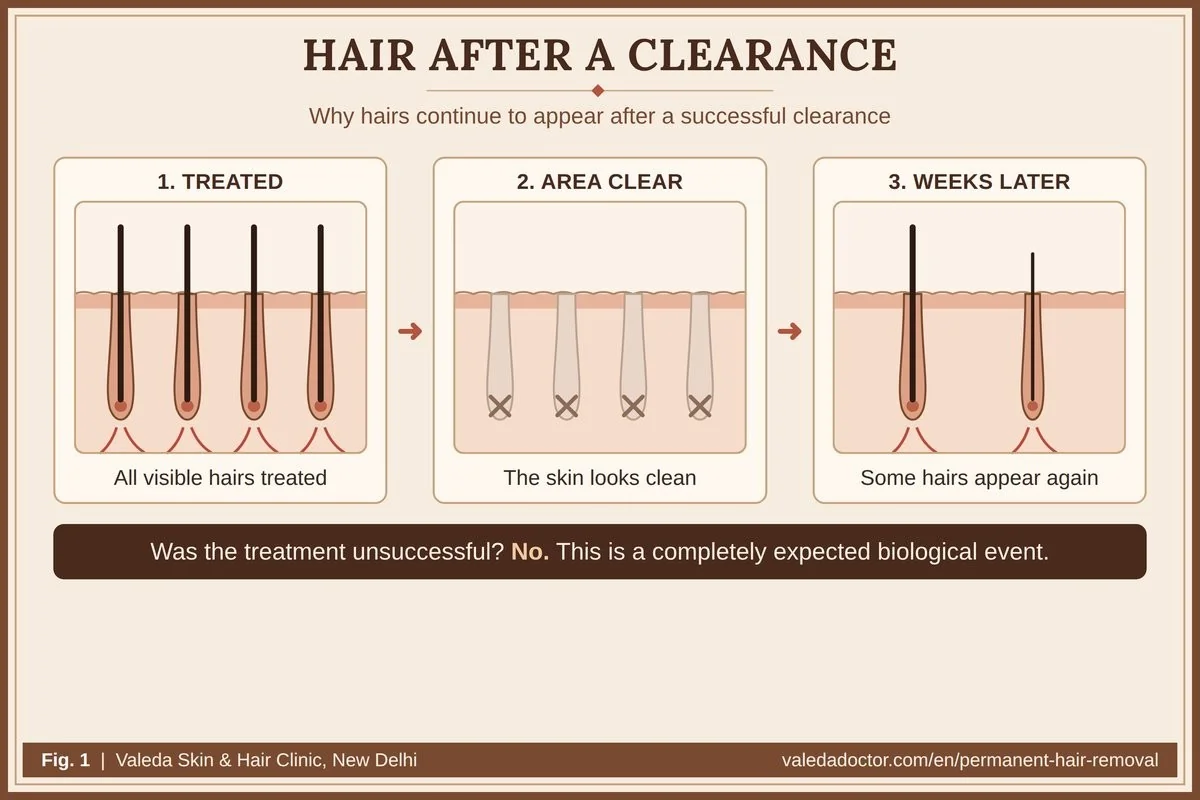
Perhaps no concept in permanent hair removal creates more confusion than the appearance of hairs after a successful clearance. A person observes that the area was treated, the area became clear and the visible hairs disappeared. Then after a few weeks or months, hairs begin appearing again. The natural question is: was the treatment unsuccessful?
No. The appearance of hairs after a successful clearance is a completely expected biological event.
The hairs appearing after a clearance belong to two entirely different categories. (For a full explanation of what a Clearance is and how the 40-day biological cycle works, refer to: Section 5 — Understanding Clearance)
The Two Categories of Hairs Appearing After a Clearance
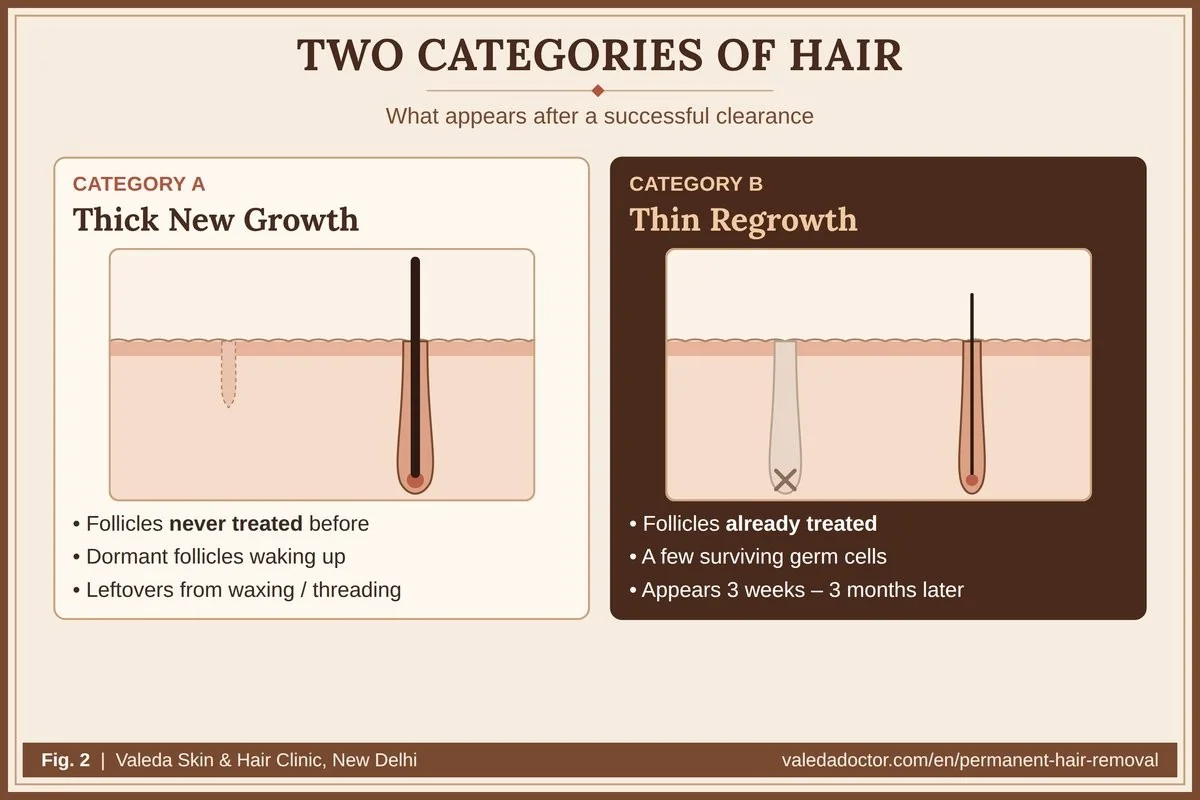
Category A — Thick New Growth and Category B — Thin Regrowth. Understanding the difference between these two categories is one of the most important keys to understanding permanent hair removal.
- Thick New Growth: dormant follicles becoming active, plus leftovers from previous waxing and threading.
- Thin Regrowth: surviving germ cells in distorted follicles — appears 3 weeks to 3 months later.
What Happens Immediately After a Clearance?
All visible hairs available during that clearance cycle have been treated, and the area now appears clean. Beneath the skin, however, there still remain dormant follicles, resting follicles, delayed follicles, recently activated follicles, previously waxed follicles and partially treated follicles capable of producing Thin Regrowth. These follicles gradually become visible during the following weeks and months.
Category A — Thick New Growth
Thick New Growth generally consists of thick hairs arising from follicles that have never previously been treated. These are not treatment failures. They are simply newly available treatment opportunities.
Component 1 — Dormant or Resting-Stage Follicles
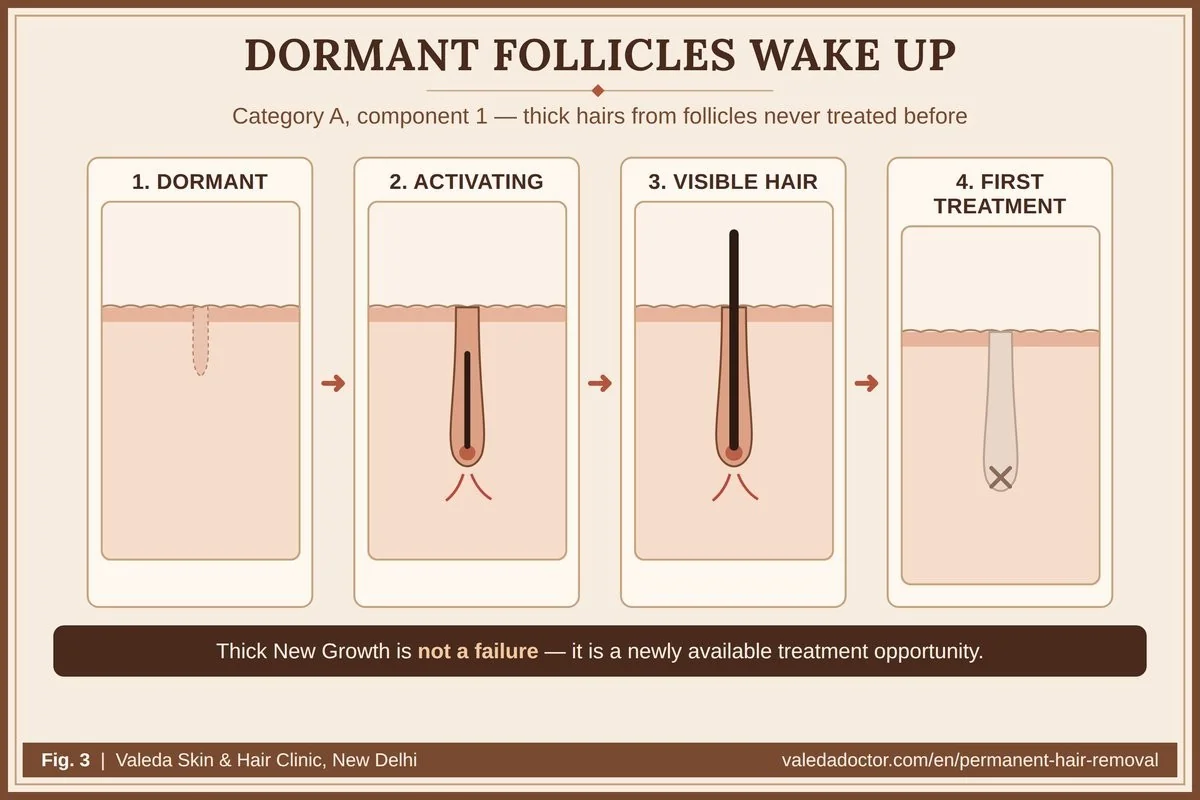
At any given time, a substantial proportion of follicles remain in telogen stage, resting stage or dormant stage. These follicles cannot be treated as they are not visible. As they become biologically active, they begin producing visible hairs that appear as Thick New Growth — usually thick, strong, deeply rooted and apparently untouched, because they have never previously been treated.
Dormant Follicle ➜ Activated Follicle ➜ Visible Hair Appears ➜ Available For First Permanent Treatment
Component 2 — Leftover Crop From Previous Temporary Hair Removal
Many individuals begin EBVHCM treatment after years of waxing, threading, tweezing, plucking, sugar waxing and other pulling methods. When a person waxes today, only the visible crop is removed. A substantial proportion of follicles remain beneath the skin and continue their biological development, gradually appearing over subsequent weeks and months. Many of the Thick New Growth hairs appearing during the first few clearances therefore represent leftovers of previous temporary hair removal practices rather than treatment failure.
Understanding the Waxing Illusion
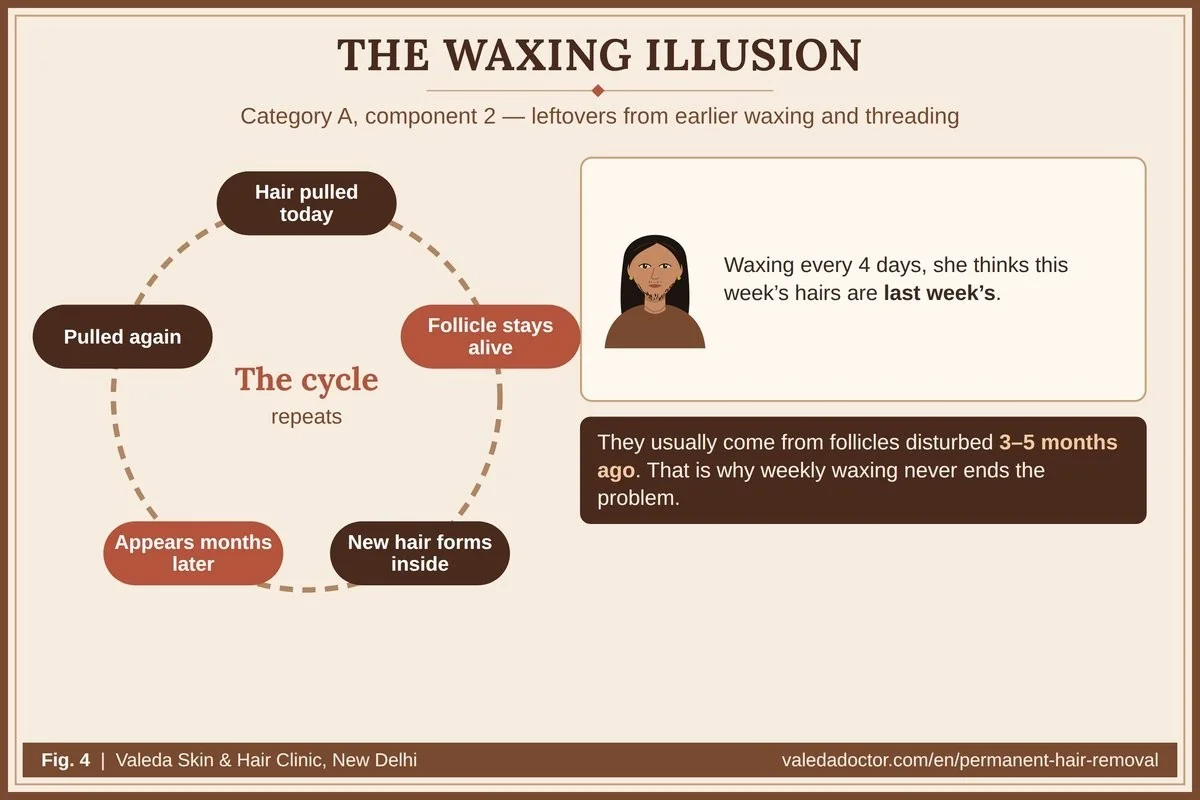
Suppose a woman has been waxing every four days for several years. She may believe that the hairs appearing this week are the same hairs she removed last week. Biologically this is usually not true. The hairs appearing today may represent follicles that were disturbed three, four or five months ago. This explains why weekly waxing never solves the problem — the follicles simply continue appearing in cycles.
Hair Pulled Today ➜ Follicle Remains Alive ➜ New Hair Forms Internally ➜ Appears Months Later ➜ Pulled Again ➜ Cycle Repeats
The Transition From Waxing to EBVHCM
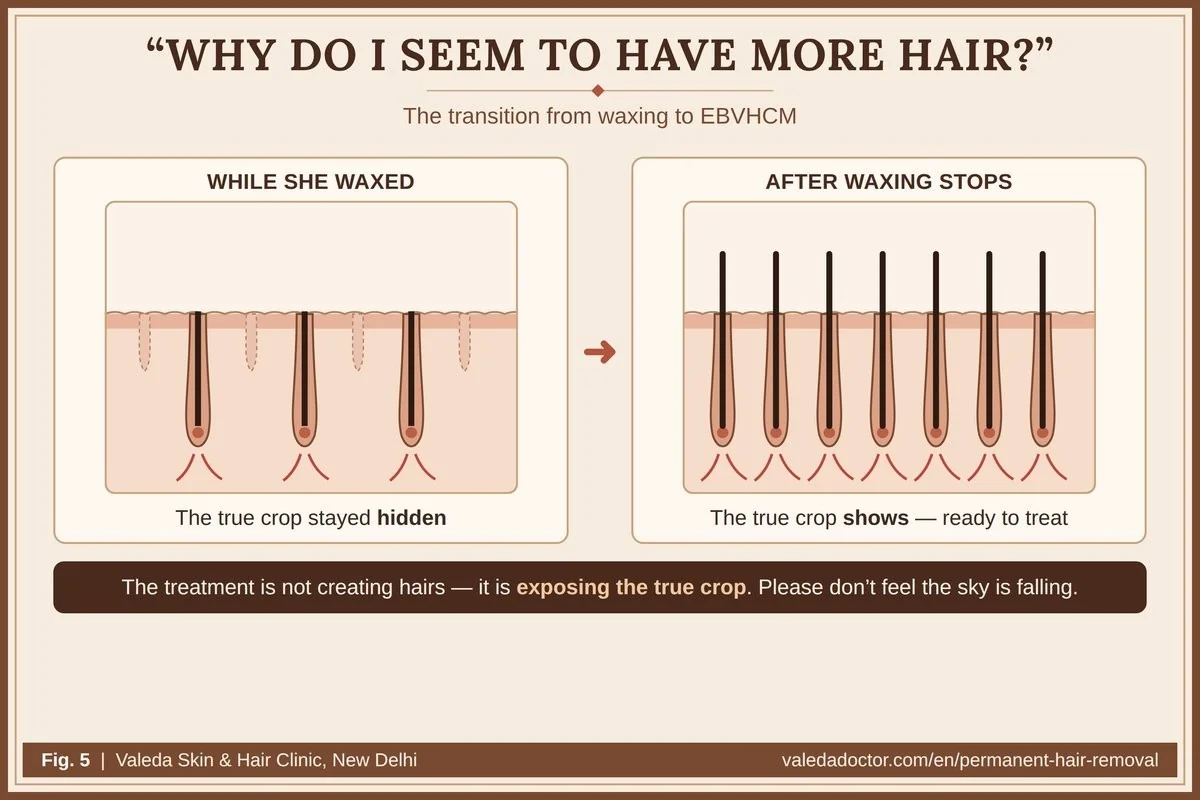
When treatment begins, the doctors at Valeda Skin & Hair Clinic advise individuals to discontinue waxing, threading, tweezing, plucking and all other pulling methods. Consequently, the visible crop at the next visit may appear larger than what the individual was accustomed to seeing after a routine waxing session.
“After starting treatment, why do I seem to have more hairs than before?” The treatment is not creating new hairs. The treatment is exposing the true crop that was previously being hidden by repeated temporary hair removal methods.
If this phase occurs, please do not feel that the sky is falling. This is a temporary and passing phase.
Waxing Stopped ➜ Hidden Hair Appears ➜ Visible Crop Looks Larger ➜ Hair Gets Treated Permanently ➜ Density Begins Falling
Category B — Thin Regrowth
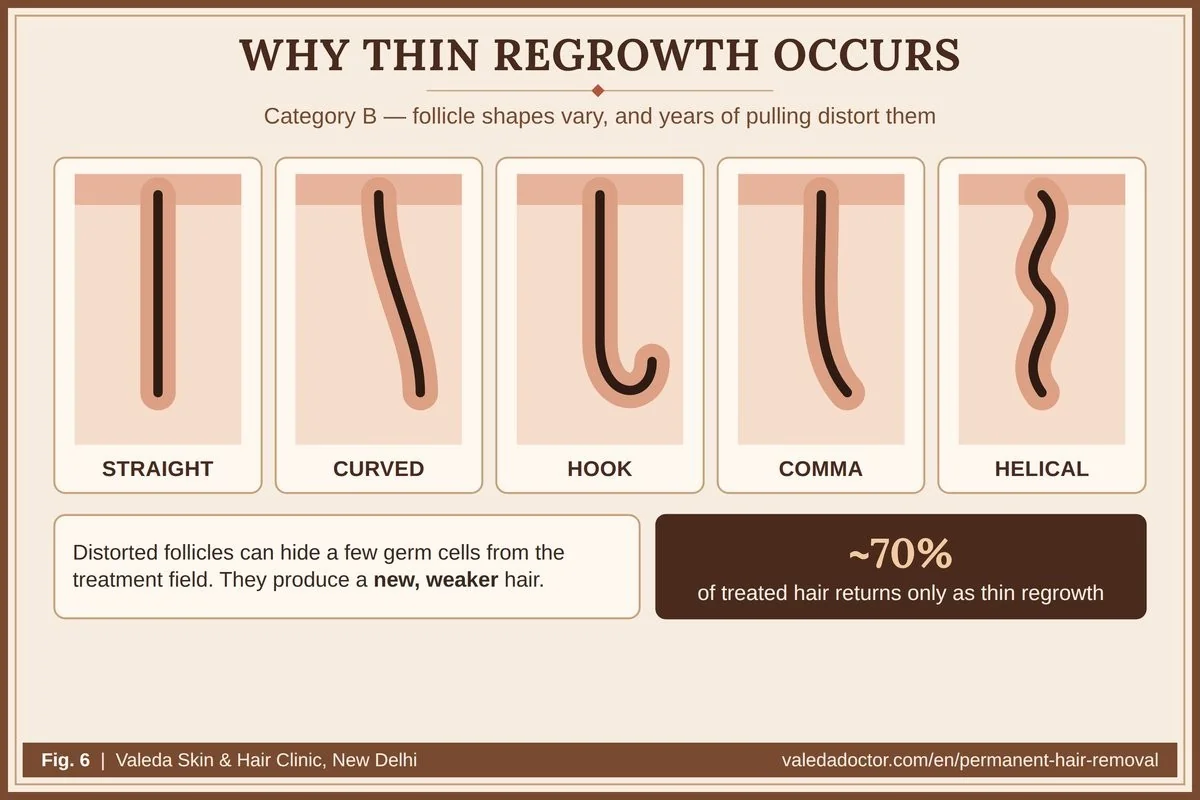
Unlike Thick New Growth, Thin Regrowth represents follicles that have already been treated. These hairs are usually thinner, softer, weaker, less deeply anchored and lighter in appearance than the predecessor hair. Approximately 70% of Valeda-treated hair returns only as thin, weak regrowth.
Why Does Thin Regrowth Occur?
Not all follicles possess a simple straight structure. Many may be curved, hook-shaped, comma-shaped, helical, embedded or distorted by years of waxing, threading, tweezing or plucking. The objective of EBVHCM is the permanent destruction of the germinal structures responsible for future hair production. During treatment, the applied charge intensities generate destructive effects within the lower portion of the follicle, spreading horizontally as well as vertically upwards.
Because of highly variable follicular anatomy, the generated field may not always cover every potential germ cell during the first treatment cycle. A small number of surviving germinal cells may remain, capable of producing a new but weaker follicle — which subsequently appears as Thin Regrowth.
Original Follicle ➜ EBVHCM Treatment ➜ Majority Of Germ Cells Destroyed ➜ Small Residual Germinal Activity ➜ Thin Regrowth Appears ➜ Permanently Eliminated In Subsequent Clearances
Why Thin Regrowth Is Usually Thinner
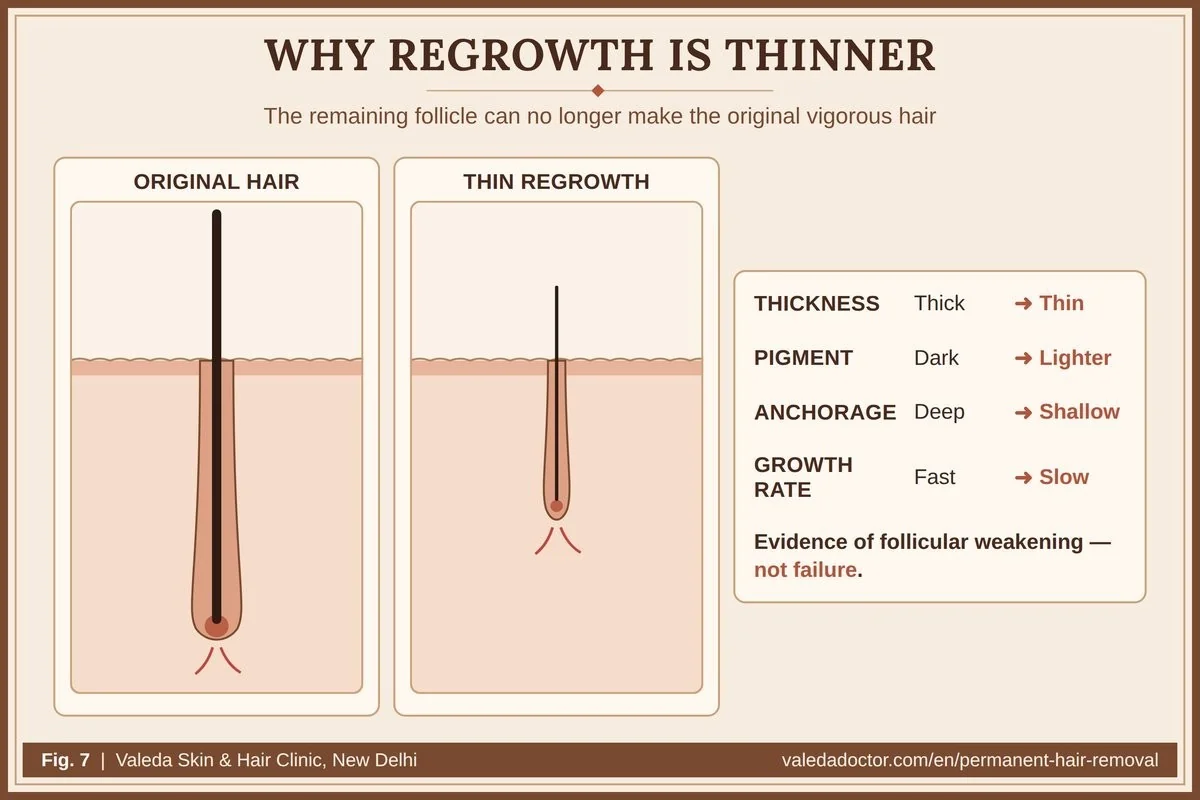
Thin Regrowth almost always returns in a weakened form. Patients commonly observe reduced thickness, reduced pigmentation, reduced anchorage and reduced growth rate. The remaining follicular structures are no longer capable of producing the same vigorous hair that existed originally.
The doctors at Valeda Skin & Hair Clinic regard Thin Regrowth as evidence of substantial follicular weakening — not treatment failure.
When Does Thin Regrowth Usually Appear?
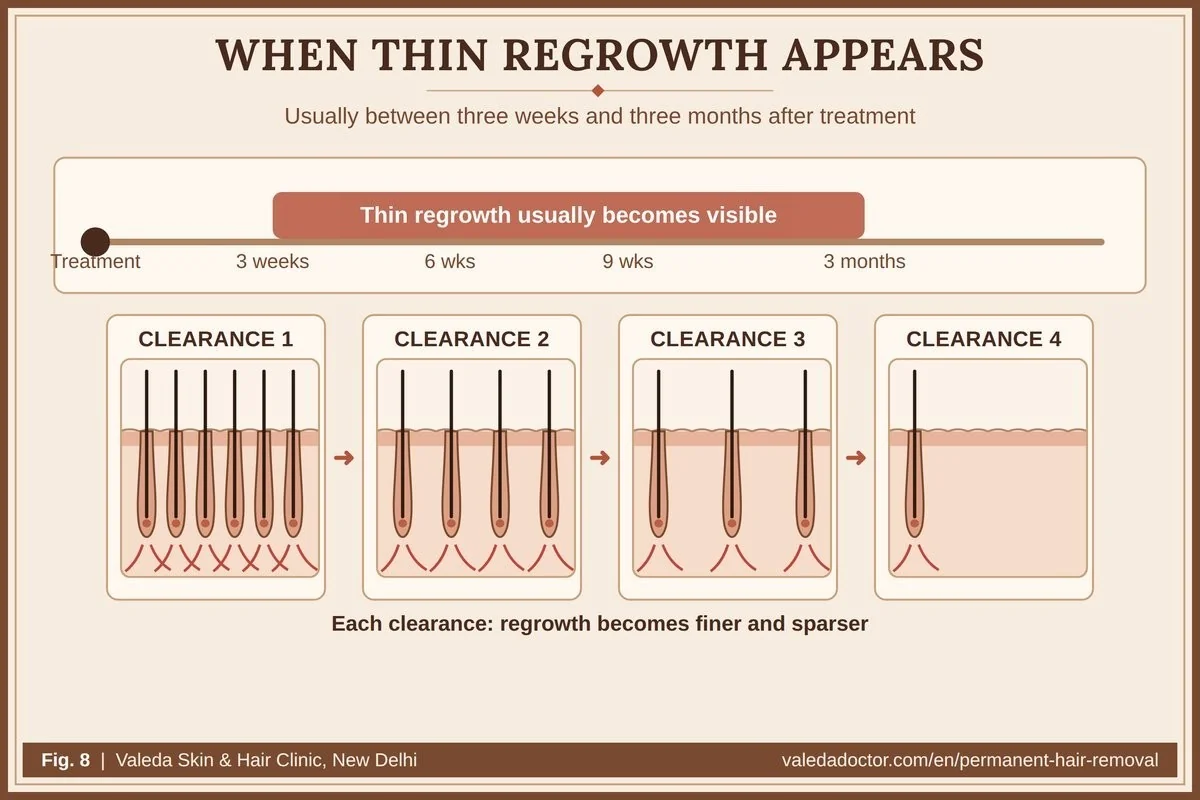
Thin Regrowth hairs commonly become visible between three weeks and three months after treatment. Because they arise from already-weakened follicles, each one is permanently eliminated in a subsequent clearance — and with every clearance the regrowth becomes finer and sparser.
Treatment ➜ 3 Weeks To 3 Months ➜ Thin Regrowth Visible ➜ Treated In Next Clearance ➜ Finer And Sparser Each Time
The Temporary Overlap Phase
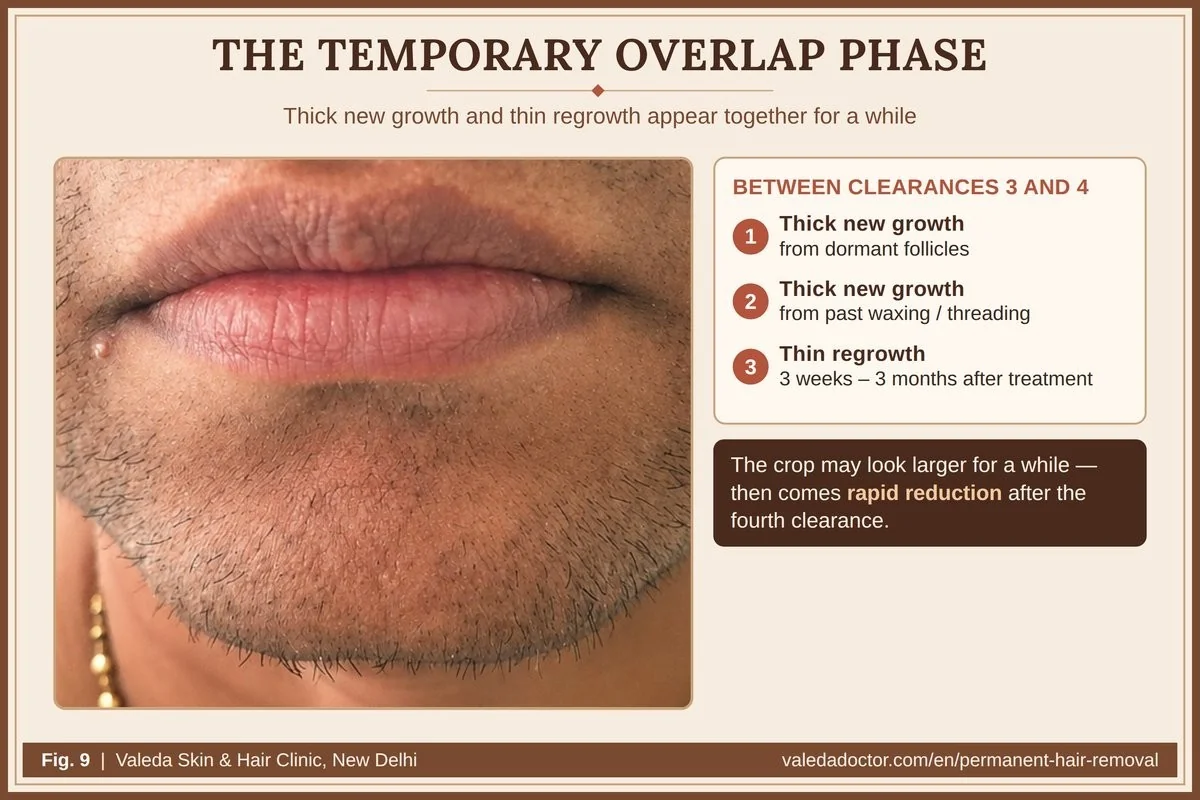
Between the third and fourth clearances:
- Thick New Growth continues arriving from dormant follicles
- Thick New Growth from previous waxing / threading continues appearing
- Thin Regrowth begins appearing between 3 weeks and 3 months after treatment
Thick New Growth and Thin Regrowth temporarily overlap. This overlap may occasionally create the impression that the problem is increasing. In reality the opposite is happening — the hidden crop is becoming visible so that it can be permanently treated.
Thick New Growth + Thin Regrowth ➜ Temporary Increase In Visible Crop ➜ Fourth Clearance ➜ Rapid Reduction Thereafter
The Most Encouraging Phase of Treatment
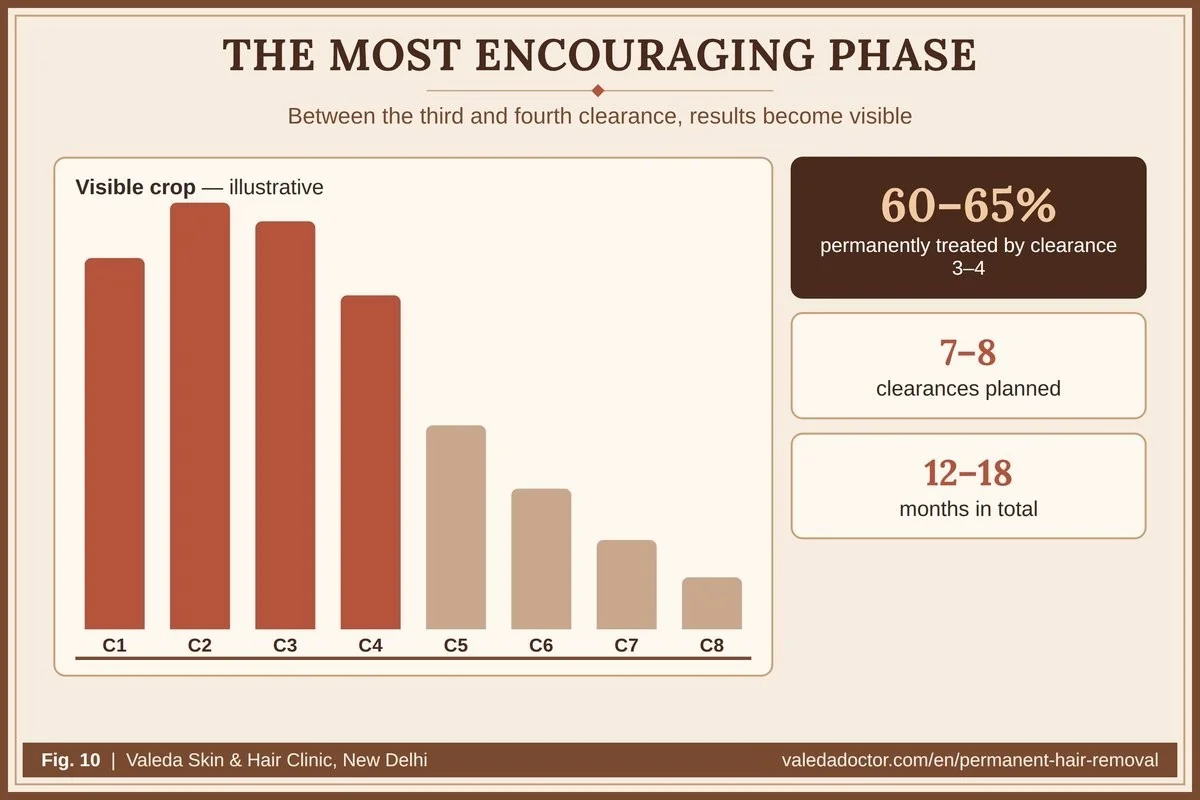
One of the most rewarding periods usually occurs between the third and fourth clearance. Visible results usually appear here, and the doctors and experts at Valeda Skin & Hair Clinic have repeatedly observed that by this stage approximately 60–65% of the biologically active follicular population may already have been permanently addressed.
An important note: during your visits to Valeda Skin & Hair Clinic, you may meet other patients and ask about their personal experiences. Some may tell you that their problem was completely resolved by the third or fourth clearance. This does happen when all the biological variables are favourable — and both the patient and the clinic are genuinely happy when it does.
However, the clinic always quotes 7–8 clearances over a complete programme of approximately 12–18 months as the realistic planning estimate — not to discourage, but to set honest and achievable expectations. If resolution comes sooner, everyone is happy. If the full programme is required, you have planned for it.
Clearance 1 ➜ Clearance 2 ➜ Clearance 3 ➜ Clearance 4 ➜ Approximately 60–65% Permanent Reduction ➜ Progressively Smaller Crop ➜ Long-Term Permanent Resolution
SUMMARY — SECTION 6
After a clearance: hairs reappearing is expected — they fall into two categories.
Thick New Growth: follicles never treated before — dormant follicles waking, and leftovers from earlier waxing and threading. Newly available treatment opportunities, not failures.
Thin Regrowth: follicles already treated, returning thinner, lighter and weaker, 3 weeks to 3 months after treatment. About 70% of treated hair returns only this way.
Overlap: between the 3rd and 4th clearances both appear together; the crop may look larger for a while, then falls rapidly.
Milestone and plan: about 60–65% permanent reduction by the 3rd–4th clearance; 7–8 clearances over approximately 12–18 months as the realistic plan.
Next: with new growth and regrowth understood, the Duration Tables in Section 7 become meaningful and the cost tables predictable.