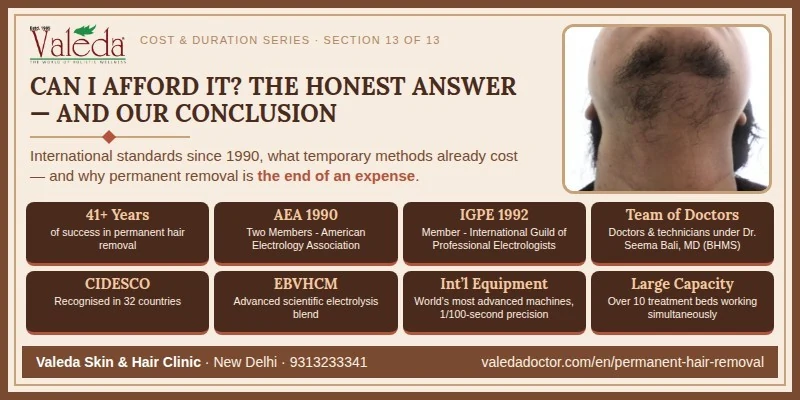
Cost & Duration · Section 13 of 13
Cost & Duration of Permanent Hair Removal
Section 13 — International Standards, Professional Background & Final Conclusion
SECTION 13 — International Standards, Professional Background & Final Conclusion
International Standards
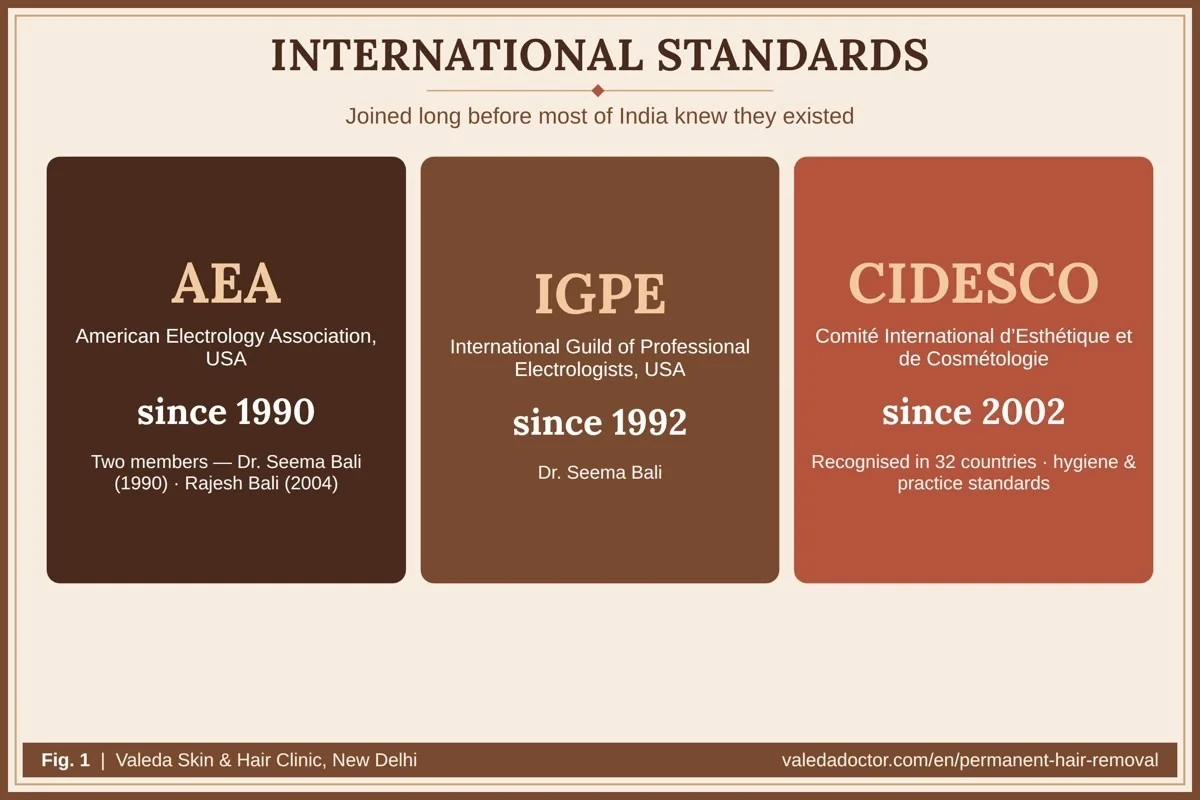
Long before most practitioners in India knew that international electrology standards existed, Valeda Skin & Hair Clinic had joined them. Dr. Seema Bali has been a member of the American Electrology Association (AEA), USA, since 1990, and of the International Guild of Professional Electrologists (IGPE), USA, since 1992. Rajesh Bali joined the AEA in 2004 — making Valeda home to two AEA members.
Hygiene, sterilisation, professional practice and quality control at the clinic also draw on CIDESCO — the Comité International d’Esthétique et de Cosmétologie, recognised in 32 countries — with which the clinic has been associated since 2002. These are not certificates on a wall; they are the standards every sitting is measured against.
Professional Background — The Technical and Scientific Foundation
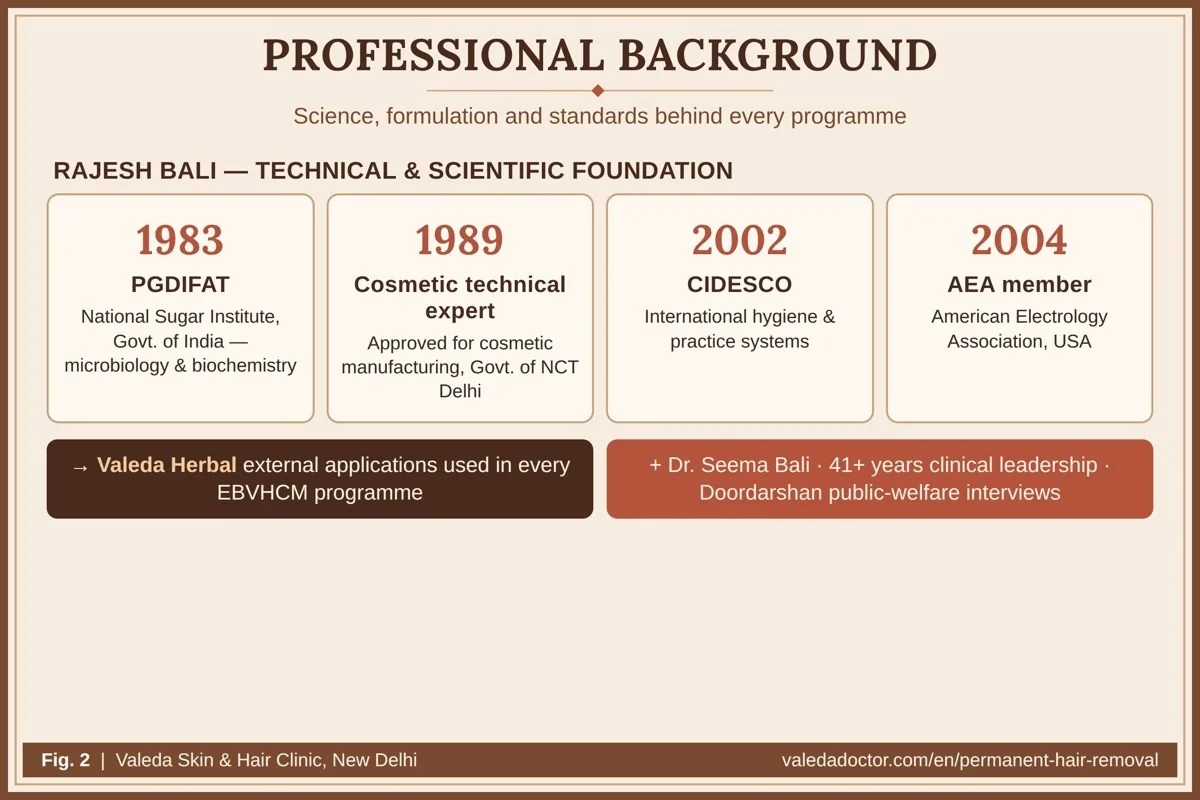
Permanent hair removal sits within a wider framework of cosmetic science, formulation chemistry, biological measurement and professional standards. At Valeda Skin & Hair Clinic, that technical foundation has been built over several decades by Rajesh Bali:
- PGDIFAT — 1983: Post-Graduate Diploma in Industrial Fermentation and Alcohol Technology, National Sugar Institute, Government of India — microbiology, biochemistry and applied biological sciences.
- Cosmetic Formulation & Manufacturing — since 1989: approved technical expert for cosmetic manufacturing under Government of NCT of Delhi regulations; the foundation of the Valeda Herbal range, including the external applications used in every EBVHCM programme.
- CIDESCO exposure — since 2002: international hygiene, practice and quality-control systems.
- Member, American Electrology Association (AEA), USA — since 2004.
Alongside Dr. Seema Bali’s clinical leadership — including her public-welfare interviews on Doordarshan in the pre-internet era — this scientific grounding is why treatment planning at Valeda is analytical rather than guesswork.
“Even the Laser Clinic Said the Same Thing”
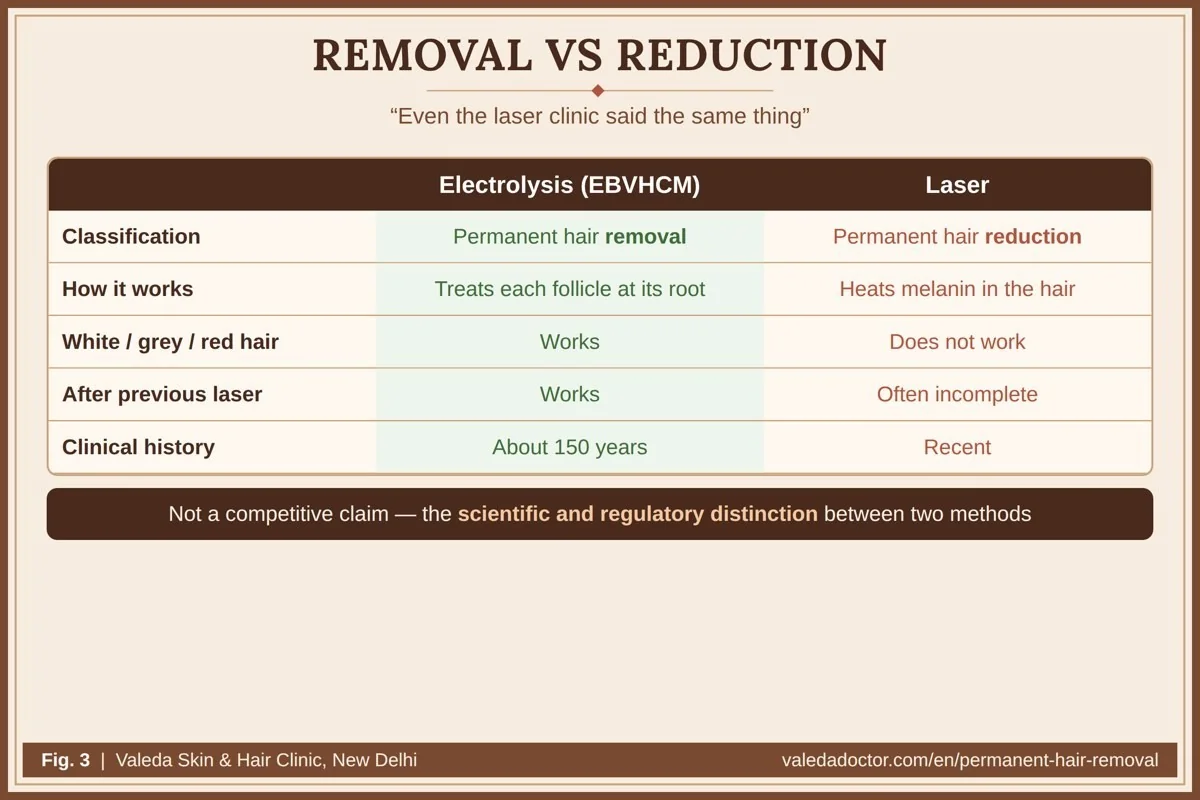
This concern is valid and deserves a direct answer. Laser clinics offer packages, sessions — and often the word “permanent”. But the scientifically accurate term for laser is permanent hair reduction. The US Food and Drug Administration allows laser devices to claim only reduction; electrolysis is the method recognised as permanent hair removal, with a clinical history of about 150 years. Dr. Seema Bali wrote about the limits of laser as early as 1992, and a vice-president of a laser manufacturer (ThermoLase Corporation) later confirmed directly to the clinic that no laser achieves permanent removal.
The mechanisms are entirely different. Laser targets melanin, so it fails on white, grey, red and light hair, and on many hormone-sensitive follicles. Electrolysis destroys the follicle regardless of hair colour, skin tone, hormonal profile or previous laser. This is not a competitive claim — it is the scientific and regulatory distinction between two methods.
“It Is Too Expensive. I Cannot Afford It.”
Over four decades, the doctors at Valeda Skin & Hair Clinic have heard this in its fuller, very human form: “How much will the whole treatment cost? We are not sure we can afford it. I am fine with it, but how will I explain it to my family? The laser clinic said the same thing. What if we start and cannot finish?” These are not unreasonable concerns. This section answers each of them, honestly.
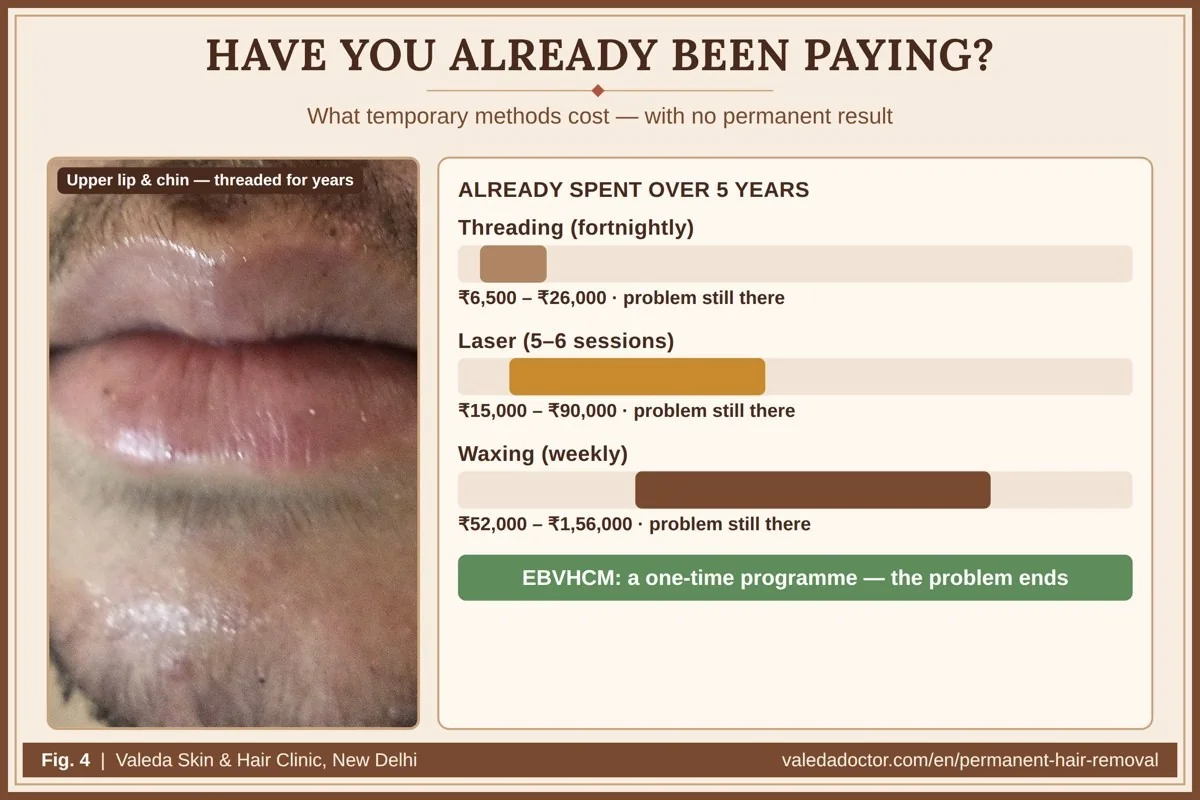
First, consider what you may already have spent. Threading chin and upper lip every fortnight at ₹50–₹200 a session costs about ₹1,300–₹5,200 a year — ₹6,500–₹26,000 over five years. Weekly facial waxing at ₹200–₹600 costs about ₹10,400–₹31,200 a year — ₹52,000–₹1,56,000 over five years. Five to six laser sessions at ₹3,000–₹15,000 each come to ₹15,000–₹90,000. In every case, the problem is still there — often worse.
| Method | Annual Spend (Approx.) | 5-Year Total | End Result |
|---|---|---|---|
| Threading (fortnightly) | ₹1,300 –₹5,200 | ₹6,500 –₹26,000 | Problem continues |
| Waxing (weekly) | ₹10,400 –₹31,200 | ₹52,000 –₹1,56,000 | Problem continues and worsens |
| Laser (5–6 sessions) | ₹15,000 –₹90,000 (once) | More sessions needed | Incomplete — often reversed |
| EBVHCM at Valeda | As per your case (Section 9) | One-time programme | Problem ends permanently |
Compare these with the 12 real examples in Section 9. The question is not whether you can afford EBVHCM — it is whether you can afford to keep not doing it.
Efficiency — and the Real Cost per Hour
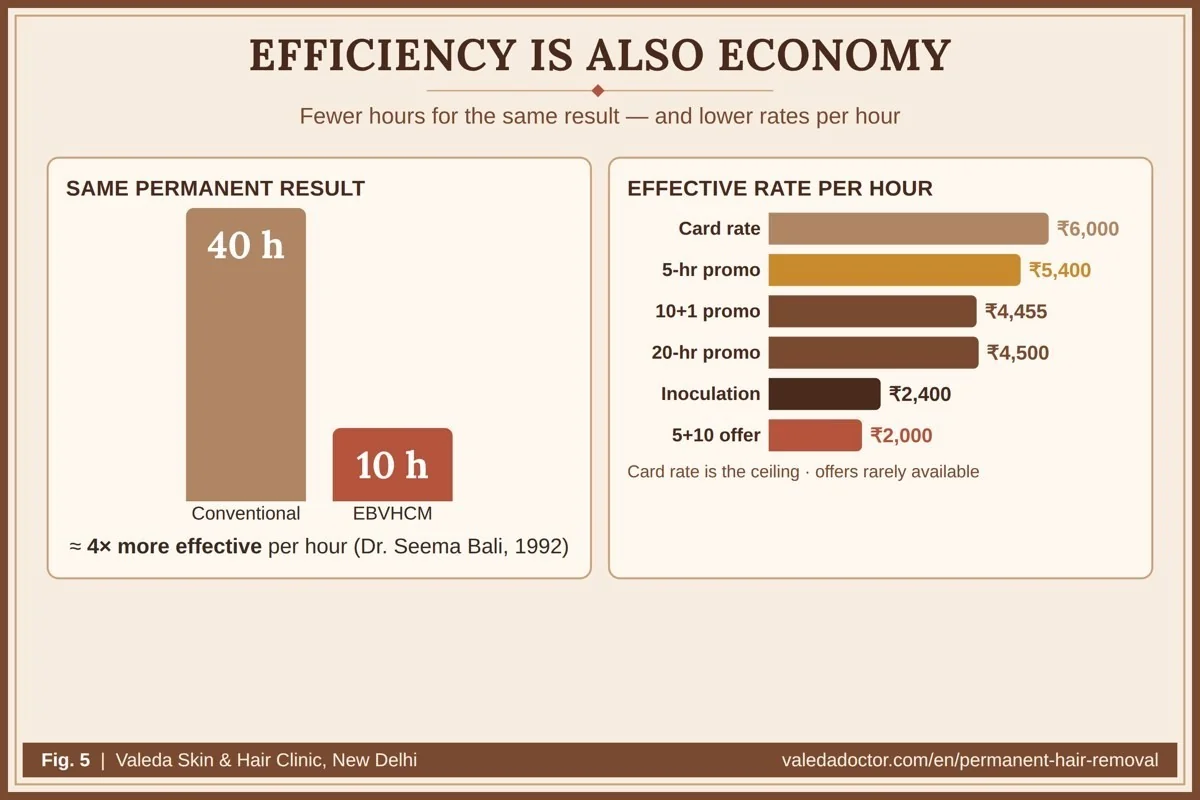
Dr. Seema Bali explained in a national magazine article in 1992 that EBVHCM is approximately four times more effective than conventional electrolysis — not four times faster, but four times more effective per hour of treatment. If conventional electrolysis needs 40 hours to achieve what EBVHCM achieves in 10, the cost of the same permanent result at Valeda is effectively a quarter. The 242 combinations, constitutional medicines, deep hydration and 41 years of experience are not only quality factors — they are cost-efficiency factors.
| Option | Price | Effective Rate per Hour |
|---|---|---|
| Card rate (reference) | ₹6,000 per hour | ₹6,000 |
| 5-Hour Promo | ₹27,000 | ₹5,400 |
| 10-Hour Promo (10+1 = 11 hours) | ₹49,000 | ₹4,455 |
| 20-Hour Promo | ₹90,000 | ₹4,500 |
| Inoculation Privilege (rarely available) | As applicable | ₹2,400 |
| 5+10 Introductory Programme (rarely available) | ₹30,000 for 15 hours | ₹2,000 |
The card rate is the ceiling, not the floor. Offers are rarely available, may change without notice and remain subject to the Card Rate Safety Rule (Section 8).
You Do Not Need the Full Amount on Day One — and Nothing Treated Is Lost
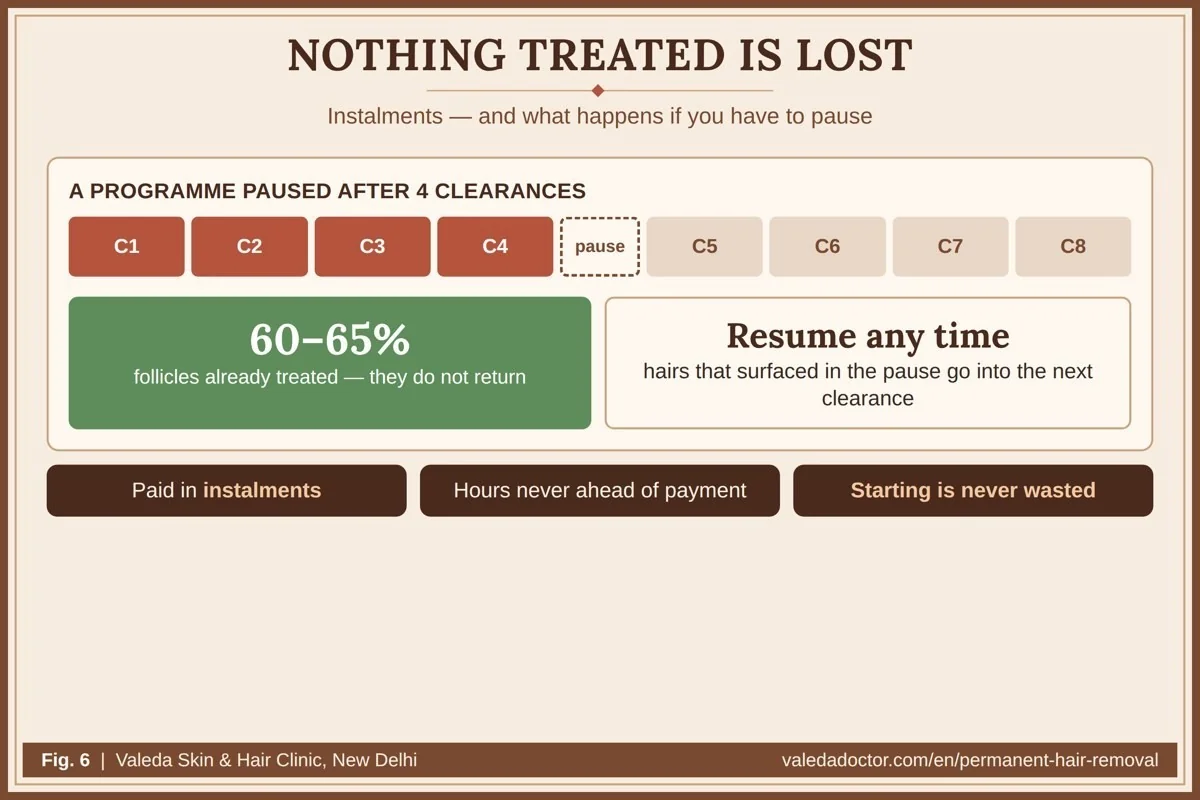
The complete programme is never paid in one go. Payment is in instalments (Section 8), and the Card Rate Safety Rule ensures that treatment given never runs ahead of the amount paid at card rate. For programmes under 30 hours, the first visit is ₹10,000 with the balance in instalments; for 30+ hour programmes with 5+10 available, the first visit is ₹34,485. You begin with what you can manage, and the programme unfolds alongside your payments.
What if we start but cannot complete it? The answer is unambiguous: whatever is permanently treated stays permanently treated. If a programme is paused after 3–4 clearances, the approximately 60–65% of follicles already treated do not return. When treatment resumes, the hairs that surfaced during the pause are simply treated in the next clearance. The calendar extends — the progress is preserved. Starting is never wasted.
“How Do I Explain This to My Family?”
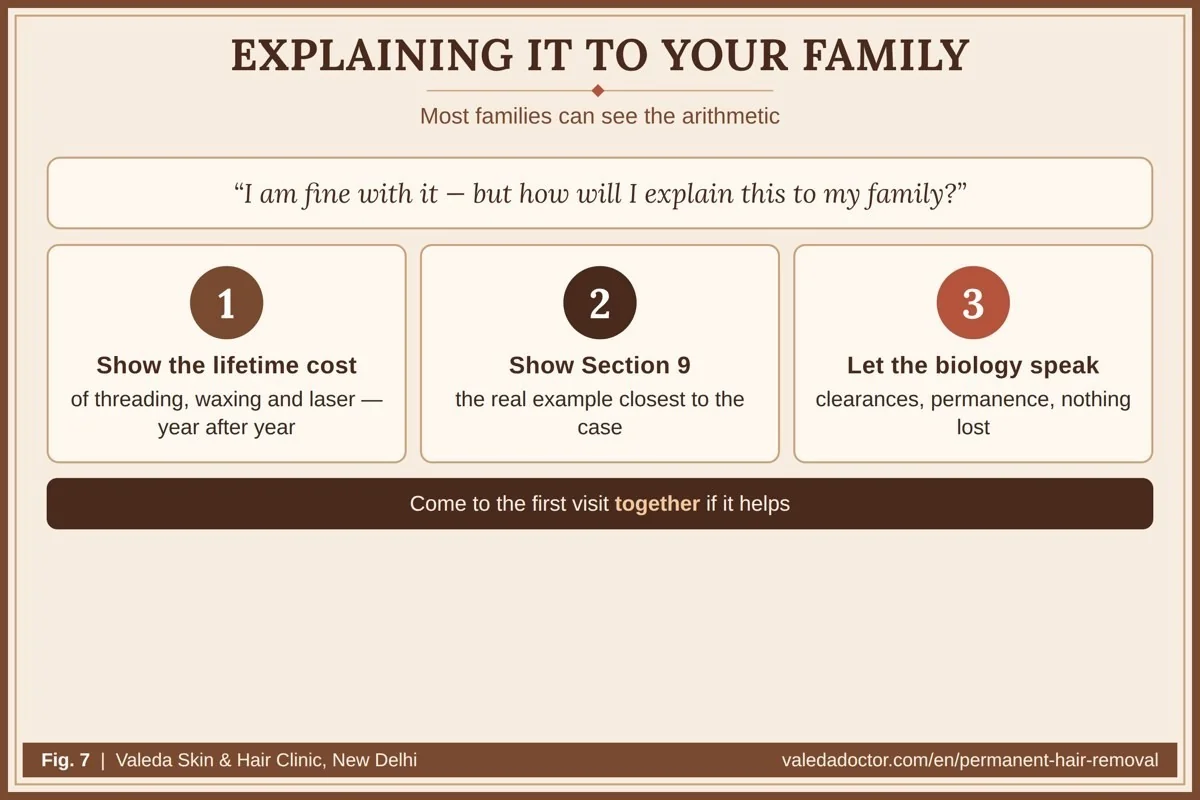
This question is specific, honest and deeply human — and the team has heard it again and again. The most effective way is the lifetime comparison above: not what this programme costs, but what the alternative costs, year after year, with no permanent result — and with the gradual worsening that waxing and threading cause.
Most families, once they see the full picture, respond very differently from what was expected. Most families can see arithmetic — and most have watched someone they love live with this problem, and its emotional weight, for years. Show them Section 9. Let the numbers speak. Then let the biology speak. And if it helps, come to the first visit together.
Final Conclusion
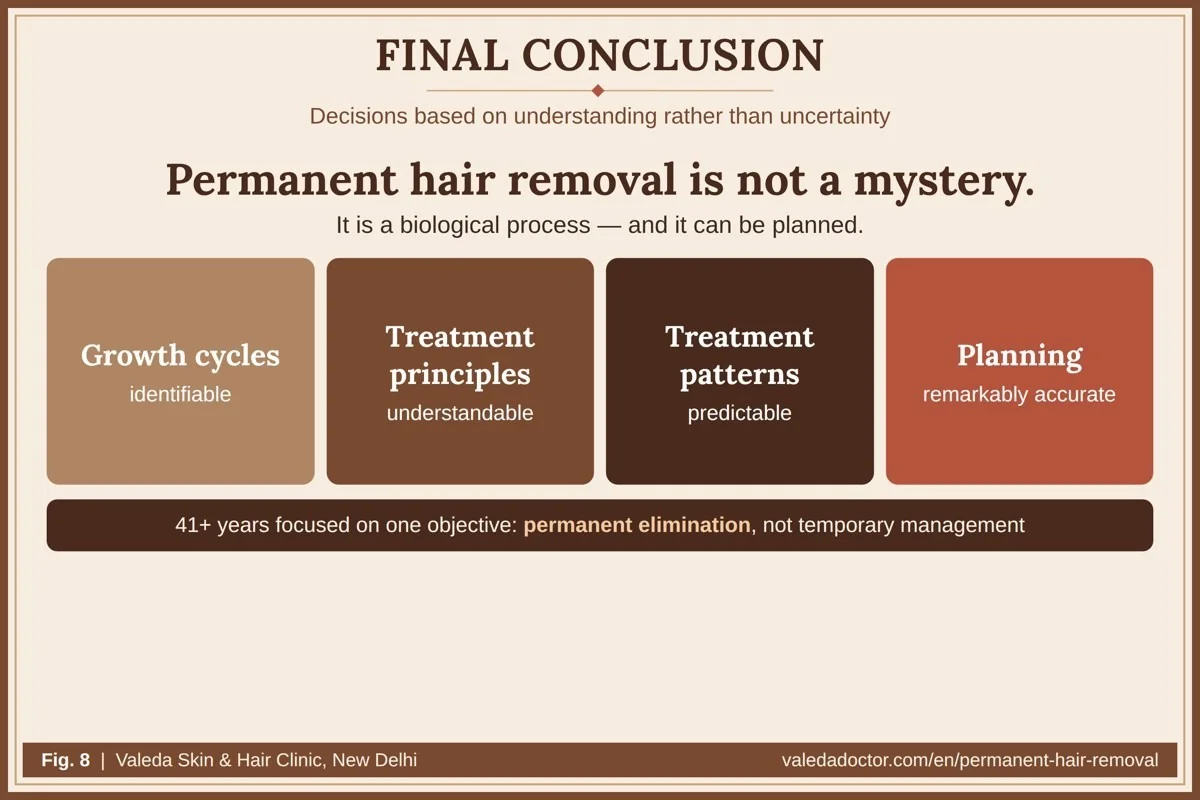
After reading this guide, one fact should now be clear: permanent hair removal is not a mystery. It is a biological process. It follows identifiable growth cycles, understandable treatment principles and predictable patterns — and when approached scientifically, it can be planned with remarkable accuracy.
The purpose of this guide was never to persuade you to undergo treatment. It was to help you understand why unwanted hair appears, why temporary methods fail, why clearances are needed, why thick new growth and thin regrowth occur, why duration and expenditure can be estimated, why payments can be planned — and why treatment planning matters, so that your decision rests on understanding rather than uncertainty.
For more than 41 years, Valeda Skin & Hair Clinic has stayed focused on one objective: permanent elimination of unwanted hair rather than temporary management. Countless people have come after repeated waxing, endless threading, years of tweezing, laser, paradoxical hypertrichosis, PCOD / PCOS / PMOS-related growth, white and grey hair, and failed electrolysis elsewhere. Managing such cases, again and again, is what shaped EBVHCM.
The Complete Guide in One Line
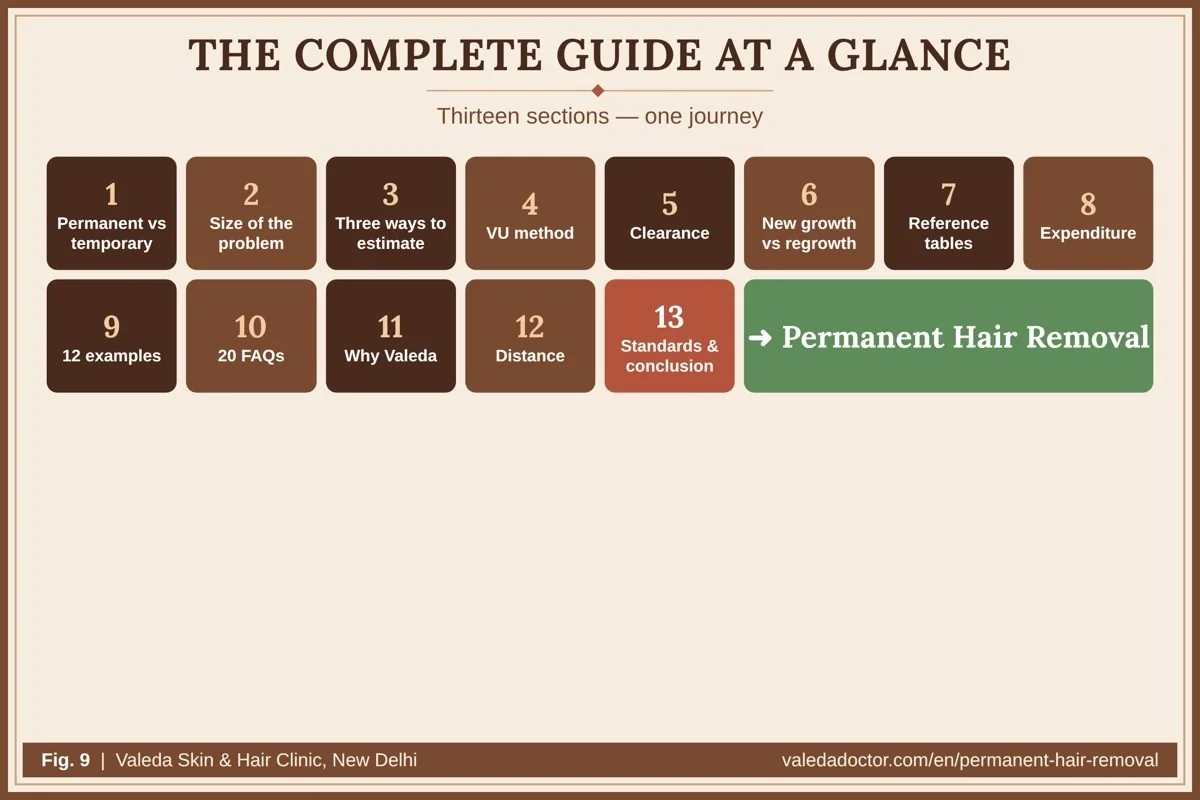
Temporary Methods ➜ Follicle Biology ➜ Hair Density ➜ VU Method ➜ Clearances ➜ Thick New Growth ➜ Thin Regrowth ➜ Duration Planning ➜ Cost Planning ➜ Payment Structures ➜ Offers & Packages ➜ 12 Practical Examples ➜ 20 FAQs ➜ Why EBVHCM ➜ Why Valeda ➜ Distance Does Not Matter ➜ Permanent Hair Removal.
Many people first arrive asking only: “What will it cost?” After understanding the subject, most realise the better question is: “What will it take to solve the problem permanently?” Cost then becomes a reflection of the biological work required — and with the right programme, the right payment structure and the right clinical partnership, it becomes both predictable and manageable.
Our Invitation to You
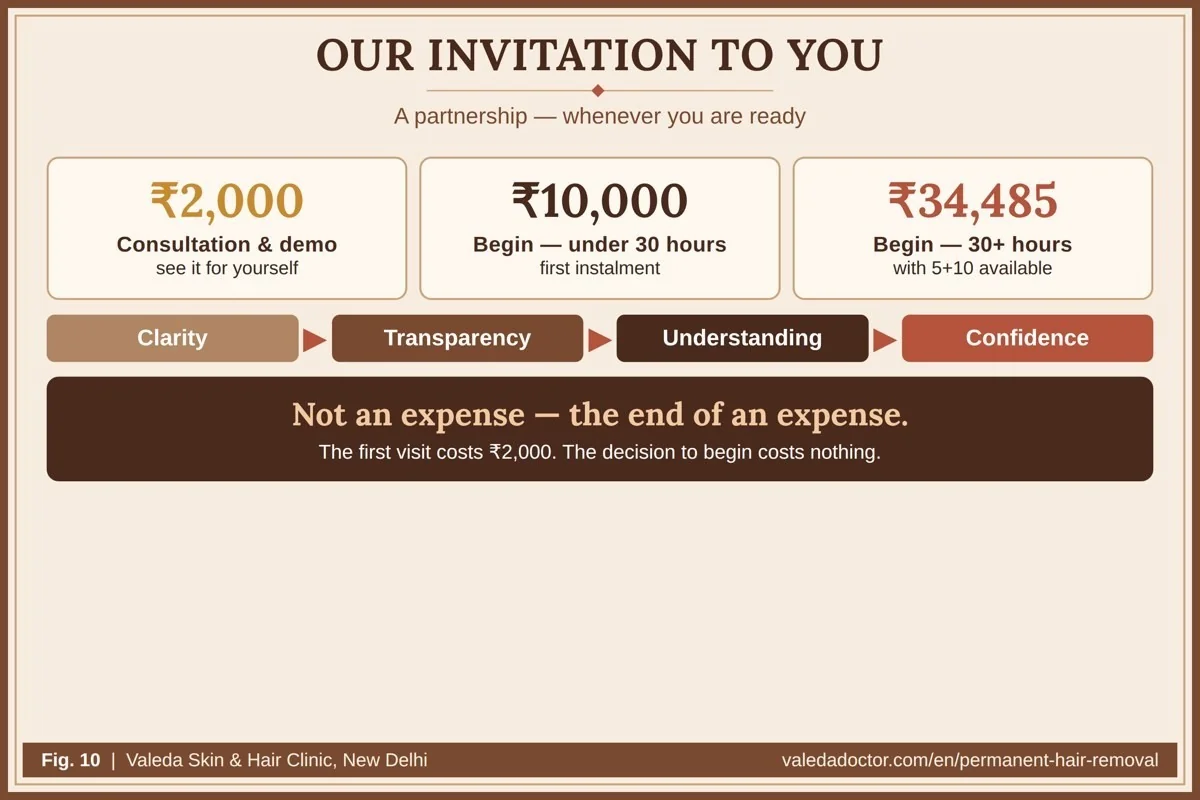
Permanent hair removal is a partnership between you and Valeda Skin & Hair Clinic: Better Understanding ➜ Better Compliance ➜ Better Results ➜ Greater Satisfaction. You do not need to solve the whole financial picture before beginning. Carry ₹2,000 for a consultation and procedure demonstration; ₹10,000 to begin a programme under 30 hours; or ₹34,485 to begin a 30+ hour programme with 5+10. Everything else is planned together at that first visit — come with your questions, your concerns, and your family if that helps.
Those who say “I cannot afford it” and walk away often return years later — with a more distorted case and more money already spent. Those who say “I cannot afford to keep doing this for ever” and begin are the ones who reach the end of the programme and stop thinking about their hair. Whether you choose to visit today, next month or next year, we hope this guide helps you decide with knowledge and confidence: Clarity ➜ Transparency ➜ Understanding ➜ Confidence.
The first visit costs ₹2,000. The decision to begin costs nothing. Permanent hair removal is not an expense — it is the end of an expense.
SUMMARY — SECTION 13 — INTERNATIONAL STANDARDS & FINAL CONCLUSION
International standards: AEA since 1990 (two members), IGPE since 1992, CIDESCO practice standards.
Professional background: Dr. Seema Bali’s 41+ years of clinical leadership; Rajesh Bali’s scientific and formulation foundation (PGDIFAT 1983, cosmetic expert since 1989).
Electrolysis vs laser: electrolysis is permanent hair removal; laser is permanent hair reduction and cannot treat white hair.
Affordability: temporary methods often cost as much over the years; EBVHCM is about four times more effective; ₹2,000 per hour under offer; instalments; nothing treated is lost.
Final Conclusion: permanent hair removal is not a mystery — it can be planned. It is a partnership, and not an expense but the end of one.