
Cost & Duration · Section 10 of 13
Cost & Duration of Permanent Hair Removal
Section 10 — 20 Frequently Asked Questions About Duration & Cost: The Questions People Actually Ask
SECTION 10 — 20 Frequently Asked Questions About Duration & Cost
The Questions People Actually Ask
Over more than four decades, the doctors at Valeda Skin & Hair Clinic have noticed a consistent pattern. Even people who have read everything — the science, the clearance concept, the examples — arrive with questions the written material did not quite answer. Not because the material was incomplete, but because some questions only crystallise when a real decision is being made. This section answers the 20 questions most often asked by people seriously considering treatment — honestly.
More FAQs on PCOD / PCOS / PMOS, electrolysis, white hair, laser hair reduction, treatment safety, beard hair, hirsutism and paradoxical hypertrichosis are in the comprehensive FAQ section of the Valeda website.
FAQ 1 — Why Can Permanent Hair Removal Not Be Completed in One Sitting?
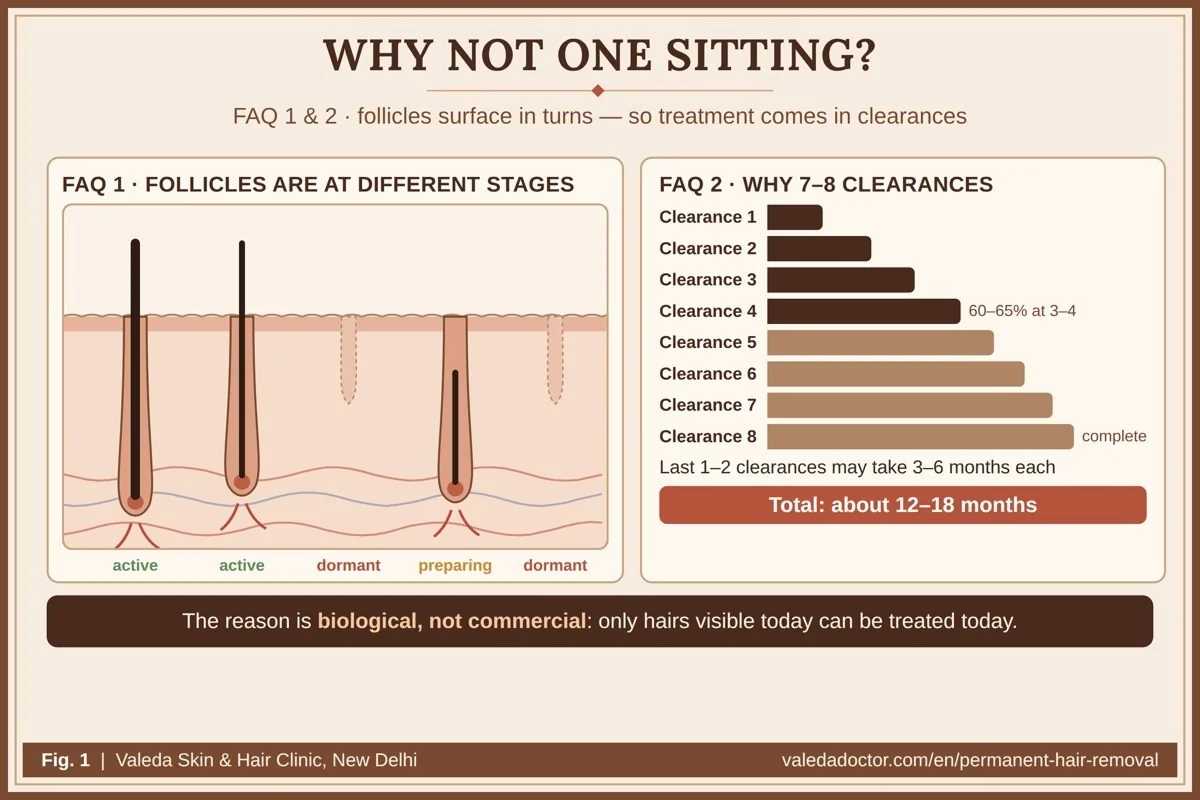
After years of temporary methods that had to be repeated endlessly, it can feel disappointing that permanent hair removal also needs several sessions. The reason is biological, not commercial. At any moment some follicles are active, some resting, some dormant and some preparing to grow. EBVHCM can permanently treat only the follicles whose hairs are visible and available today. The dormant ones surface over the coming months — and they too must be treated.
FAQ 2 — Why Are 7–8 Clearances Generally Required?
Four decades of records at Valeda Skin & Hair Clinic show that 3–4 clearances usually bring visible results — by then approximately 60–65% of the targeted follicles are permanently treated — and that 7–8 clearances allow most active follicles to complete their cycle. In cases with a history of pulling, the 2nd and 3rd clearances are often longer than the first, as left-over and resting hairs surface. The last 1–2 clearances may each take 3–6 months, because the final hairs appear slowly. This is why the complete programme is planned over approximately 12–18 months. Some patients see permanence earlier — but 7–8 is the number that matches the biology.
FAQ 3 — What Exactly Is a Clearance?
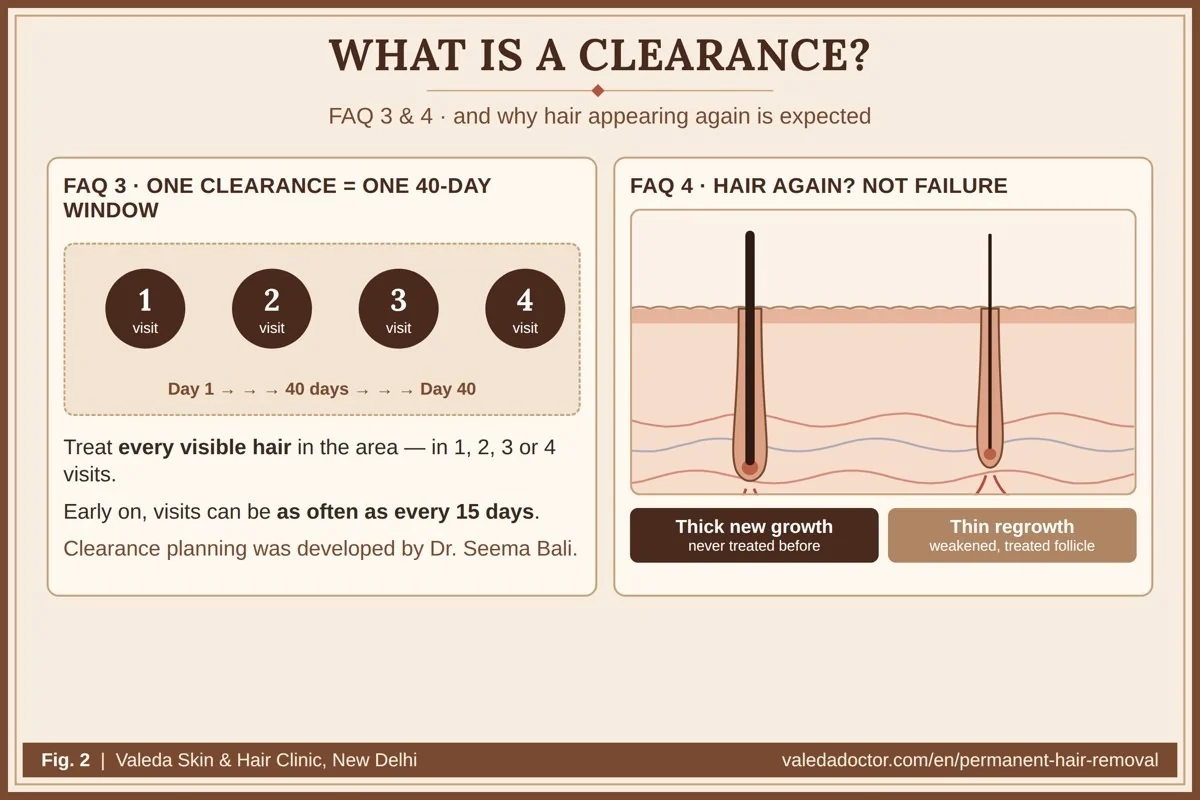
A clearance means treating all hairs that are visible and available in a skin area within a 40-day biological cycle — however many visits that takes. One clearance may need 1, 2, 3 or 4 visits, depending on the size of the crop and your schedule; in the early months, visits can be as often as every 15 days. The term, and the method of planning by clearances, were developed by Dr. Seema Bali. (Full explanation in Section 5 — Understanding Clearance.)
FAQ 4 — Hair Is Appearing Again After My Treatment. Has the Treatment Failed?
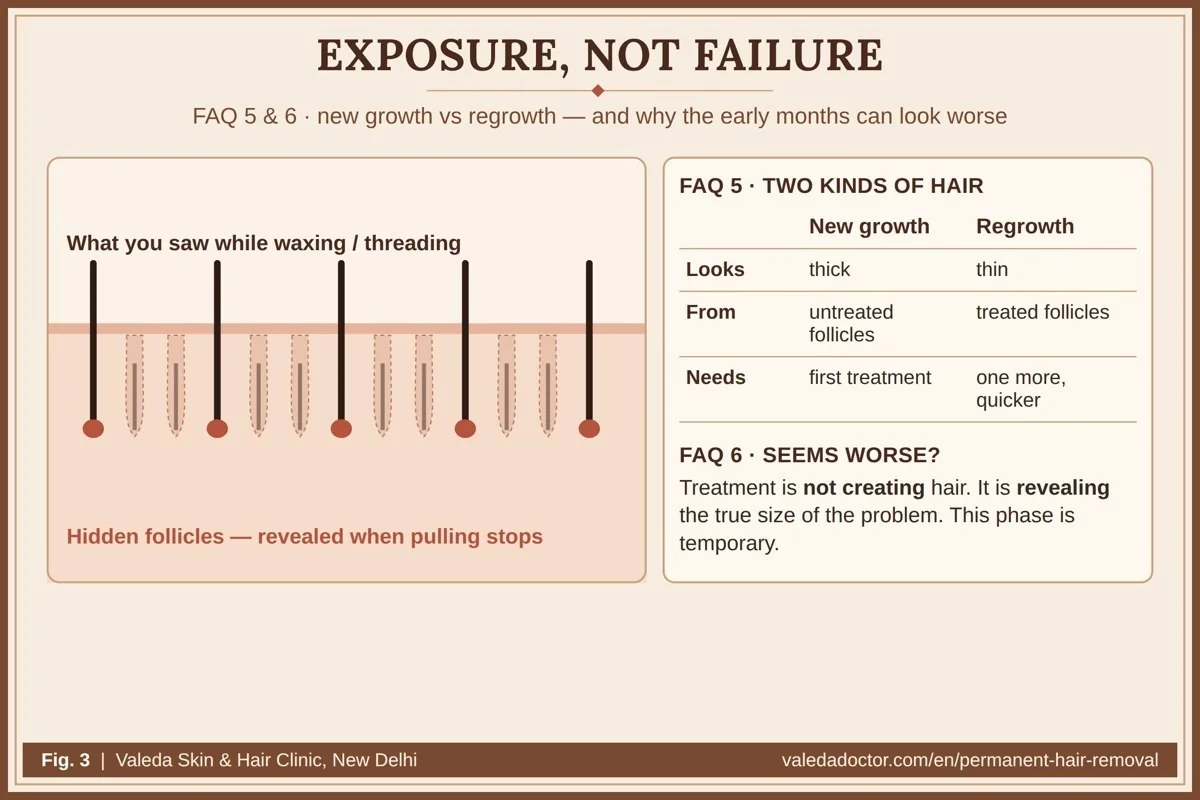
No. This is one of the most important reassurances in this whole guide. Hair appearing after a clearance is an expected biological event. The new hairs are of two kinds: thick new growth — follicles that were dormant, or suppressed by waxing and threading, now appearing for the first time — and thin regrowth — weaker hairs from treated follicles where a few germinal cells survived. Both are expected; neither means failure.
FAQ 5 — What Is the Difference Between New Growth and Regrowth?
| Thick New Growth | Thin Regrowth | |
|---|---|---|
| Appearance | Usually thick | Usually thin |
| Origin | Previously untreated follicles | Previously treated follicles |
| Why it appears | Dormant follicles activating | Surviving germinal cells |
| What to expect | First-time treatment | One more, quicker treatment |
Understanding this difference removes much of the anxiety of the early months. (Section 6.)
FAQ 6 — Why Does My Problem Seem to Have Increased Since I Started Treatment?
This can be the most emotionally difficult phase — and the doctors take it seriously. When treatment begins, you stop waxing, threading, tweezing and plucking. The follicles those methods were hiding now appear naturally. Treatment is not creating hair; it is revealing the true size of a problem that was always there. This phase is temporary — please do not feel that the sky is falling. Your doctor will guide you through it.
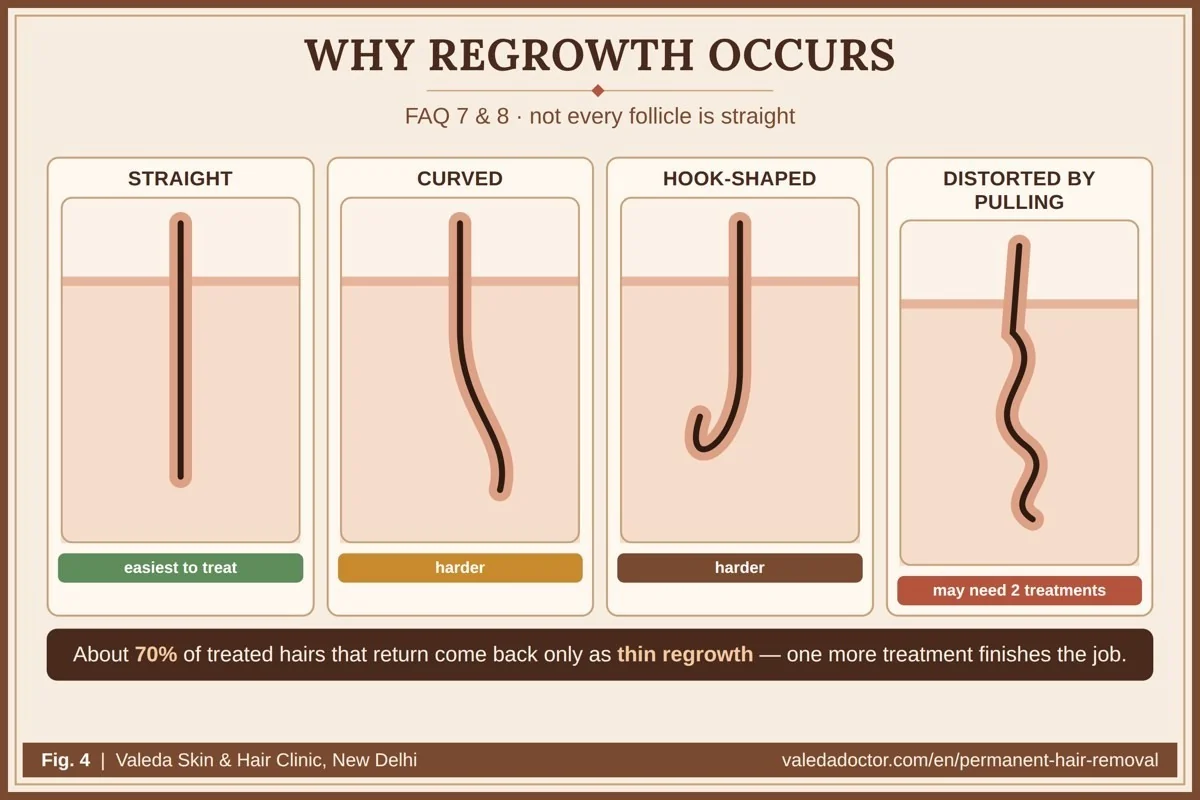
FAQ 7 — Why Does Regrowth Occur?
Not every follicle is straight. Many are curved, hook-shaped, helical, embedded or distorted by years of pulling. Sometimes a few germinal cells survive the first treatment and produce a new, weaker hair. In our experience, approximately 70% of treated hairs that return come back only as thin regrowth. That is not a sign that treatment failed — it shows the follicle was substantially weakened, and one more treatment finishes the job.
FAQ 8 — Why Do Some Follicles Need More Than One Treatment?
Follicles distorted by waxing, threading, tweezing, plucking or long-term hormonal influence often have curved or irregular shapes that make complete first-pass treatment harder. This is a normal biological reality — and one reason why people with a long history of tampering need more clearances than those whose hair was never pulled. It is also why the Factor-of-8 applies to pulled hair (Section 3).
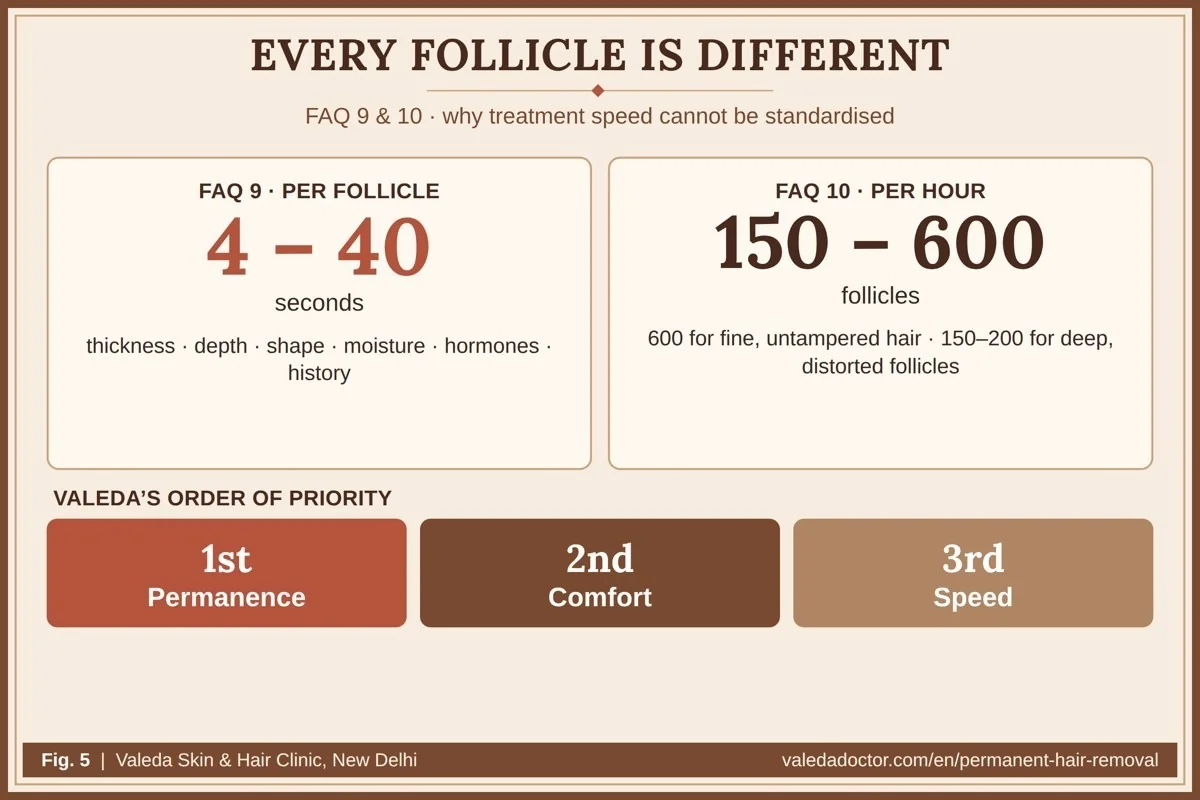
FAQ 9 — Why Does One Follicle Take 4 Seconds and Another 40 Seconds?
Because every follicle is different. Thickness, depth, shape, moisture, hormonal influence and treatment history vary from follicle to follicle — sometimes dramatically. A single follicle may need approximately 4 to 40 seconds for proper treatment. This is why treatment speed cannot be standardised across patients the way laser sessions are.
FAQ 10 — How Many Hairs Can Be Treated per Hour?
Under practical clinical conditions, approximately 150 to 600 follicles per hour. Fine upper-lip hair in an untampered case may allow 600 per hour; deep, distorted follicles in a long-term waxing case may allow only 150–200. What matters is not how many hairs were treated in an hour, but how many were permanently treated. Valeda Skin & Hair Clinic's order of priority: Permanence first, Comfort second, Speed third.
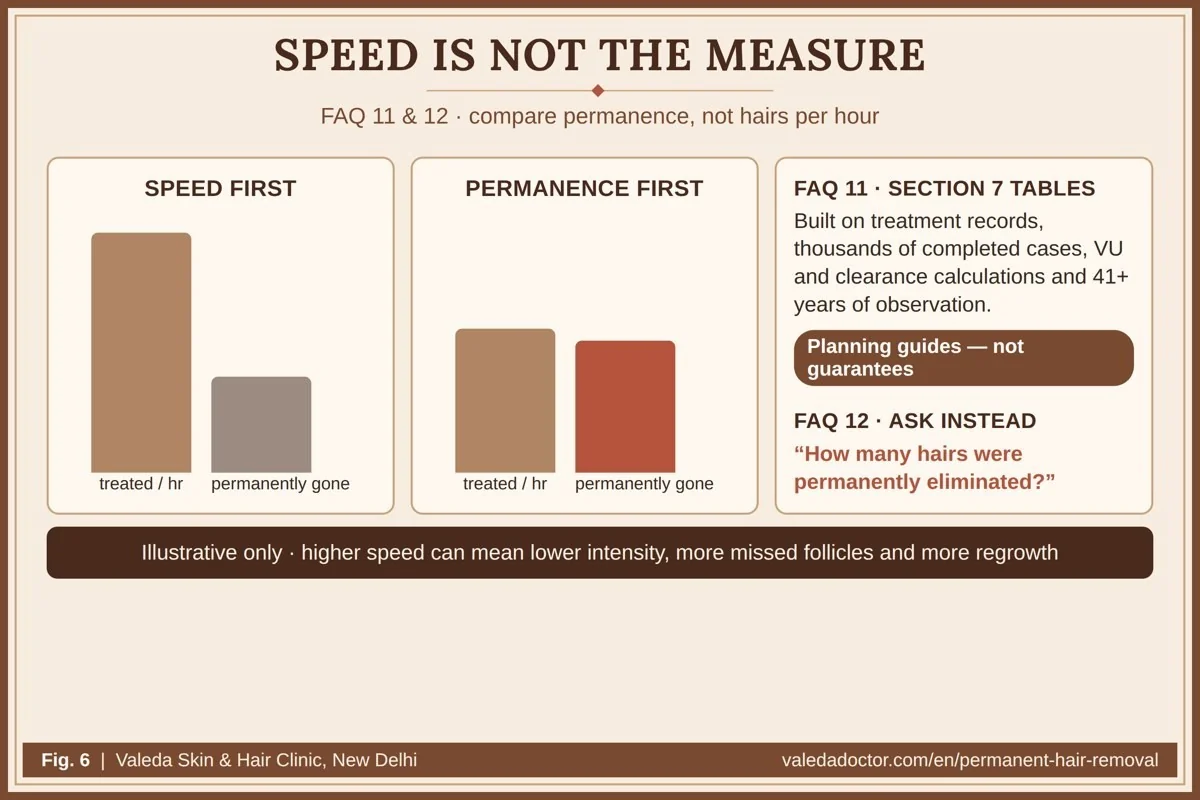
FAQ 11 — How Accurate Are the Duration Tables in Section 7?
The tables in Section 7 are built on actual treatment records, thousands of completed cases, Valeda Unit (VU) and clearance calculations, and more than 41 years of clinical observation. They are planning guides — not guarantees. Individual variation exists, but they are among the most reliable references available in electrology practice in India today.
FAQ 12 — Should I Compare Clinics by How Many Hairs They Treat per Hour?
Not if you want a permanent result. The more meaningful question is: How many hairs were permanently eliminated? Higher speed does not mean a better outcome — it can mean lower intensity, more missed follicles and more regrowth. Speed alone is the wrong measure.
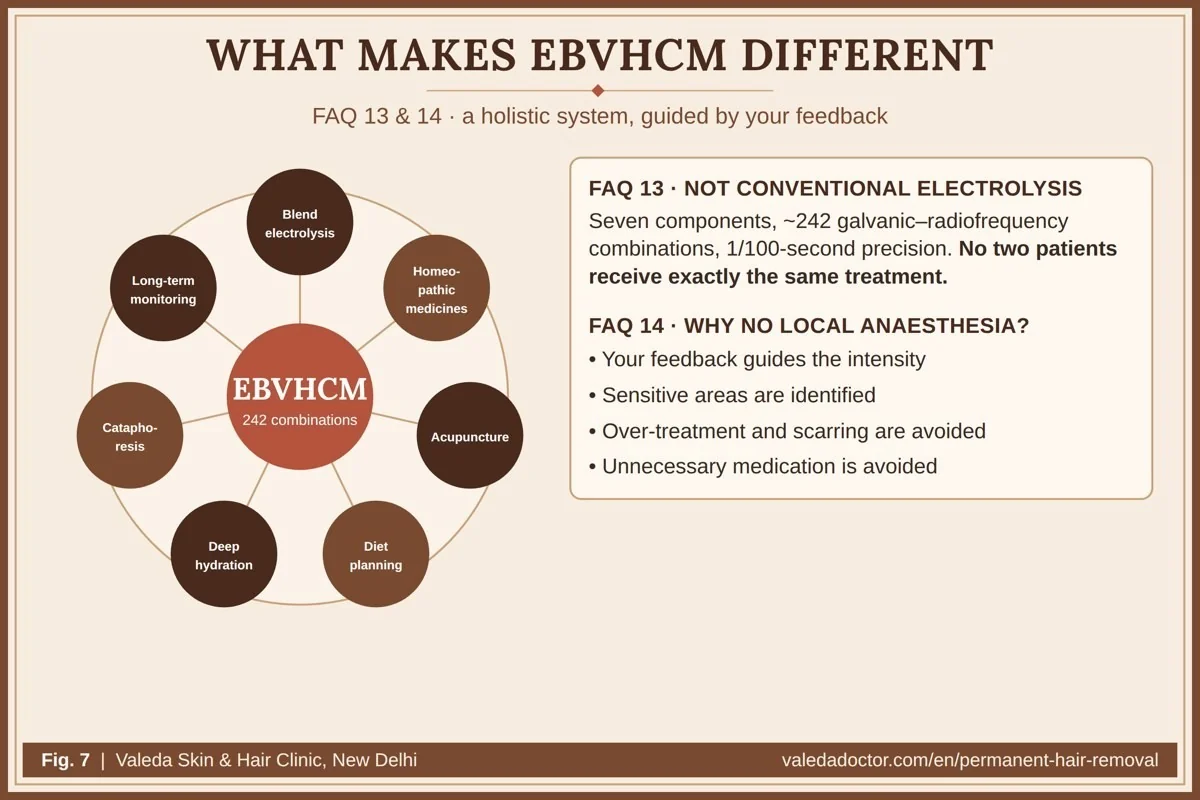
FAQ 13 — Why Does Valeda Believe EBVHCM Gives Better Results Than Conventional Electrolysis?
Because EBVHCM is not conventional electrolysis. It integrates:
- Blend electrolysis (galvanic + thermolysis)
- Constitutional homeopathic medicines
- Acupuncture
- Constitutional diet planning
- Deep hydration through mucopolysaccharides
- Cataphoresis neutralisation
- Long-term biological monitoring
In addition, approximately 242 galvanic–radiofrequency combinations may be used according to individual needs, on international equipment working to a precision of 1/100 of a second. No two patients receive exactly the same treatment.
FAQ 14 — Why Is Local Anaesthesia Generally Not Recommended?
Because it removes valuable feedback. What you feel during treatment helps the electrologist calibrate intensity, identify sensitive areas and avoid over-treatment. Local anaesthesia can encourage over-treatment, which increases the risk of unnecessary tissue injury and avoidable scarring. Wherever practical, unnecessary medication is avoided.
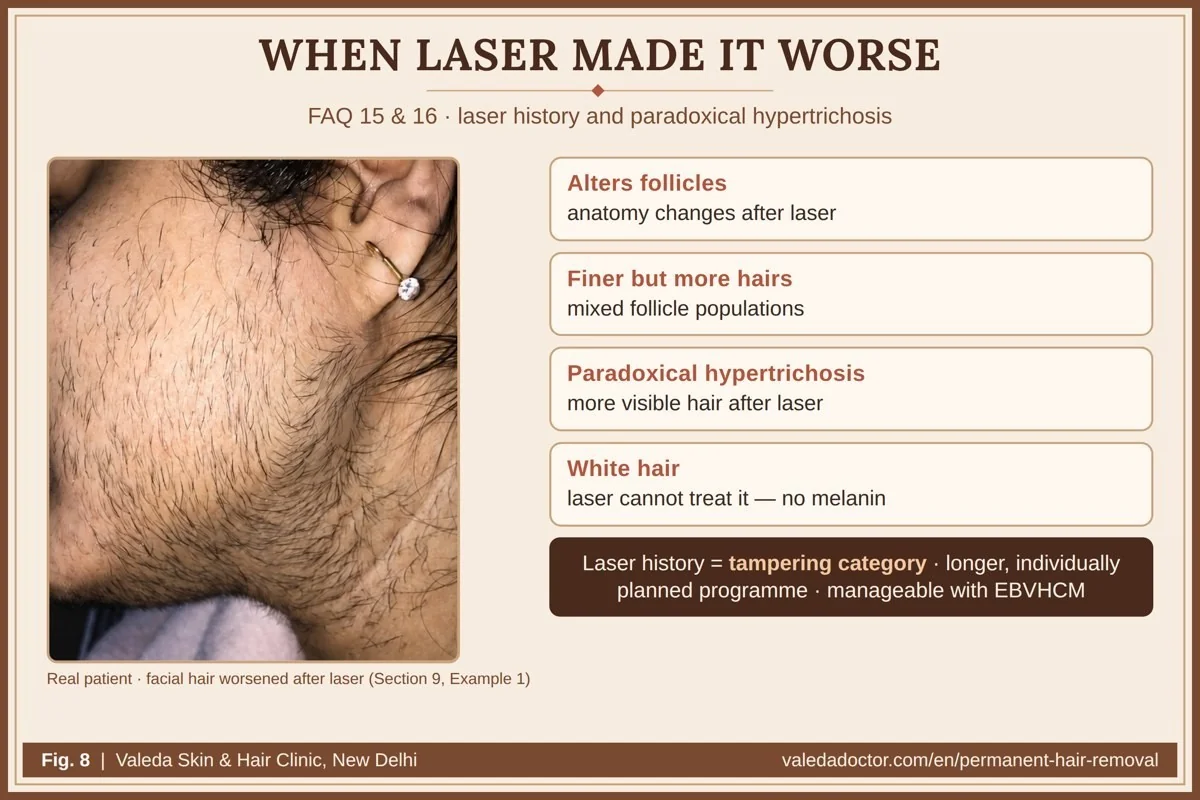
FAQ 15 — Can Previous Laser Sessions Affect My Duration?
Yes — significantly. Laser may alter follicular anatomy, produce finer but more numerous hairs, create mixed follicle populations and occasionally contribute to paradoxical hypertrichosis. Laser also cannot treat white or grey hair, because there is no melanin to absorb its energy. Laser-history cases are planned individually and always fall in the tampering category, with longer programmes — as in Example 1 of Section 9. They are among the cases most frequently managed at Valeda Skin & Hair Clinic.
FAQ 16 — What Is Paradoxical Hypertrichosis?
Paradoxical hypertrichosis is an increase in visible hair growth after laser treatment: previously fine, dormant or barely visible follicles begin producing thicker, more noticeable hair. Valeda Skin & Hair Clinic has managed such cases for decades with EBVHCM. If this has happened to you, please know that it is a recognised clinical phenomenon, it is manageable — and you are not alone.
FAQ 17 — Why Does the Neck Take So Much More Time Than I Expected?
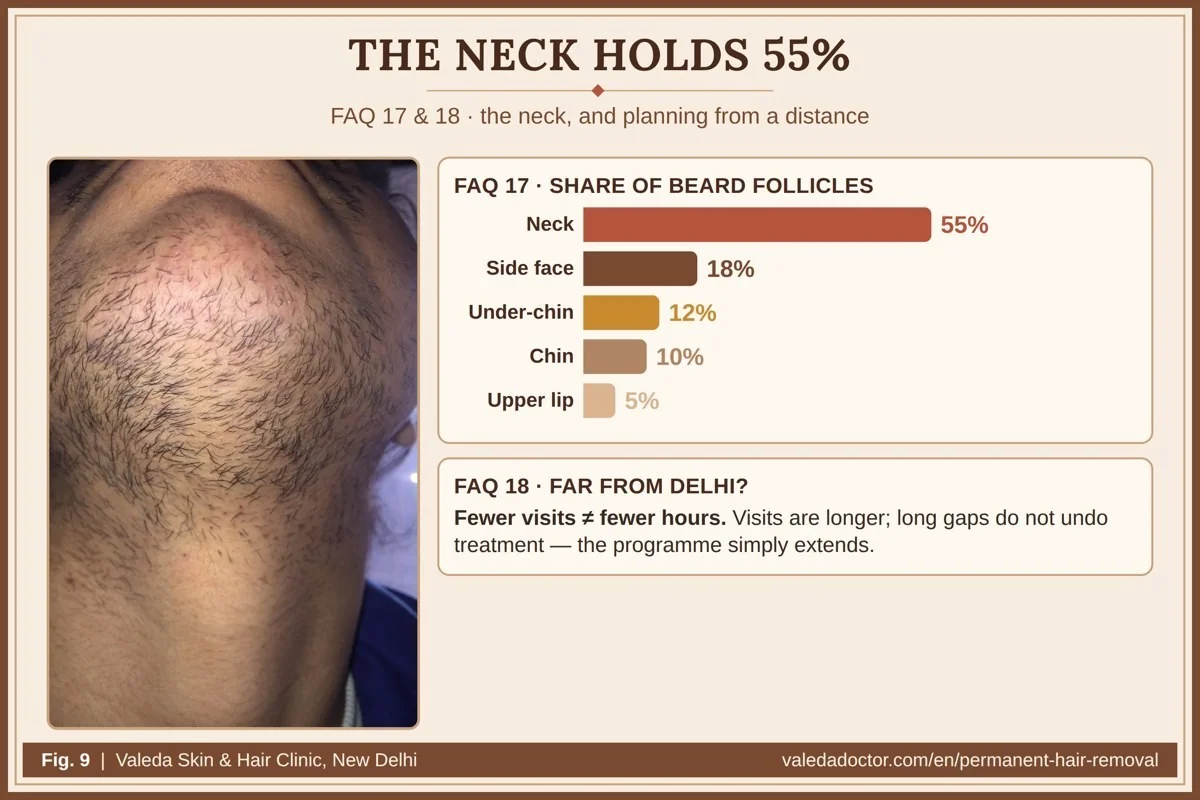
Because the neck holds approximately 55% of all follicles in the complete beard area: Neck 55% ➜ Side Face 18% ➜ Under-Chin 12% ➜ Chin 10% ➜ Upper Lip 5%. Most people seeking complete beard or complete facial hair removal underestimate the neck until they see this distribution — one of the most important numbers in Section 7.
FAQ 18 — I Live Far From Delhi. Can I Reduce the Number of Visits?
Yes. Schedules are customised for long-distance patients. But fewer visits does not mean fewer hours: the total follicle burden stays the same. Larger crops accumulate between visits, so each visit is longer. Long gaps do not undo the treatment already done — the programme simply extends in proportion. Total hours and cost stay broadly similar; only the pattern of visits changes. (Section 12 — Distance Does Not Matter.)
FAQ 19 — Can My Actual Expenditure Be Lower Than the Table Estimates?
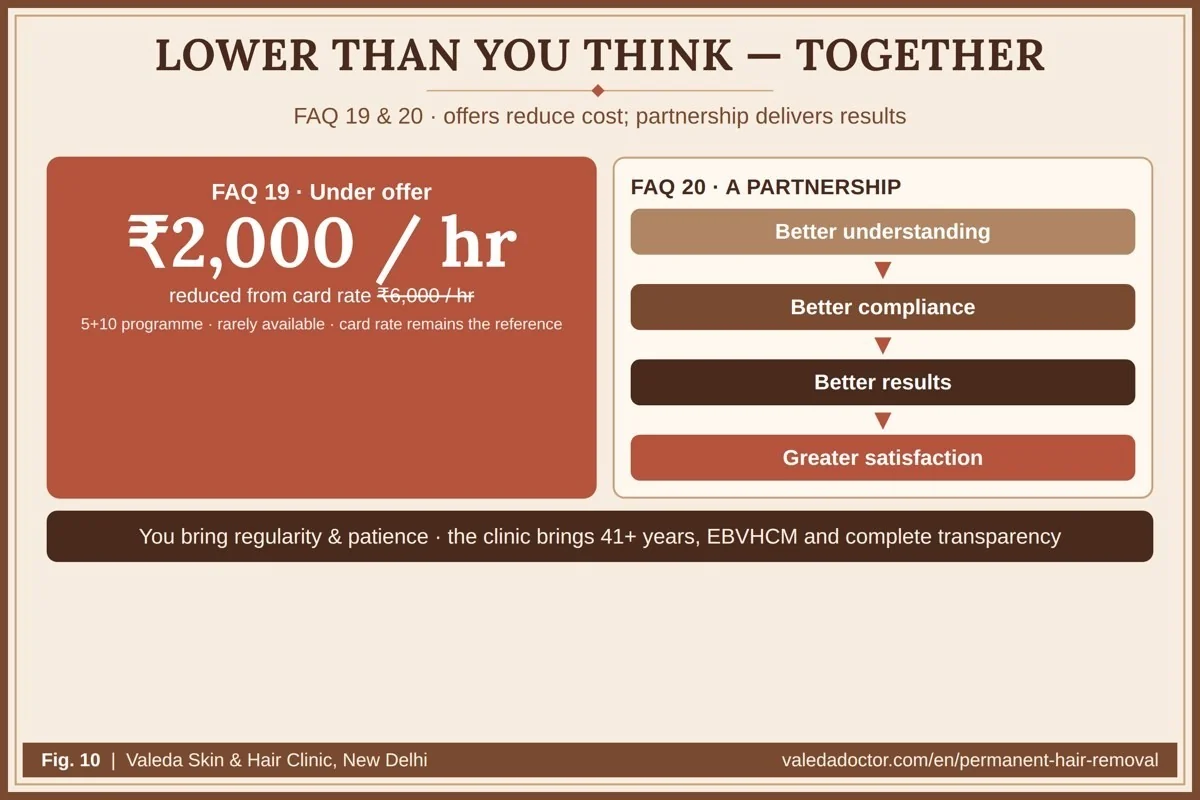
Yes — often substantially lower. Under offer, the 5+10 Introductory Programme brings the rate down to ₹2,000 per hour, reduced from the card rate of ₹6,000 per hour; the Inoculation Privilege (₹2,400 per hour), promotional packages and instalments also help. These offers are rarely available, and the card rate remains the reference under the Card Rate Safety Rule. The 12 real examples of Section 9 show exactly how this works — each budget being the complete projection for a 12–18-month programme, paid in stages, never in one go.
FAQ 20 — What Is the Most Important Thing to Understand Before Beginning?
Permanent hair removal is a partnership between you and Valeda Skin & Hair Clinic. You bring regularity, compliance, willingness to follow the constitutional diet plan, willingness to stop temporary methods, and patience through the early months. The clinic brings 41+ years of clinical experience, the EBVHCM system, constitutional medicines, dietary guidance, and the transparency of this entire guide.
Better Understanding ➜ Better Compliance ➜ Better Results ➜ Greater Satisfaction. The information in this guide is not just reading material — it is the first part of the treatment itself.
SUMMARY — SECTION 10 — 20 FAQS
Multiple clearances: a biological necessity, not commercial convenience — 7–8 clearances over approximately 12–18 months; visible results at 3–4.
Early months: a problem that seems worse is exposure, not failure. Thick new growth and thin regrowth are both expected.
Speed is not the measure: permanence is — 4 to 40 seconds per follicle, 150–600 follicles per hour.
Laser history: lengthens the programme and can cause paradoxical hypertrichosis; laser cannot treat white hair.
Neck and distance: the neck holds 55% of beard follicles; long-distance patients can reduce visits, not hours.
Cost: under offer ₹2,000 per hour instead of the ₹6,000 card rate — and the most important thing is partnership.