Cost & Duration · Sections 1 & 2 of 13
Cost & Duration of Permanent Hair Removal
Sections 1 & 2 — Permanent vs Temporary Hair Removal, and the True Size of Your Hair Problem
SECTION 1 — Permanent Hair Removal Is Not the Same as Temporary Hair Removal
If You Are Reading This, You Already Know
You already know that threading every few days does not solve the problem. You already know that waxing every week creates a dependence that seems to deepen with time. You may know — from personal experience — that laser sessions that promised permanence delivered something considerably less.
You are reading this page because you are looking for something different. Something that actually ends the problem rather than managing it indefinitely. This chapter was written for you.
Before discussing hours, costs and programmes, it is worth understanding exactly why temporary methods fail — not because it is scientific reading, but because understanding this will help you recognise what is genuinely different about permanent hair removal through EBVHCM at Valeda Skin & Hair Clinic.
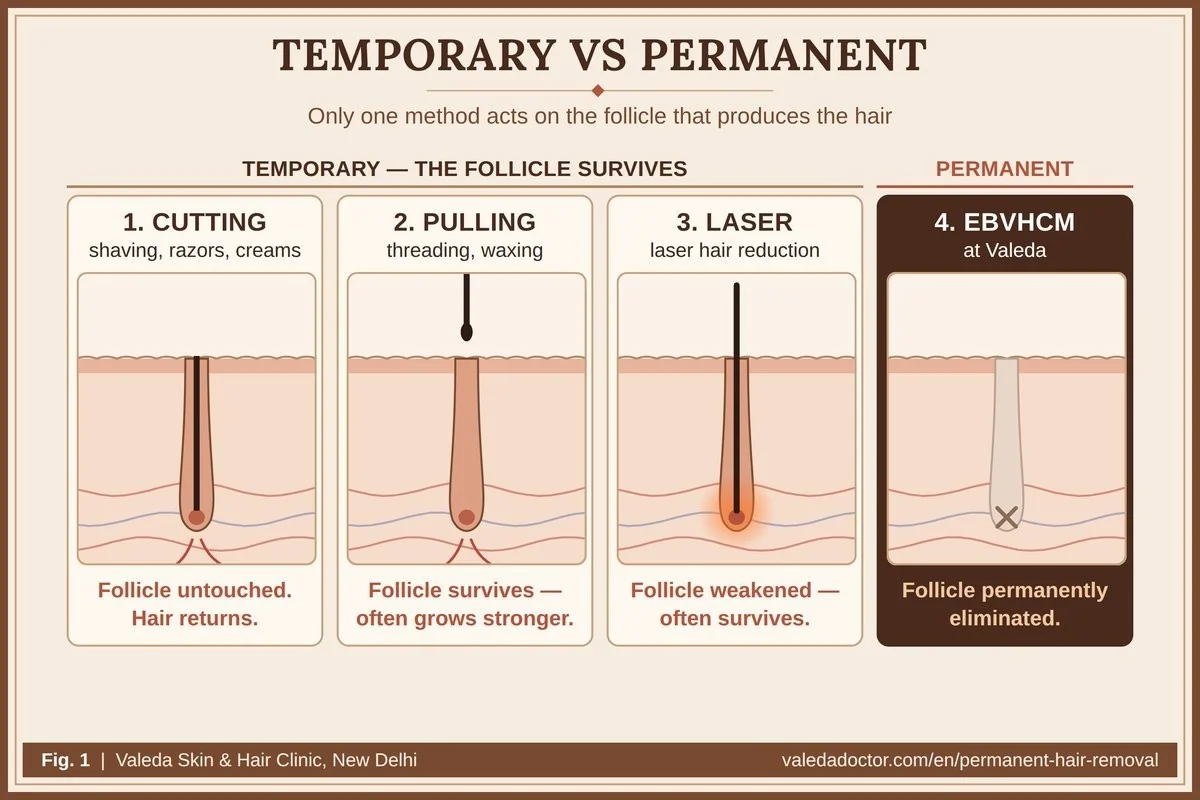
Temporary methods may remove the visible hair for a short period, but they do not permanently eliminate the follicle responsible for producing it. Permanent hair removal aims at the permanent destruction of the follicle itself. That distinction — simple as it sounds — changes everything about how duration and cost are understood.
For practical understanding, temporary hair removal methods may broadly be divided into three categories: cutting, pulling and laser hair reduction.
Category 1 — Cutting Methods
Examples: Scissors, Trimmers, Razors, Shaving, Chemical Shaving Creams, Depilatory Creams and Hair Removal Creams.
To understand why these methods are temporary, we must first understand the structure of hair itself. Hair is essentially a keratinized integumentary structure. Contrary to common belief, the hair is biologically dead from the moment it is formed.
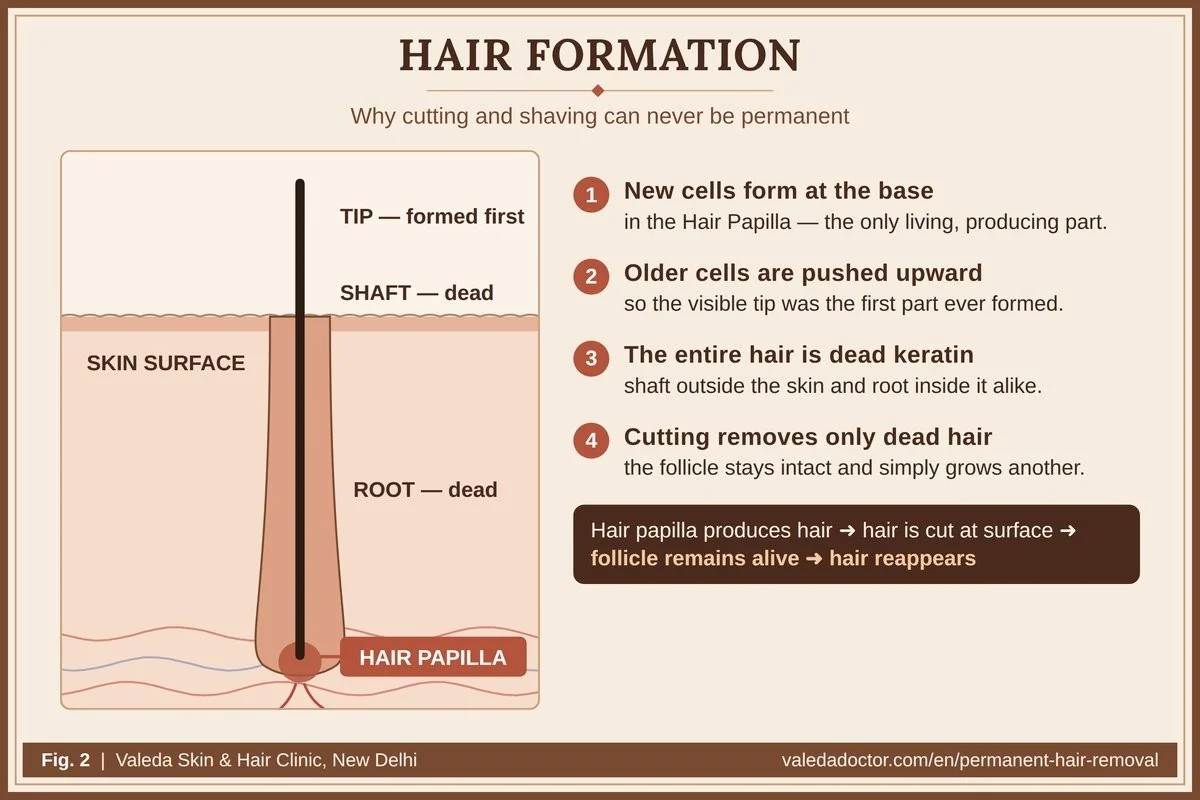
Hair formation begins at the base of the follicle in a specialised structure known as the Hair Papilla. New cells are continuously added at this level. As newer cells are formed, the previously formed portion is pushed upwards. Consequently:
- The tip of the hair visible outside the skin was the first part to be formed
- The shaft visible outside the skin is dead
- The root portion lying inside the skin is also dead
- The entire hair structure — whether cut or pulled — is a dead keratinized structure
Therefore, when shaving or cutting is performed, only the visible dead portion of the hair is removed. The follicle remains completely intact and simply produces another hair. The hair reappears.
Why Shaving Particularly Frustrates Women
When the skin is stretched and the hair is cut at surface level, the area may temporarily feel smooth. But as the skin returns to its natural position, the cut end of the hair begins emerging again. This commonly produces stubble, stud-like projections, rough texture and a shadow effect.
While this may be socially acceptable for many males, women seeking smooth, unblemished skin find it deeply unsatisfactory. Not because they are asking for too much — but because the method is fundamentally incapable of delivering what they need.
Hair Papilla Produces Hair ➜ Hair Is Dead Keratin Structure ➜ Hair Is Cut At Surface ➜ Follicle Remains Alive ➜ Hair Reappears
Category 2 — Pulling Methods
Examples: Threading, Tweezing, Plucking, Pulling With Fingernails, Waxing, Hot Wax, Cold Wax, Brazilian Wax, Sugar Wax, Katauri Wax, Honey Preparations, Besan Preparations, Atta Preparations, Multani Mitti Preparations, Homemade Pulling Mixtures and Pumice Stones.
In all these methods, the entire dead hair structure is forcibly pulled out of the follicle. Although the area may appear clear immediately after, the follicle itself remains alive — and interprets this sudden extraction as a signal requiring repair and replacement.
The Trap That Tightens Over Time
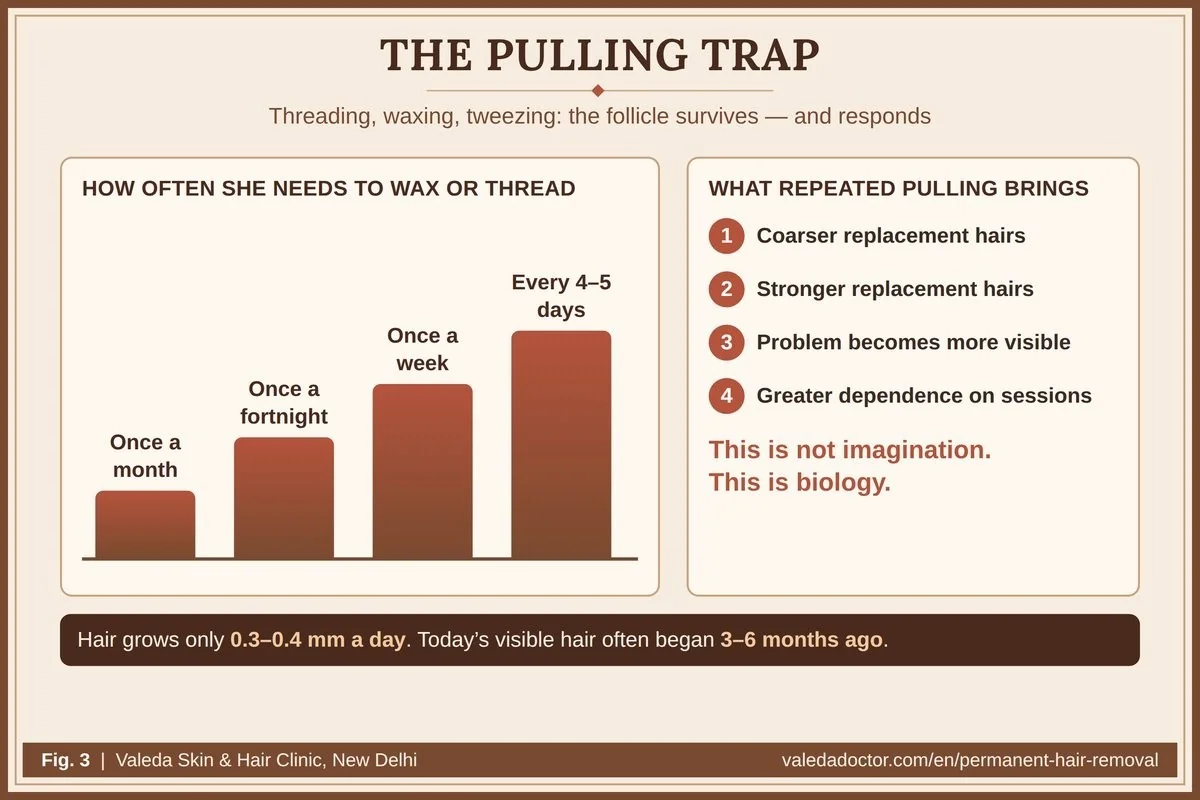
This is the pattern that so many individuals recognise in their own lives: what began as waxing once a month became once a fortnight. Once a fortnight became once a week. And for many individuals with hormonal conditions or a long history of pulling — once a week becomes every four or five days. This is not imagination. This is biology.
The doctors and experts at Valeda Skin & Hair Clinic have repeatedly observed that the repair response triggered by repeated pulling is often associated with increased local blood circulation, improved nutritional supply and increased biological activity within susceptible follicles. Over time, this contributes to coarser replacement hairs, stronger replacement hairs, increased visibility of the problem and greater dependence upon repeated sessions. The waxing is not solving the problem. In many cases, it is slowly making it worse.
An Important Biological Reality
Human hair grows approximately 0.3–0.4 millimetres per day. The visible crop appearing one week after waxing is generally not the same crop removed one week earlier. Depending upon the body area, a follicle may require three to six months before the newly produced hair becomes externally visible. Therefore the hairs you see today frequently represent follicles that were stimulated several months ago.
This concept becomes extremely important when understanding why treatment takes multiple clearances rather than a single session. (For a full explanation of Clearance and Clearance Cycles, refer to: Section 5 — Understanding Clearance)
Dormant Follicles — The Hidden Problem
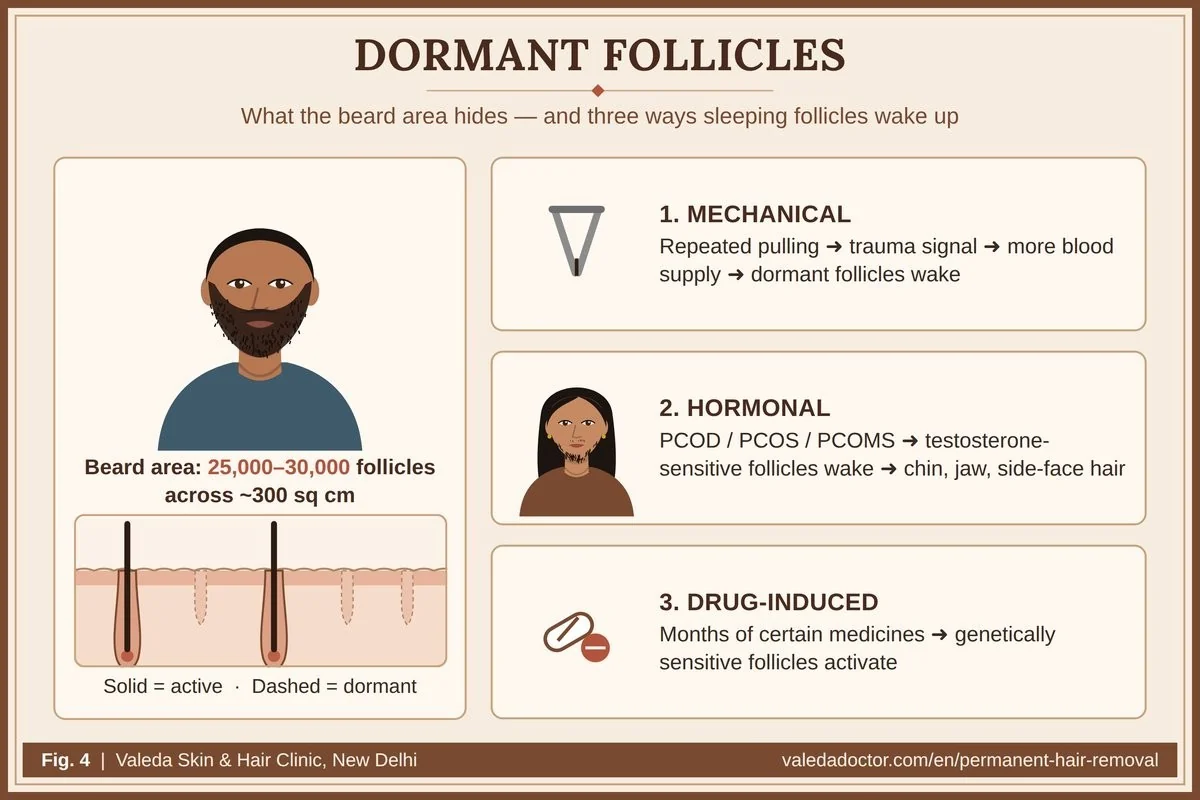
A significant proportion of follicles remain dormant or inactive at any given time. For example, a complete beard area may contain approximately 25,000–30,000 terminal follicles across approximately 300 square centimetres of skin — but a substantial percentage remain dormant and invisible. The doctors at Valeda Skin & Hair Clinic have repeatedly observed that dormant follicles may become activated through three mechanisms.
1. Mechanical Stimulation
Repeated waxing, threading, tweezing and plucking may stimulate increased follicular activity in susceptible individuals.
Mechanical Pulling ➜ Trauma Signal ➜ Hyperemia & Increased Blood Supply ➜ Nutritional Availability ➜ Activation Of Susceptible Follicles ➜ Coarser, Deeper & Distorted Hair Growth
2. Hormonal Stimulation
Testosterone-sensitive follicles may become activated when hormonal influences exceed physiological limits. This is one reason why individuals suffering from PCOD (Polycystic Ovarian Disease), PCOS (Polycystic Ovary Syndrome) or PCOMS (Polycystic Ovarian Morphology Syndrome) may experience progressive unwanted hair growth.
Hormonal Disturbance ➜ Testosterone-Sensitive Follicles ➜ Dormant Follicle Activation ➜ Terminal Hair Formation ➜ Progressive Unwanted Hair Growth
3. Drug-Induced Stimulation
Certain medicines taken continuously for several months may activate follicles genetically sensitive to that particular drug.
Long-Term Drug Exposure ➜ Sensitive Follicular Population ➜ Follicular Activation ➜ Increased Hair Growth
Category 3 — Laser Hair Reduction
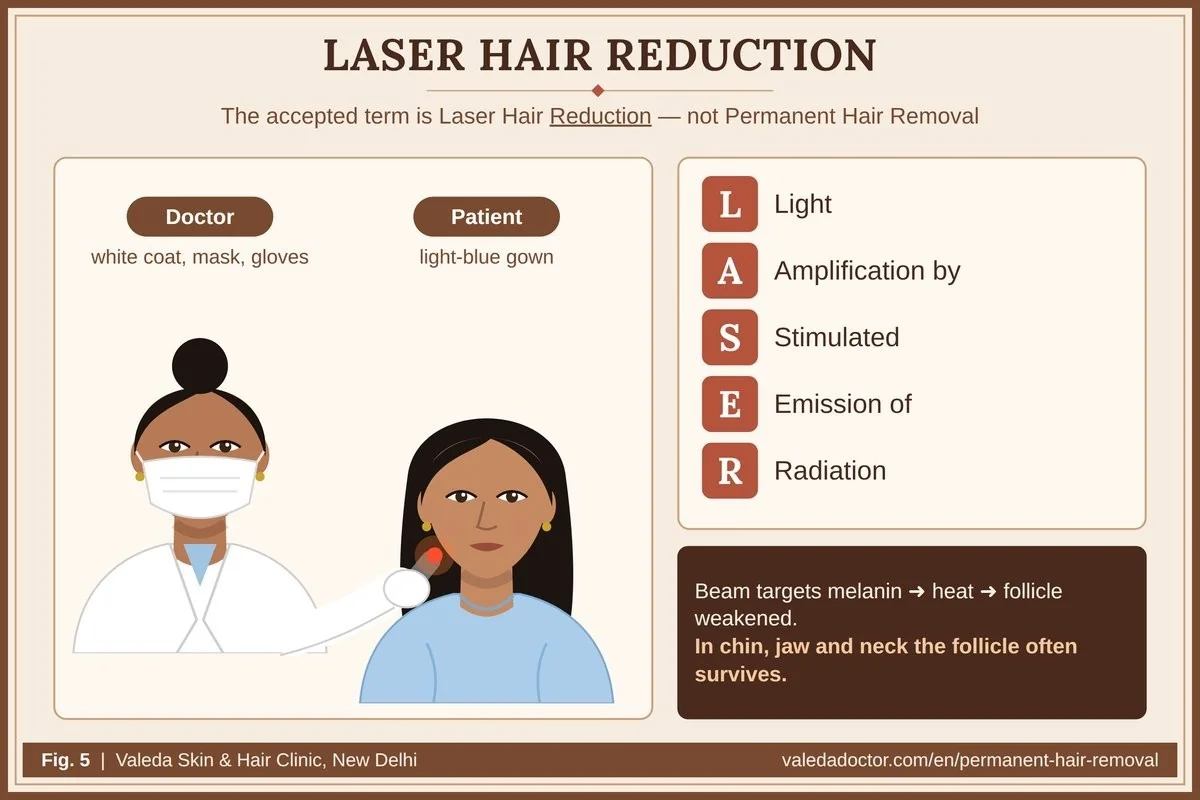
Laser technology represented a genuine advancement when it began being used for hair reduction in the mid-1990s. Valeda Skin & Hair Clinic also utilises laser technology where appropriate and where it is likely to benefit the individual. But here is what the laser industry does not always say clearly: the accepted term is Laser Hair Reduction — not Permanent Hair Removal.
Laser is not wrong. Expecting permanence from laser is wrong.
Laser serves a useful purpose as a substitute for waxing and threading in appropriate cases. For many individuals it reduces the frequency of temporary hair removal significantly. It is therefore best understood as an advanced temporary hair removal method — not a permanent solution.
LASER stands for Light Amplification by Stimulated Emission of Radiation. The beam targets melanin pigment within the hair. The absorbed energy converts into heat. The heat may weaken the follicle and reduce future hair production.
But in many situations — particularly in testosterone-sensitive areas like Chin, Under-Chin, Side Face, Beard Area and Neck — the generated heat does not completely eliminate all follicular germ cells. The follicle survives. The hair returns. And repeated sessions create a cycle of expectation and disappointment that many individuals at Valeda Skin & Hair Clinic know all too well.
Paradoxical Hypertrichosis — When Laser Makes Things Worse
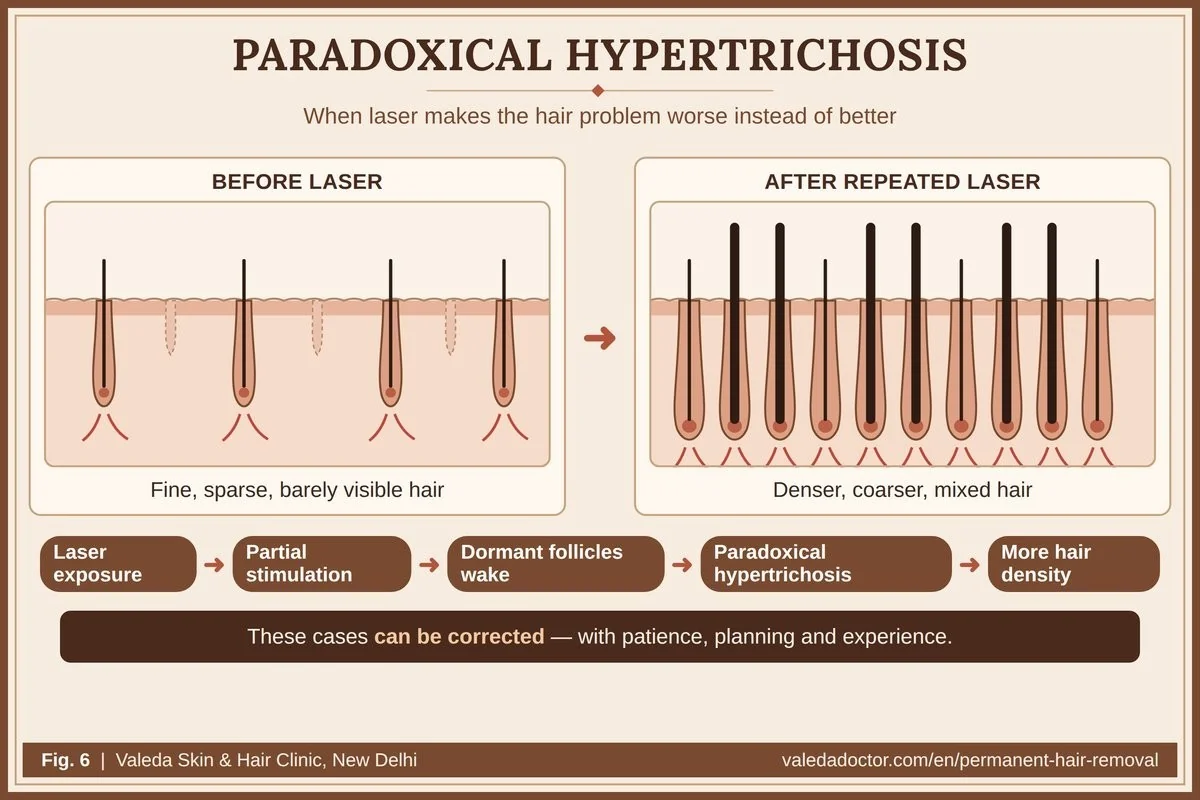
One of the most concerning and under-discussed consequences of laser treatment is Paradoxical Hypertrichosis — a condition in which, instead of decreasing, the hair problem actually increases following laser exposure.
Previously fine, dormant or less visible follicles begin producing thicker, more noticeable hairs. The individual who underwent laser to reduce hair finds themselves with more visible hair than before — and now the remaining hair is often a mixed population of fine and coarse, black and white, superficial and deep follicles that is significantly harder to treat than the original problem.
The doctors and experts at Valeda Skin & Hair Clinic have encountered such cases repeatedly over several decades. They are among the most complex — and most motivated — patients who seek treatment here. These cases can be corrected. But they require patience, planning and experience.
Laser Exposure ➜ Partial Follicular Stimulation ➜ Dormant Follicle Activation ➜ Paradoxical Hypertrichosis ➜ Increased Hair Density
Why This Chapter Focuses on EBVHCM Permanent Hair Removal
The purpose of discussing temporary methods is not to judge anyone who has used them. Most individuals do not have better information available when they start. Threading at a local parlour, waxing at home, laser at a clinic that promised results — these are the rational choices people make when they do not yet know what is actually possible. This chapter exists to give you that information.
The primary focus is permanent hair removal using EBVHCM — Electrolysis Blend Valeda Holistic Combination Mode, developed and refined at Valeda Skin & Hair Clinic under the guidance of Dr. Seema Bali (MD, BHMS) over more than four decades. Unlike temporary methods, EBVHCM aims at the permanent destruction of the follicle itself. All duration calculations, treatment planning methods, cost estimations and timelines discussed throughout this chapter are based upon permanent follicular elimination — not temporary management.
For most facial cases, this means approximately 7–8 clearances over a complete programme of approximately 12–18 months. Some patients achieve permanent results earlier when their biological factors are favourable — but we plan for 12–18 months so that expectations stay realistic. (Clearance is explained in Section 5 — Understanding Clearance)
SECTION 2 — Understanding the Size of Your Hair Problem
The Mirror Lies — At Least Partially
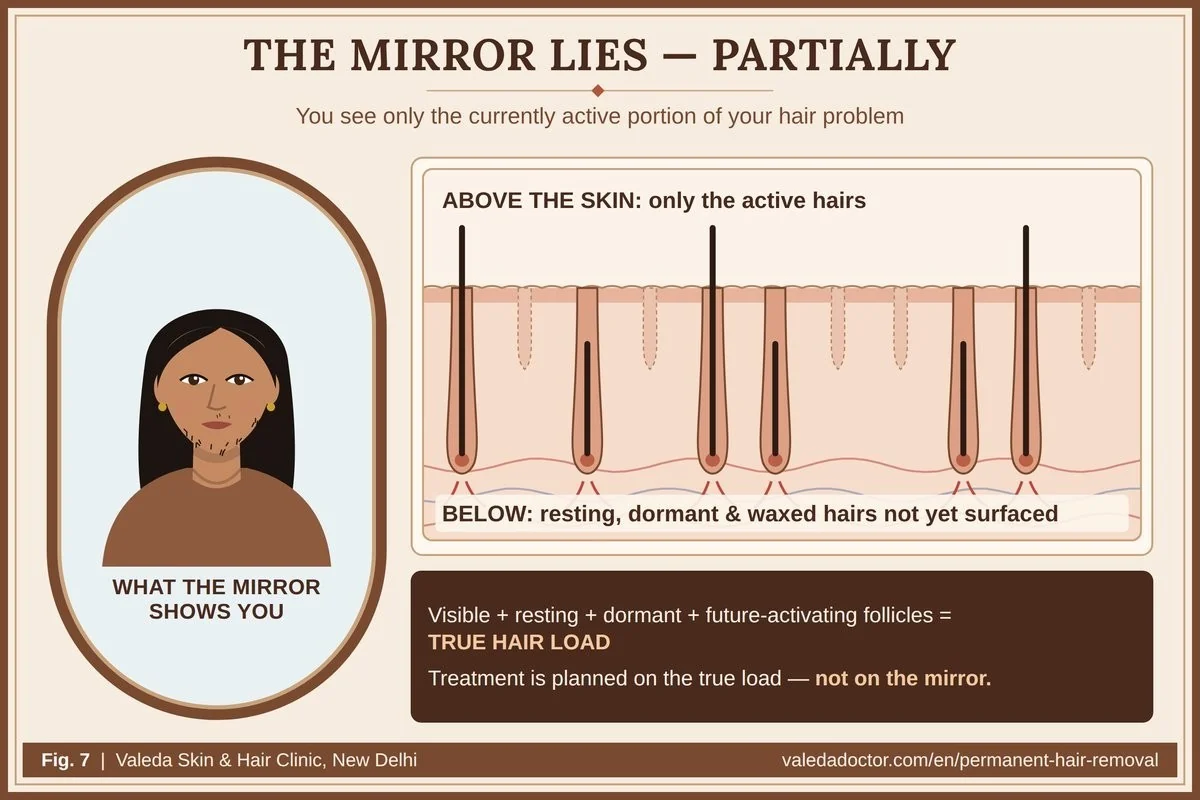
When you look in the mirror and assess your hair problem, you are seeing only a fraction of what actually exists. This is not a figure of speech. It is a biological fact that has direct consequences for your Duration estimate, your Cost estimate and your expectations during treatment.
The visible hair is only the currently active portion of your total follicular population. Beneath the surface — in the resting phase, dormant phase, growing phase or suppressed by last week’s waxing — is a substantially larger population waiting its turn.
Permanent hair removal is primarily a follicle management procedure. The actual amount of work involved does not depend on what a body area is called. It depends on how many follicles are present, how many are active, how many are dormant, how coarse they are, how deep they are, and how many treatment cycles are required to eliminate them permanently. (For a full explanation of Clearance and Clearance Cycles, refer to: Section 5 — Understanding Clearance)
Visible Hair Versus Total Hair Load
Visible hair includes only the follicles currently producing externally visible hairs. Total hair load includes visible hairs, resting follicles, dormant follicles, newly activating follicles, and previously waxed or tweezed follicles that have not yet surfaced.
A person seeing only a few hundred visible hairs may actually possess a substantially larger follicular population requiring management over time. This gap between what is visible and what actually exists is one of the central reasons why permanent hair removal takes longer than individuals initially expect — and why the estimates in this chapter exist.
Visible Hair ➜ Dormant Follicles ➜ Resting Follicles ➜ Future Activating Follicles ➜ True Hair Load
Scalp, Beard and the Density Paradox
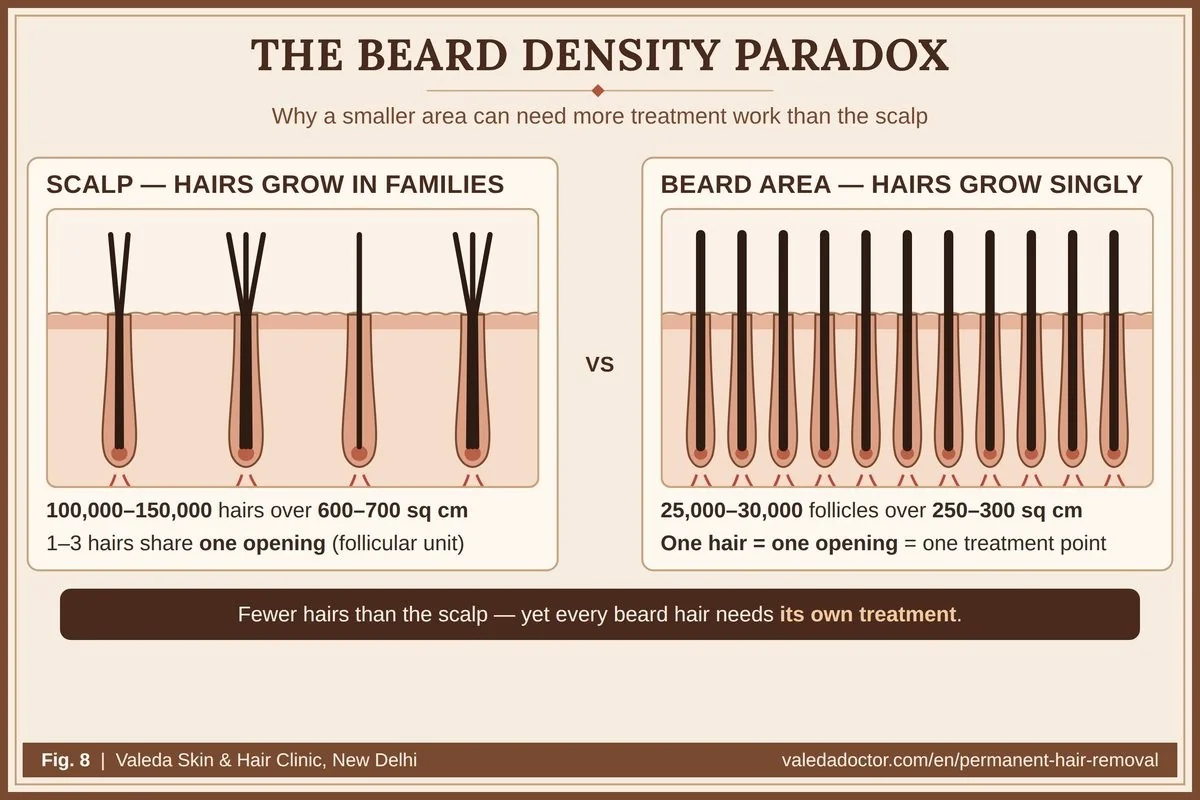
The average human scalp contains approximately 100,000–150,000 hairs distributed across approximately 600–700 square centimetres of scalp surface area. Scalp follicles usually occur in family groupings known as Follicular Units — a single unit may contain 1, 2, 3 or occasionally more hairs. Therefore the actual number of follicular insertion points is substantially lower than the total hair count.
The complete beard area — Side Face, Cheeks, Chin, Under-Chin, Jawline and Neck — together occupies approximately 250–300 square centimetres of skin surface. Based upon clinical observations and treatment records accumulated over more than four decades at Valeda Skin & Hair Clinic, a complete male beard may contain approximately 25,000–30,000 terminal hair follicles. This figure is the reference point for understanding Duration, Treatment Hours, Clearance Cycles and Cost Estimation throughout this chapter.
Many individuals are surprised that the beard appears as dense as scalp hair despite containing far fewer total hairs. The explanation: scalp hair grows in families, with multiple hairs per insertion point; beard hair grows singly, with one hair per insertion point. Every visible beard hair typically requires its own separate follicular insertion point — which is why the beard requires such substantial treatment time despite covering a smaller surface area than the scalp.
| Body Region | Approx. Surface Area | Total Hair Count | Typical Follicular Structure |
|---|---|---|---|
| Human Scalp | 600–700 sq cm | 100,000–150,000 | Multiple hairs per follicular unit |
| Complete Male Beard | 250–300 sq cm | 25,000–30,000 | Predominantly single-hair units |
| Male Chest | 500–600 sq cm | 15,000–25,000 | Single or double-hair units |
| Male Back | 800–1,000 sq cm | 20,000–35,000 | Single or double-hair units |
| Female Upper Lip | 6–10 sq cm | 250–600 | Predominantly single-hair units |
These figures are for educational understanding and treatment planning. Actual density varies considerably between individuals.
Why Follicular Numbers Matter More Than Mirror Impressions
At Valeda Skin & Hair Clinic, treatment planning is based upon biological realities rather than cosmetic impressions. When discussing duration and expenditure, we prefer to think in terms of Follicles, Density, Surface Area, Treatment Speed and Clearance Cycles — not vague visual descriptions like “not that much hair” or “quite a lot of hair.” These descriptions mean different things to different people. Follicle counts do not.
Once the follicular population is understood, the next question becomes: how do we actually estimate duration and cost? The answer lies in three independent calculation methods — explained in Section 3.
Why Does Unwanted Hair Appear in the First Place?
Before a person can make peace with their hair problem, they need to understand one thing clearly: in most cases, it is not their fault. Unwanted hair on the face and body has specific causes — both external and internal. Understanding these causes changes the entire way a person relates to their condition.
External Causative Factors
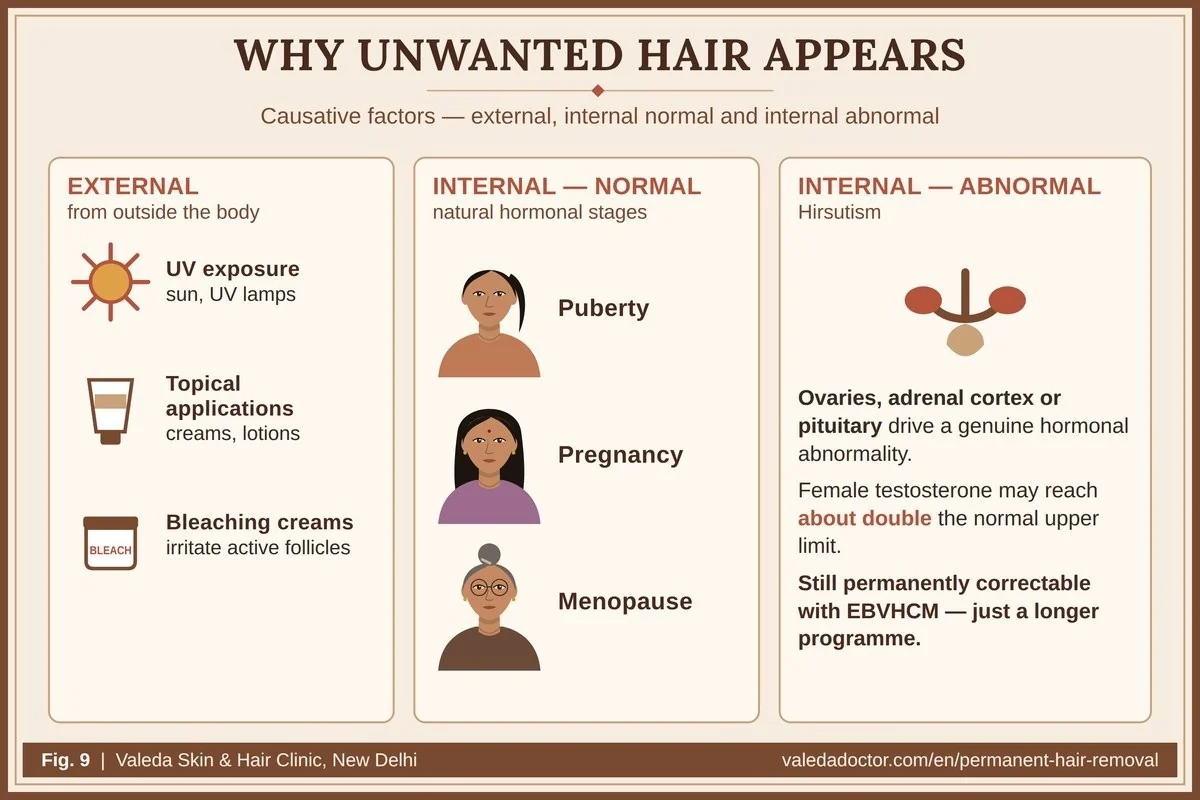
External factors originate outside the body and act upon the skin or the follicle from outside: prolonged or repeated exposure to ultraviolet rays (including sun exposure and UV lamps), and topical applications to which the skin reacts — certain creams, lotions and bleaching preparations. Bleaching creams deserve special mention: when used repeatedly on areas with active follicles, they can act as a topical irritant and stimulate follicular activity in susceptible individuals. Many individuals who have used bleaching creams for years to manage visible facial hair do not realise that this very practice may have contributed to the progressive worsening of the problem they were trying to conceal.
Normal Internal Factors
These are natural hormonal changes that every person passes through: puberty — the first major hormonal shift, during which facial hair may begin appearing in genetically susceptible individuals; pregnancy — hormonal changes during and after pregnancy can activate dormant follicles; and menopause — declining oestrogen relative to androgens can increase visible facial hair in women. The vast majority of individuals who seek treatment at Valeda Skin & Hair Clinic fall within this normal category — meaning their problem is not caused by a hormonal disorder.
Abnormal Internal Factors — Hirsutism
When the problem is driven by a genuine hormonal abnormality — involving the ovaries, adrenal cortex or pituitary gland — it is classified as Hirsutism. In hirsutism, the testosterone level in females may approximately double beyond the normal upper limit. This is a medically significant condition.
However — and this is important — even hirsutism cases can be permanently corrected with EBVHCM. A higher testosterone level means a more complex and longer programme. It does not mean an unsolvable one. When testosterone is only slightly raised — not enough to classify as hirsutism — this too can be permanently corrected with EBVHCM. A mildly elevated level is not a hormonal problem in the clinical sense. It is a biological variation that responds well to treatment.
The 90% Category — And Why Awareness Matters So Much
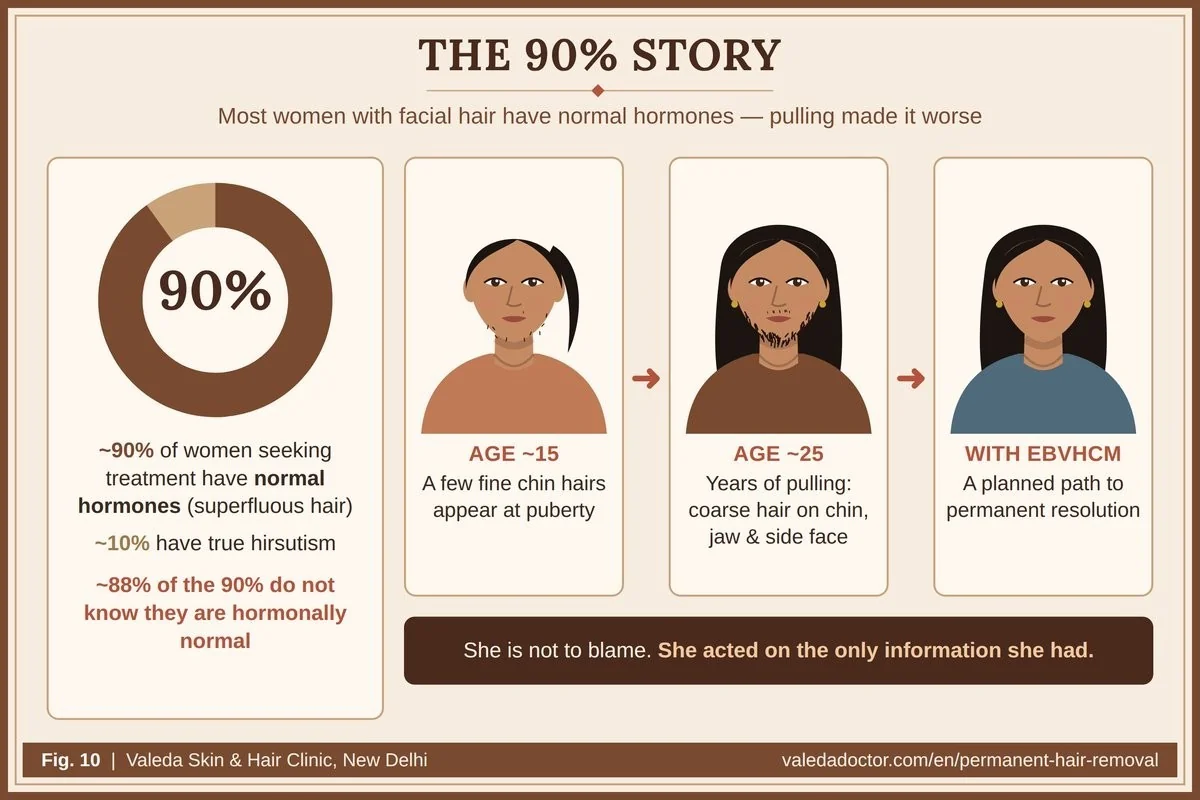
Here is something that will surprise many readers: approximately 90% of females seeking permanent hair removal at Valeda Skin & Hair Clinic fall within the normal hormonal category. They do not have a hormonal disorder. Their testosterone is not meaningfully elevated. Their problem began at puberty — a normal event — and their follicles responded to normal hormonal stimulation in a genetically susceptible area.
And approximately 88% of them are not aware that they fall within this normal category. Out of this understandable ignorance, many of them — over months and years — have converted what was a straightforward case into a distorted or medically complicated one. Not through any fault of their own, but through the only actions available to them without proper information: waxing, threading, tweezing — repeatedly, urgently, because the hair kept coming back.
The Story That Explains Everything
Consider what happens when a young woman first notices hair on her chin or side face during puberty. Her first instinct — entirely natural and understandable — is to get rid of it. From the root. By pulling it out. She does not know — because nobody told her — that hair on the arms and legs is genetically programmed to grow to only a few millimetres. The follicles in those areas have a built-in biological ceiling.
But hair on the chin, side face and jawline is different. These follicles are genetically programmed to grow to lengths of up to thirty centimetres — the beard follicle model. When a follicle with this genetic programme is repeatedly pulled out, traumatised, stimulated and activated — it does not give up. It responds. It deepens. It distorts. It produces coarser hair. It activates its dormant neighbours.
The young woman who was managing a mild puberty-related chin hair problem in her teens may find herself, a decade later, with a moderate to severe facial hair condition — not because her hormones changed dramatically, but because the waxing and threading she did faithfully every few days, every few weeks, progressively expanded the problem she was trying to control.
She is not to blame. She was acting on the only information available to her.
What This Means for You
If you have been waxing, threading or tweezing for years — and the problem has progressively worsened — now you know why. The method was not wrong given what you knew. But continuing it now that you know the alternative serves neither your skin nor your long-term outcome. If you are at the early stage — if you have just begun to notice hair growth and are considering how to manage it — this information may save you years of increasing dependence.
In either case, EBVHCM at Valeda Skin & Hair Clinic offers a genuine path toward permanent resolution. Not a promise of perfection in one session. But a scientifically planned, transparently communicated, clinically experienced path toward an end to the problem.
SUMMARY — SECTIONS 1 & 2
Cutting methods: The follicle is never touched. Hair reappears. Stubble and shadow are the inevitable result.
Pulling methods: The follicle is traumatised but survives — and often strengthens. Dependence increases over time. Dormant follicles activate. The problem quietly grows.
Laser hair reduction: Useful as a waxing substitute. Not permanent. In susceptible individuals, may trigger Paradoxical Hypertrichosis — making the problem worse rather than better.
EBVHCM at Valeda Skin & Hair Clinic: Targets the follicle permanently. Progressive reduction across 7–8 clearances over a complete programme of approximately 12–18 months. Built on 41+ years of clinical experience. The only category in this list where the word permanent actually applies.
The mirror: It shows only the currently active portion of your hair problem — not the dormant population that will continue emerging for months and years.
The purpose of this chapter: To give you the full biological picture, so that the estimates, hours and costs that follow are not just numbers, but numbers you understand and can plan around. Section 3 explains how those estimates are actually arrived at.