

Cost & Duration · Sections 3 & 4 of 13
Cost & Duration of Permanent Hair Removal
Sections 3 & 4 — Three Independent Ways We Estimate Duration and Cost, and the Valeda Unit (VU) Method
SECTION 3 — Three Independent Ways We Estimate Duration and Cost
You Deserve an Honest Estimate — Not a Guess
If you have reached this page, you are probably someone who has already spent considerable time, money and emotional energy trying to manage unwanted hair. Threading every few days. Waxing that leaves the skin sore. Laser sessions that promised permanent results but delivered something quite different. And now you are asking the one question that nobody has answered clearly: “How long will this actually take? And what will it actually cost?”
At Valeda Skin & Hair Clinic, we believe you deserve a real answer — not a vague range designed to get you through the door. This is why we cross-check every estimate through not one but three independent methods. When all three methods point to a similar figure, we know the estimate is grounded in reality — not optimism, not salesmanship, and not guesswork.
Why Most Clinics Cannot Give You a Straight Answer
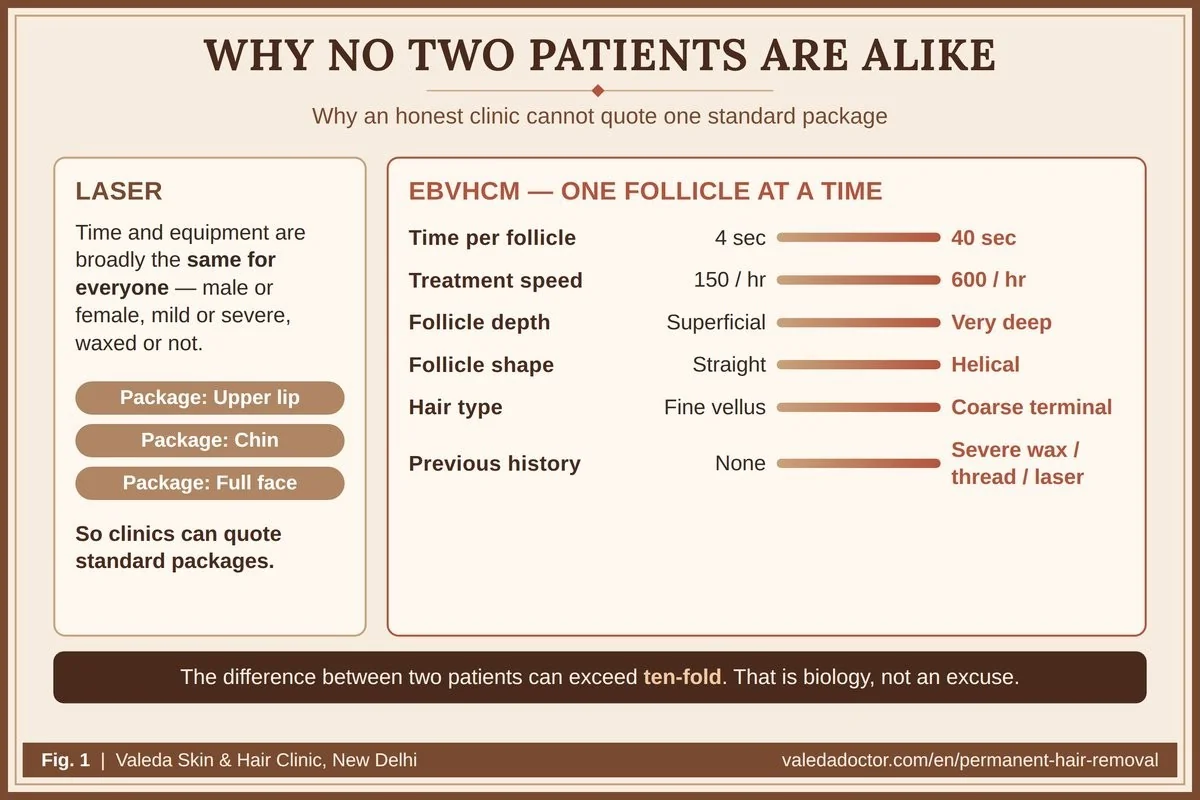
One of the most frustrating experiences individuals report before coming to Valeda Skin & Hair Clinic is that every clinic gives a different figure — and none of them explain why. The honest answer is: permanent hair removal through EBVHCM works one follicle at a time. The variation between two patients may exceed ten-fold. That is not an excuse — it is a biological fact.
In laser treatment, the professional time and equipment inputs remain broadly similar irrespective of whether the patient is male or female, hair density is mild or severe, or previous waxing history exists or not. Laser clinics worldwide can therefore quote standardised packages by area size and session count. Permanent hair removal through EBVHCM (Electrolysis Blend Valeda Holistic Combination Mode) is entirely different.
| Parameter | Possible Variation |
|---|---|
| Treatment Time Per Follicle | 4 Seconds to 40 Seconds |
| Treatment Speed | 150 to 600 Follicles Per Hour |
| Follicle Depth | Superficial to Very Deep |
| Follicle Shape | Straight to Helical |
| Hair Type | Fine Vellus to Coarse Terminal |
| Previous History | None to Severe Waxing / Threading / Laser |
This is why the entire chapter was written — so that you can understand where the numbers come from, evaluate them yourself, and arrive at Valeda Skin & Hair Clinic already informed. (For a full explanation of Clearance Cycles, refer to: Section 5 — Understanding Clearance)
Method 1 — Actual Follicle Treatment Rate
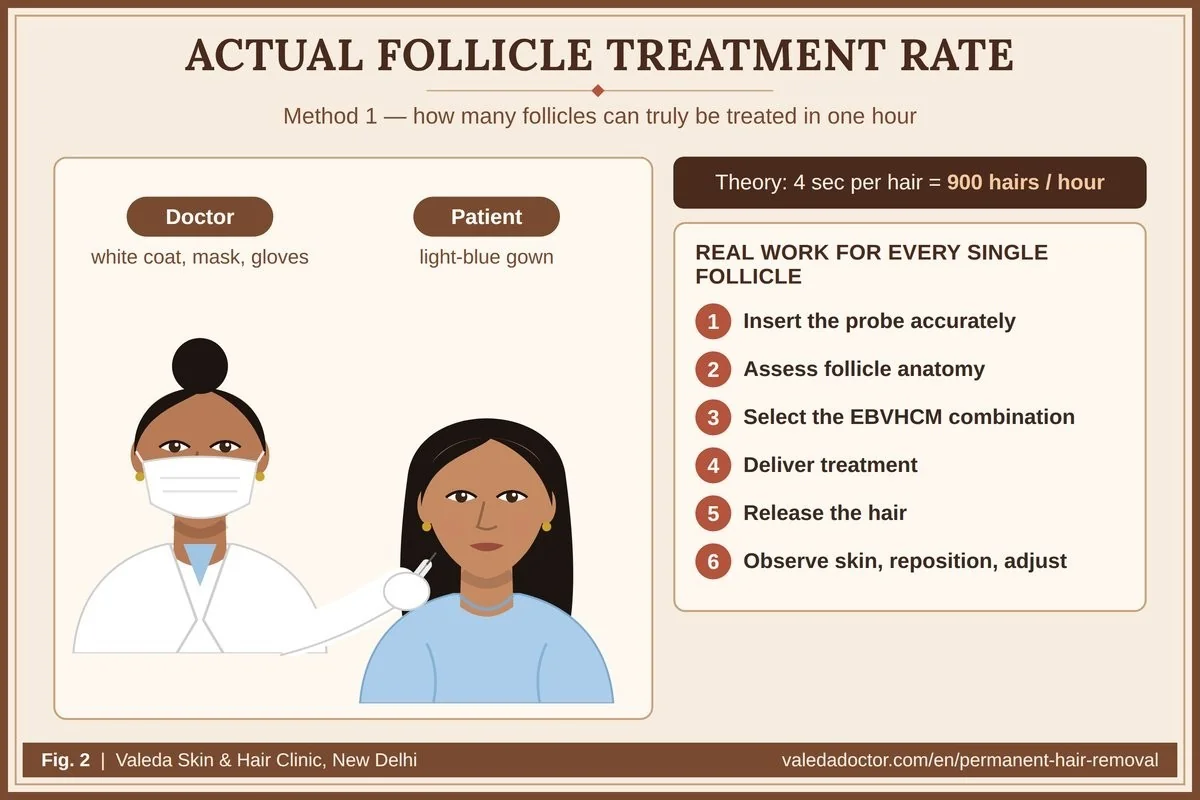
The most direct way of estimating treatment duration is by calculating how many follicles can realistically be treated in one hour.
If every follicle required only four seconds, a mathematical calculation would suggest 900 hairs per hour. However, practical treatment involves much more. The operator must insert the probe accurately, assess follicular anatomy, select the appropriate EBVHCM combination, deliver treatment, release the hair, observe skin response, reposition and adjust parameters — all while accommodating normal patient movements.
Four seconds per follicle is the theory. Real, careful treatment of each follicle is what sets the actual pace.
The Valeda Clinical Speed Range
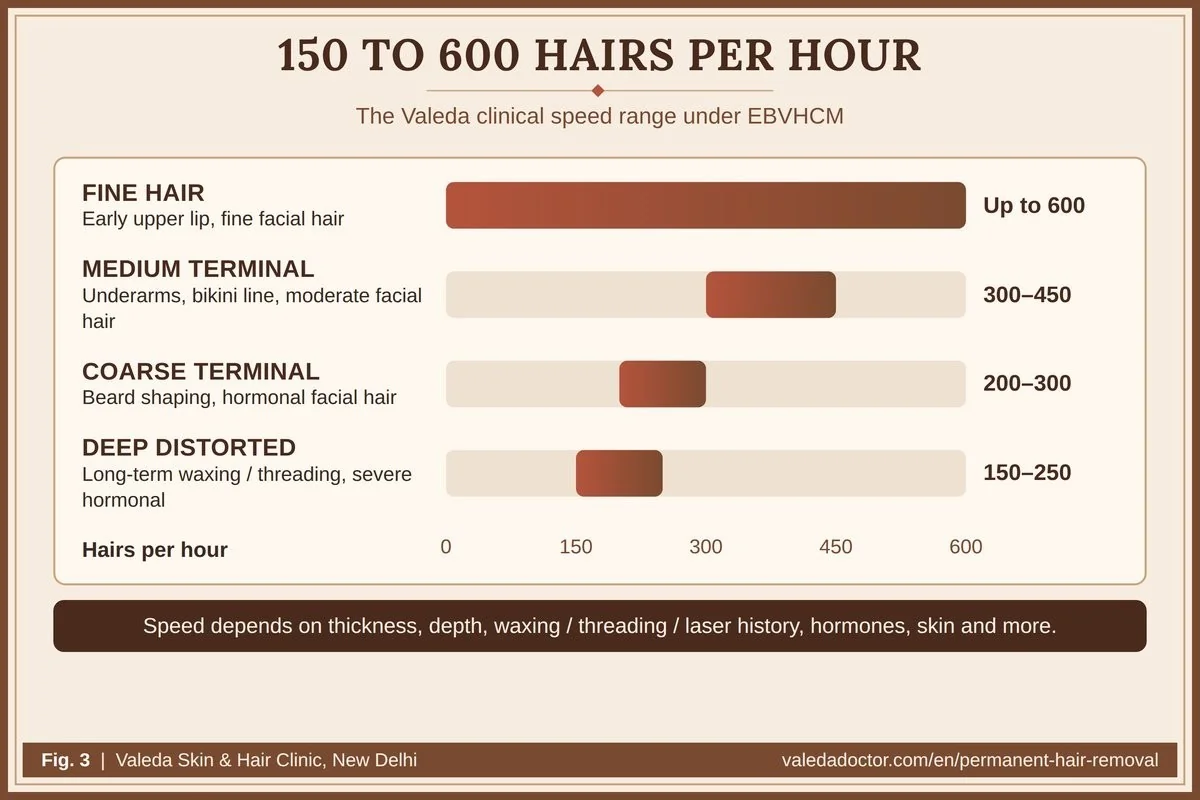
Based upon long-term practical observations at Valeda Skin & Hair Clinic, realistic treatment speeds under EBVHCM generally fall between 150 and 600 hairs per hour, depending upon:
- Hair Thickness
- Follicle Depth
- Previous Waxing And Frequency
- Previous Shaving And Frequency
- Previous Laser History
- Previous Threading And Frequency
- Hormonal Influences
- Follicular Distortion
- Skin Characteristics
- Oil Or Moisture Gradient Of Skin
- Genetic Density
- Whether Concern Involves All Vellus And Terminal Hair Or Terminal Hair Only
- Ingrown Hair History
- Whether Previous Tampering Scabs And Marks Are Deep Or Superficial
- Skin Hypersensitivity Or Photosensitivity
- Pustular Acne Or Acne-Prone Skin
- Medicines Being Taken For Other Conditions
- Use Of Oral Contraceptive Pills
- Fine Hair Cases — Up To 600 Hairs Per Hour: Early Upper Lip, Fine Facial Hair, Superficial Follicles
- Medium Terminal Hair Cases — 300–450 Hairs Per Hour: Underarms, Bikini Line, Moderate Facial Hair
- Coarse Terminal Hair Cases — 200–300 Hairs Per Hour: Beard Shaping, Hormonal Facial Hair, Distorted Follicles
- Deep Distorted Follicles — 150–250 Hairs Per Hour: Long-Term Waxing Cases, Long-Term Threading Cases, Historically Plucked Follicles, Severe Hormonal Cases, Complete Beard Removal In Transgender Individuals And Males, Thick Skin Areas
Method 2 — The Factor-of-8 Formula
The second estimation system is built on one of the most quietly powerful observations made across decades of permanent hair removal practice at Valeda Skin & Hair Clinic. After the very first complete clearance of a treatment area, something remarkable becomes available — a real number. Not an estimate based on a visual assessment, not a guess based on the mirror. A number based on actual treatment of your actual follicles. (For a full explanation of what a Clearance is, refer to: Section 5 — Understanding Clearance)
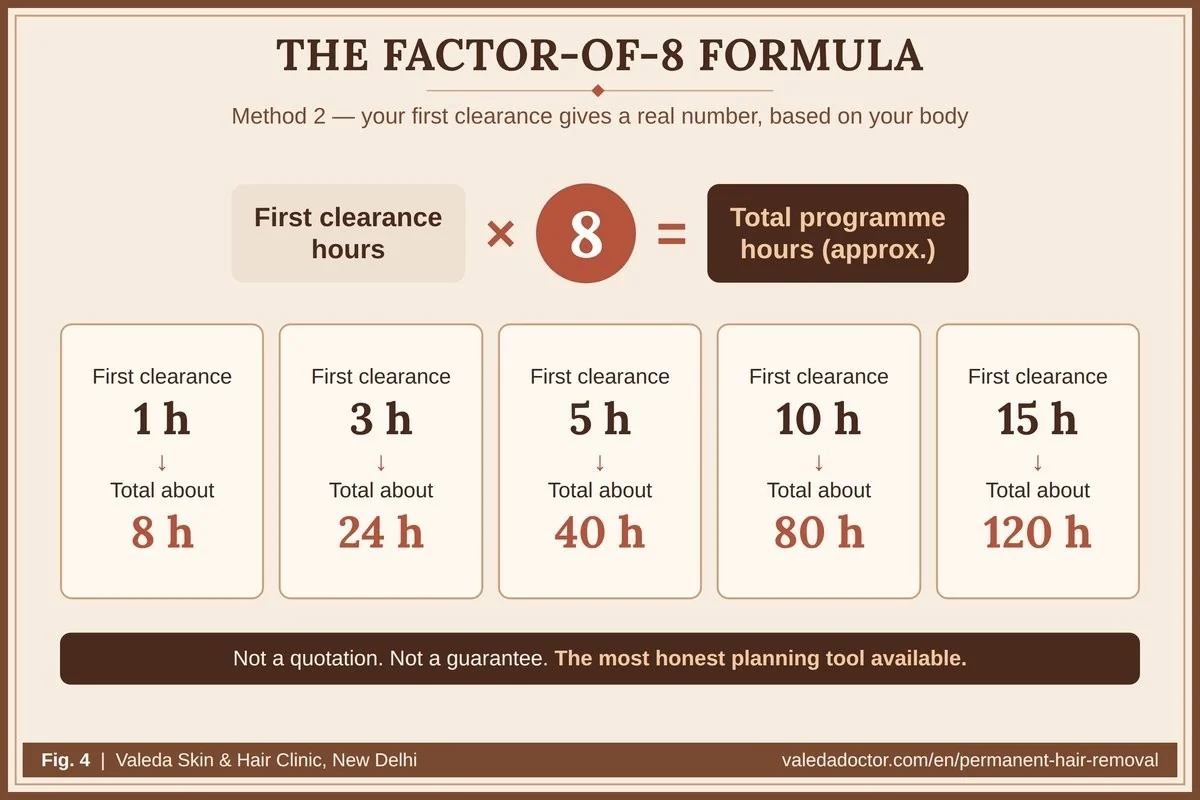
That number — the time taken for your first complete clearance — when multiplied by approximately eight, gives a reliable estimate of your total programme.
Total Estimated Treatment Hours = First Clearance Hours × 8
This is not a quotation. It is not a guarantee. It is the most honest planning tool available.
| First Clearance Time | Estimated Total Programme |
|---|---|
| 1 Hour | Approximately 8 Hours |
| 3 Hours | Approximately 24 Hours |
| 5 Hours | Approximately 40 Hours |
| 10 Hours | Approximately 80 Hours |
| 15 Hours | Approximately 120 Hours |
Why the Factor-of-8 Formula Works
The Factor-of-8 Formula works best for hair that has been tampered with by pulling — waxing, threading, tweezing and plucking. In such cases, the second and third clearances are usually longer than the first. The new growth that appears at this stage is mainly the left-over hair from earlier temporary pulling treatments, together with telogen (resting-phase) hairs that now surface as new growth.
Hair already treated at Valeda behaves very differently: approximately 70% of Valeda-treated hair returns only as thin, weak regrowth. Visible results usually appear after 3–4 clearances — by which time approximately 65% of the targeted hair follicles have been permanently treated. From there, clearances become progressively lighter and shorter.
The Factor-of-8 Formula reflects this complete biological pattern — the heavier early clearances and the lighter later ones. And it gives you something more valuable than any package brochure — it gives you a number based on your body, not someone else’s.
First Clearance Time ➜ Multiply By 8 ➜ Estimated Programme Hours ➜ Financial Planning
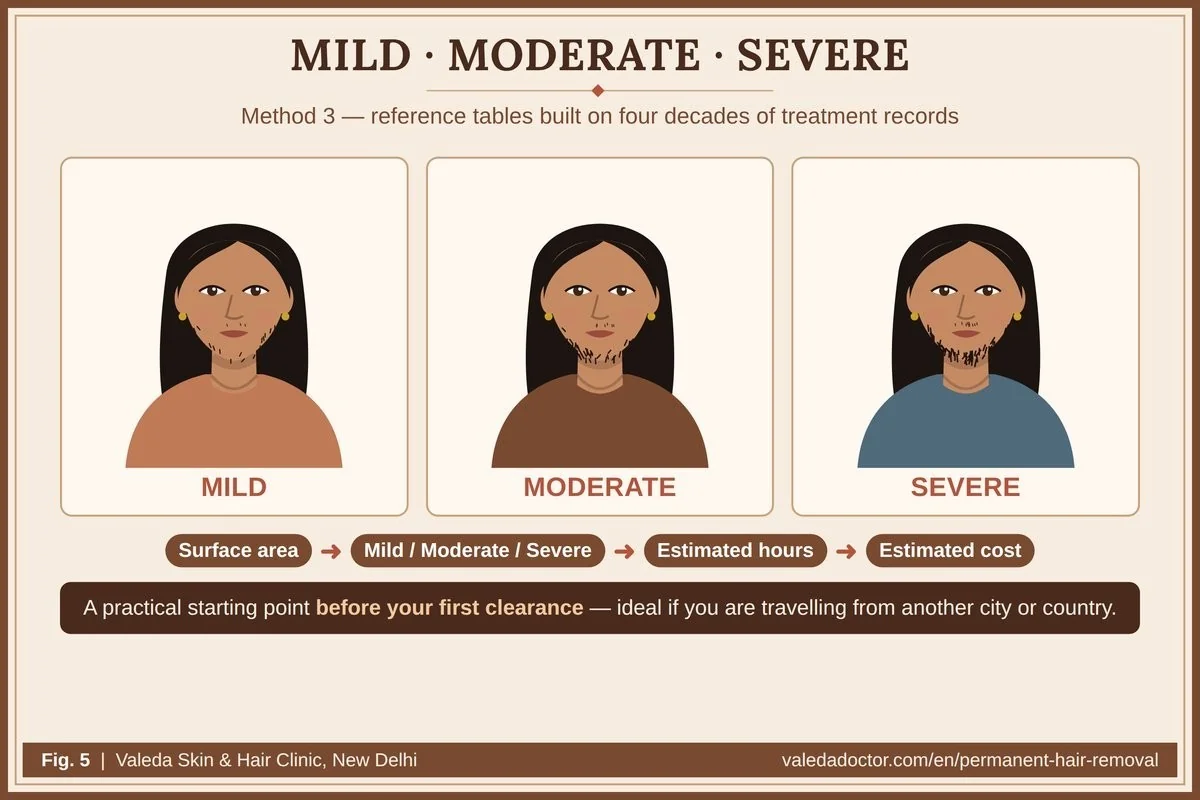
Method 3 — Mild–Moderate–Severe Reference Tables
The third method uses practical duration tables developed from more than four decades of clinical experience, thousands of completed cases, actual treatment records and repeated cross-verification.
The tables classify areas into Mild, Moderate and Severe categories and give you a starting point before your first clearance has even happened. If you have a moderate chin problem, the table tells you what similar cases have required. If you have a severe side-face case with laser history, the table reflects that too.
These tables are the most accessible entry point for a prospective patient — particularly one who is planning travel to Valeda Skin & Hair Clinic from another city or another country and wants a practical sense of the commitment involved. (The complete Mild–Moderate–Severe Duration Reference Tables are in: Section 7 — Duration & Cost Reference Tables)
Surface Area ➜ Mild / Moderate / Severe Classification ➜ Estimated Hours ➜ Estimated Cost
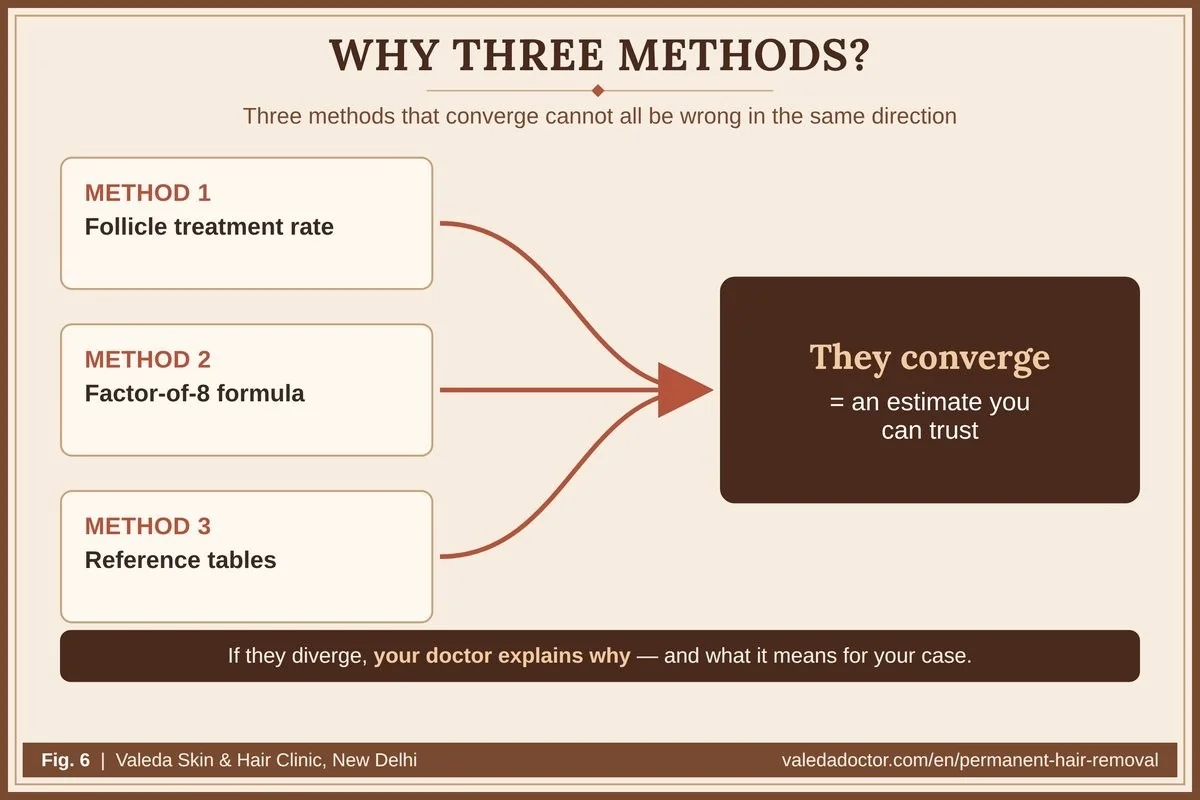
Why Three Methods and Not One?
Because one method can be wrong. Three methods that converge cannot all be wrong in the same direction.
When the Follicle Treatment Rate estimate, the Factor-of-8 estimate and the Reference Table estimate all point to a similar range — you have a planning estimate you can trust. And when they diverge, the doctors at Valeda Skin & Hair Clinic have a conversation with you about why — and what that means for your specific case.
This is what transparency looks like in practice.
A Word About Cost
Once estimated treatment hours become known, expenditure becomes much easier to understand. But treatment expenditure is not determined solely by procedure time. Five components contribute — and understanding each of them separately protects you from surprises later. These five components are discussed in detail in Section 8 — Scientific Understanding Of Treatment Expenditure.
Before discussing expenditure, we must understand the scientific system that governs treatment speed itself. That system is the Valeda Unit (VU) Method — and it is the subject of the next section.
SECTION 4 — The Valeda Unit (VU) Method
The Measurement System Behind Every Estimate
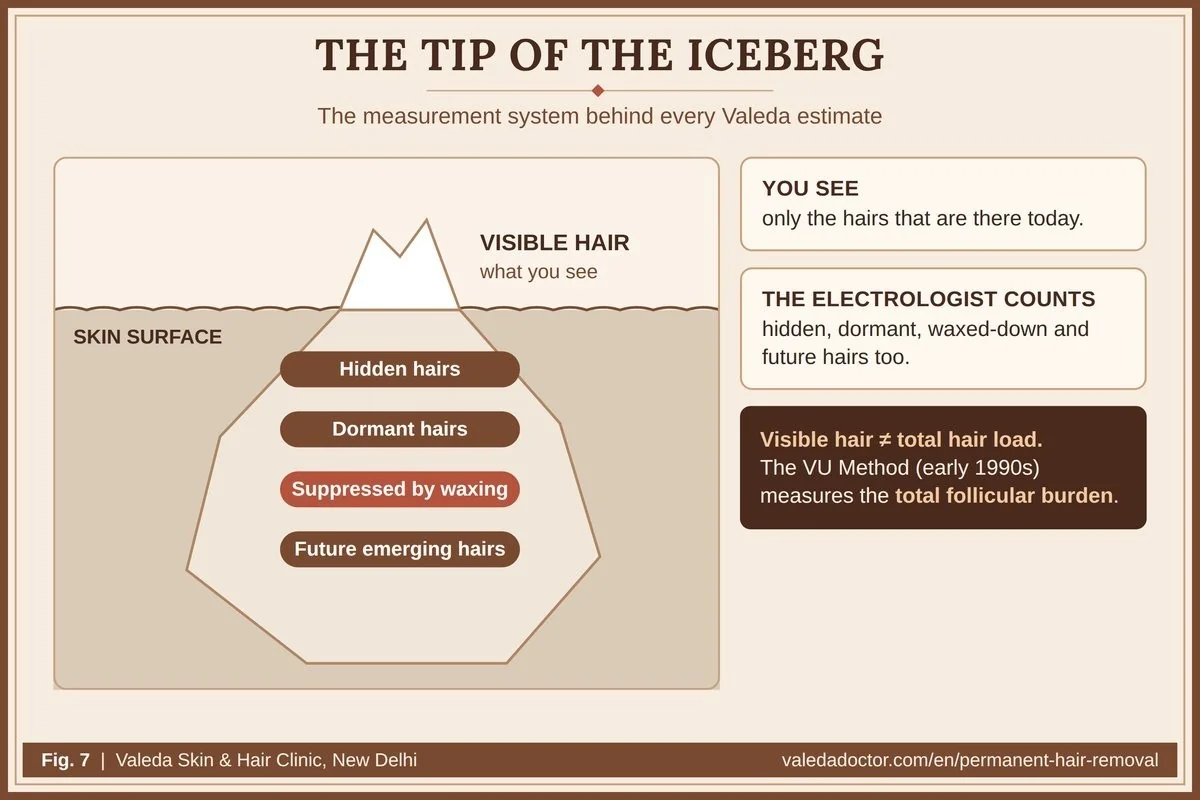
By now, one thing should be clear: the visible hair you see in the mirror is not the whole problem. It is, as we said in Section 2, only the tip of the biological iceberg.
The challenge faced by the electrologist at Valeda Skin & Hair Clinic is different from what you face in the mirror. You see the hairs that are there. The electrologist must estimate the hairs that are there, the hairs that are hidden, the hairs that are dormant, the hairs that were suppressed by last week’s waxing, and the hairs that will emerge over the next several months. This is not a guessing exercise. It is a calculation. And the Valeda Unit (VU) Method is the tool that makes it possible.
Why the VU Method Was Developed
During the early 1990s, it became increasingly apparent to the doctors and experts at Valeda Skin & Hair Clinic that many individuals were being given estimates based only on what was visible — and were therefore being significantly underestimated. A patient would present with 100 to 200 visible hairs and be told the treatment would take a few months. Then after each successive clearance, more hairs would appear. Not because treatment had failed. But because the estimate was never based on the full picture.
Over time it became clear that a proper planning system was needed — one that estimated the total follicular burden rather than just the visible crop. This led to the development of the Valeda Unit (VU) Method. It has since become one of the foundations of how Valeda Skin & Hair Clinic estimates Duration, Treatment Hours and Financial Planning for every patient.
The Fundamental Principle
Visible Hair Does Not Equal Total Hair Load.
Visible Hair ➜ Hidden Hair ➜ Dormant Hair ➜ Future Emerging Hair ➜ Total Follicular Burden
The Waxing Illusion — and the Valeda Unit (VU)
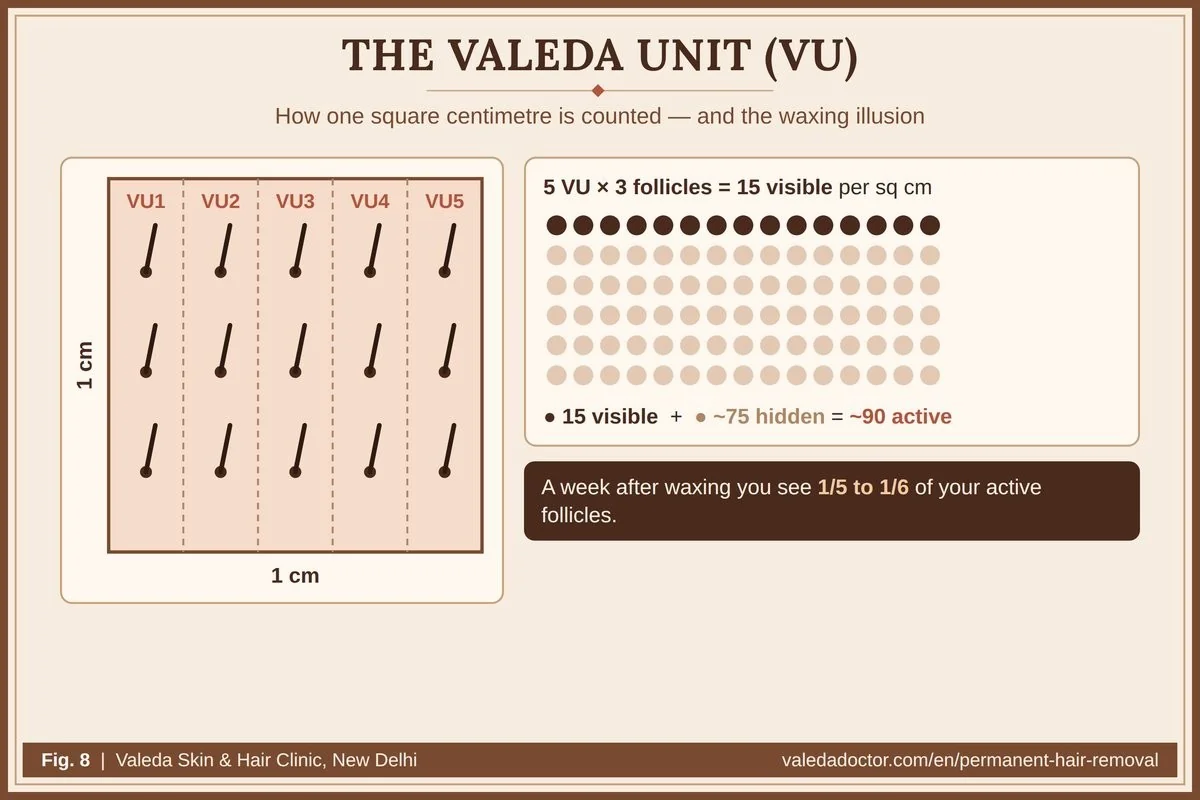
Suppose you wax your face today. One week later you see approximately 15 visible hairs per square centimetre. You might naturally think: “I have 15 hairs per sq cm.”
The doctors and experts at Valeda Skin & Hair Clinic have repeatedly observed something different. After waxing, the externally visible crop often represents only approximately one-fifth to one-sixth of the active follicular population. Therefore those 15 visible hairs may represent approximately 75 additional active follicles that have not yet surfaced.
15 Visible + 75 Hidden = Approximately 90 Active Follicles Per Square Centimetre
This is why individuals who have been waxing for years consistently find that their problem is larger than it appeared — not because treatment is creating new hairs, but because the waxing was suppressing the visible portion of a much larger population.
Definition of a Valeda Unit (VU)
For treatment estimation purposes, one square centimetre is divided into five Valeda Units (VU). Each Valeda Unit is considered to contain approximately three pilosebaceous units.
5 VU × 3 Pilosebaceous Units = Approximately 15 Externally Visible Treatable Follicles Per Square Centimetre
This does not imply that only fifteen follicles exist. It represents the practical treatment crop available during that phase of the growth cycle.
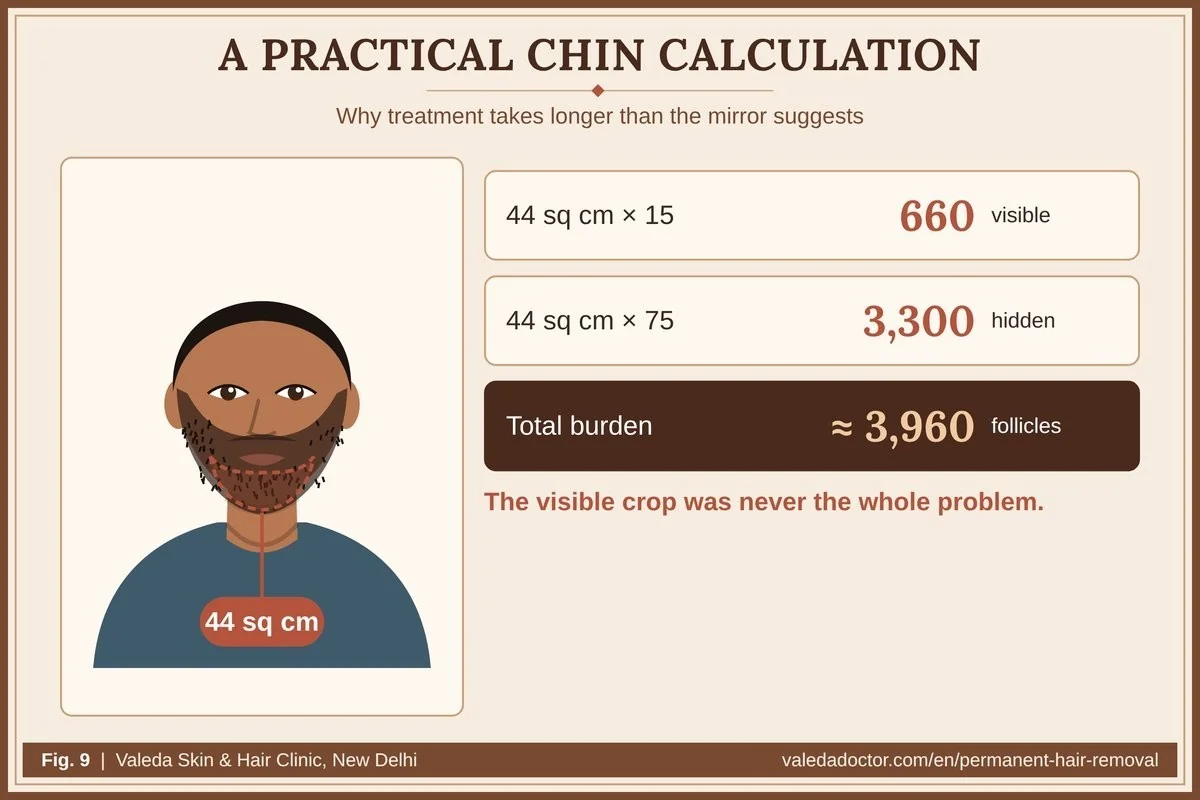
A Practical Chin Calculation
Chin area: 44 square centimetres
- 44 sq cm × 15 Visible Follicles = 660 Visible Treatable Follicles
- 44 sq cm × 75 Hidden Follicles = 3,300 Hidden Follicles
- Total Practical Follicular Burden = Approximately 3,960 Follicles
44 sq cm Area ➜ 660 Visible ➜ 3,300 Hidden ➜ Approximately 3,960 Total
When a patient asks why treatment takes longer than they expected, the answer almost always lies in this calculation.
The visible crop was never the whole problem.
The Role of EBVHCM and the 13.56 MHz Advantage
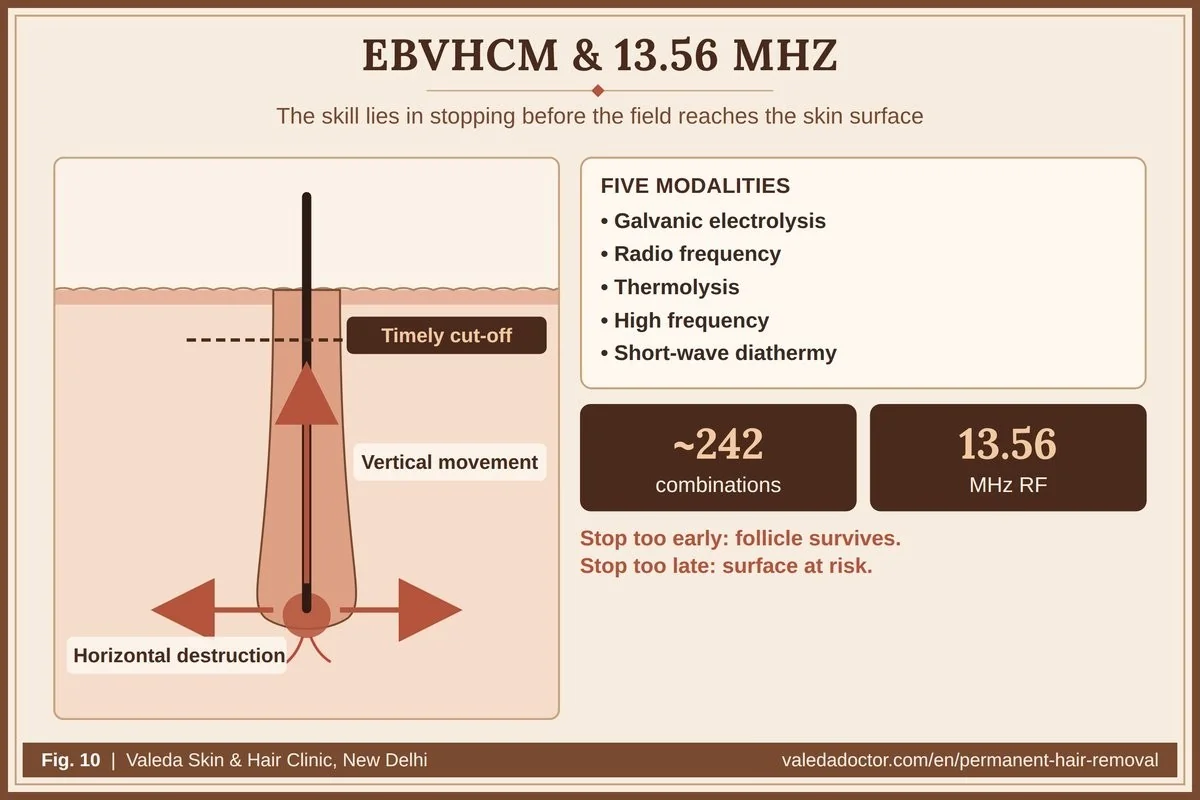
The VU Method functions alongside EBVHCM — Electrolysis Blend Valeda Holistic Combination Mode, combining Galvanic Electrolysis, Radio Frequency, Thermolysis, High Frequency and Short-Wave Diathermy. Through more than four decades of clinical development, approximately 242 treatment combinations have evolved within the EBVHCM framework. The exact combination selected for each patient depends upon the same comprehensive list of individual factors described under the Valeda Clinical Speed Range above.
Under EBVHCM, approximately 13.56 MHz Radio Frequency is utilised to accelerate the treatment process safely. The generated charge and intensities create a destruction field inside the follicle. This field moves in two directions simultaneously: horizontal movement — spreading across the lower follicular walls, eliminating germinative structures; and vertical movement — moving upward toward the skin surface.
The skill of the electrologist lies in terminating the treatment before the upward-moving field reaches the epidermis. Too early and the follicle survives. Too late and the surface is at risk. The precise judgement required in this moment is exactly why four decades of clinical experience at Valeda Skin & Hair Clinic is not a marketing claim — it is a clinical necessity.
Follicle Base ➜ Horizontal Destruction ➜ Vertical Upward Movement ➜ Timely Cut-Off ➜ Permanent Destruction With Surface Safety
The Three Cross-Verifications
- Cross-Verification 1 — VU Method + Clinical Speed Range
- Cross-Verification 2 — VU Method + Factor-of-8 Formula
- Cross-Verification 3 — VU Method + Mild–Moderate–Severe Tables
When all three broadly converge, the estimate can be trusted.
What Comes Next
Now that we understand how the follicular burden is estimated, we are ready to understand the concept that makes all planning possible: Clearance. Without understanding Clearance, no estimate of Duration, Cost, New Growth, Regrowth or the 7–8 clearance figure makes sense. Everything else in this chapter rests on this one concept.
Most facial cases need approximately 7–8 clearances, with a complete programme duration of approximately 12–18 months. The early clearances follow the 40-day cycle (visits can be as frequent as every 15 days at the start); the last one or two clearances may each take 3–6 months, because by then the hair is sparse and emerges slowly. Long gaps do not undo the treatment already done — they simply extend the total duration in proportion. (Full explanation in Section 5 — Understanding Clearance)
SUMMARY — SECTIONS 3 & 4
Section 3: You deserve a real answer. Three independent methods cross-verify every estimate: Follicle Treatment Rate ➜ Factor-of-8 ➜ Mild / Moderate / Severe Tables. Convergence = a trustworthy estimate.
Section 4: Visible hair ≠ total hair load. The VU Method estimates the full follicular burden: 15 visible = about 90 active follicles per sq cm. About 242 EBVHCM combinations. 13.56 MHz RF precision. Skill and experience are not optional — they are clinically essential.
Duration: Most facial cases need approximately 7–8 clearances over a complete programme of approximately 12–18 months.